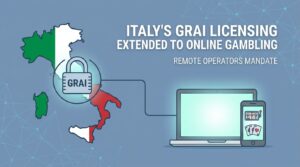
Italy’s gambling regulator, the Agenzia delle Dogane e dei Monopoli (ADM), has formally expanded the scope of its GRAI (Gioco Remoto e Altre Iniziative) licensing framework to cover online and remote operators. The move compels all digital and distance-based gambling providers active in the Italian market to obtain GRAI-specific authorisation, closing a regulatory gap that had persisted as the sector outpaced its licensing architecture. For operators already navigating Italy’s complex concession system, this represents both a compliance burden and a signal of where enforcement priorities are heading.
What the GRAI Expansion Means for Digital Operators
Before unpacking the strategic implications, it helps to frame what changed and why it matters at a business level. The GRAI licensing requirement had previously applied to a narrower set of activities, but the regulator’s decision to bring remote operators under its umbrella reflects a broader European trend: tightening oversight of digital gambling channels that have grown faster than legacy regulatory frameworks could accommodate.
- Mandatory licensing: All online and remote gambling operators serving Italian players must now hold a valid GRAI licence, regardless of where they are headquartered.
- Enforcement teeth: Operators without the required authorisation risk being classified as unlicensed, exposing them to sanctions, domain blocking, and exclusion from payment processing networks.
- The timeline for compliance has not been publicly extended, putting pressure on operators to act quickly or risk market access.
- Competitive reshuffling: Smaller or newer entrants may find the licensing process disproportionately costly, arguably consolidating market share among established concession holders.
- Regulatory alignment: Italy’s move mirrors similar tightening in jurisdictions like the Netherlands and Germany, where digital-first operators face increasingly granular oversight.
Why Italy Is Tightening Remote Gambling Oversight Now
Italy’s online gambling market generates billions in annual revenue, and ADM has faced mounting pressure from both domestic lawmakers and EU-level regulatory bodies to ensure that digital operators meet the same standards as their land-based counterparts. The gap wasn’t just theoretical. In practice, some remote operators had been functioning under older concession structures that predated the current digital landscape, creating ambiguity around compliance obligations.
That ambiguity is now gone.
ADM’s decision to require GRAI licences for remote operators also coincides with Italy’s broader push to modernise its gambling legislation, a process that has included discussions around advertising restrictions, responsible gambling mandates, and anti-money laundering protocols. The GRAI expansion fits within this wider legislative arc, even if it arrived with less fanfare than some of the more politically charged proposals around advertising bans.
Still, the timing raises questions. With Italy’s gambling concession renewal process already generating uncertainty for operators, layering on a new licensing requirement adds another variable to an already complex equation. Whether ADM will offer transitional provisions or enforce the requirement immediately remains, at least on paper, unresolved for some market participants.
Operational and Financial Impact on Licence Seekers
Securing a GRAI licence is not a rubber-stamp exercise. Operators must demonstrate compliance across multiple dimensions, including technical infrastructure, data protection, responsible gambling tools, and financial transparency. The application process involves documentation requirements that can stretch internal compliance teams, particularly for operators managing multi-jurisdictional portfolios.
| Requirement Area | Key Obligations | Typical Challenge |
|---|---|---|
| Technical Standards | Platform certification, RNG testing, server location rules | Adapting existing infrastructure to meet Italian-specific technical mandates |
| AML Compliance | Customer due diligence, transaction monitoring, suspicious activity reporting | Integrating Italian AML protocols with existing multi-market systems |
| Responsible Gambling | Self-exclusion integration, deposit limits, player activity monitoring | Aligning with ADM’s specific tool requirements, which differ from other EU markets |
| Financial Reporting | Revenue declarations, tax remittance, audit trails | Operators unfamiliar with Italy’s fiscal framework face a steep learning curve and potential penalties for misreporting |
For operators already holding Italian gambling concessions through ADM, the incremental burden may be manageable. But for those entering the market or operating under legacy arrangements, the cost of compliance could run into six figures when factoring in legal counsel, technical audits, and ongoing reporting obligations.
How This Reshapes Competitive Dynamics in Italy’s iGaming Market
One consequence that deserves attention: consolidation. When licensing costs rise and compliance complexity deepens, smaller operators face a choice between investing heavily or exiting. And in a market where the top ten operators already command a disproportionate share of gross gaming revenue, the GRAI mandate could accelerate that concentration.
Larger operators with established compliance departments and existing relationships with ADM are better positioned to absorb the new requirements. Some may even welcome the change, viewing it as a barrier that insulates them from upstart competitors. Not everyone sees it that way, of course. Industry groups representing smaller operators have previously argued that Italy’s regulatory costs already disadvantage new entrants (a distinction regulators have been slow to acknowledge publicly).
Yet the flip side is legitimacy. Operators who secure GRAI licences gain a clear, defensible position in one of Europe’s largest regulated gambling markets. For companies eyeing long-term growth in Italy, the licence is less an obstacle than a prerequisite for credibility with payment processors, affiliates, and increasingly discerning consumers.
Broader European Context and What Comes Next
Italy’s decision does not exist in isolation. Across the EU, regulators are converging on a model where online gambling operators face jurisdiction-specific licensing, even when they hold authorisations elsewhere. The European Gaming and Betting Association has long advocated for mutual recognition frameworks, but progress has been glacial. Each national regulator continues to build its own licensing architecture, and Italy’s GRAI expansion is the latest brick in that wall.
What remains less clear is whether ADM will use the GRAI framework as a foundation for further regulatory layering. If the licence becomes a gateway to additional obligations around data sharing, real-time reporting, or algorithmic transparency, operators may find themselves managing a compliance burden that evolves faster than their internal systems can adapt.
Frequently Asked Questions
What is a GRAI licence in Italy?
A GRAI licence is an authorisation issued by Italy’s ADM that permits operators to offer remote and online gambling services to Italian players. It covers technical, financial, and responsible gambling compliance requirements specific to the Italian market.
Which operators are affected by this change?
All online and remote gambling operators serving Italian customers now fall under the GRAI licensing requirement, including those previously operating under older concession structures that did not explicitly mandate this specific authorisation.
What happens if an operator does not obtain a GRAI licence?
Operating without the required licence exposes providers to enforcement actions including domain blocking, payment processing restrictions, and potential financial penalties. ADM has the authority to classify such operators as unauthorised.
Does a licence from another EU country satisfy the requirement?
No. Italy does not currently recognise gambling licences issued by other EU member states as substitutes for its own GRAI authorisation. Operators must apply directly through ADM regardless of existing licences held elsewhere.