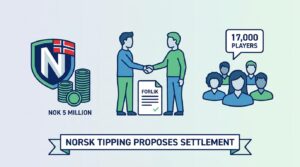
Norway’s state-owned gambling operator Norsk Tipping has put forward a NOK 5 million settlement offer to resolve a dispute involving roughly 17,000 players who filed complaints over the company’s handling of their accounts. The proposed resolution, which works out to approximately NOK 294 per claimant, addresses grievances tied to the operator’s responsible gambling mechanisms and player fund management. It marks a rare instance of a Nordic state monopoly operator facing collective player action at this scale.
What the Settlement Offer Actually Covers
Before unpacking the strategic implications, it helps to ground the numbers. Here is what the proposed deal looks like in practice:
- Total settlement pool: NOK 5 million, distributed across all eligible claimants
- Number of affected players: approximately 17,000
- Per-player payout sits at roughly NOK 294 (around €25), a figure that raises questions about whether the amount constitutes meaningful redress or a symbolic gesture
- Operator stance: Norsk Tipping has framed the offer as a good-faith resolution rather than an admission of liability
- The dispute centres on how player protections and account restrictions were applied, not on game fairness or payout integrity
A State Monopoly Under Unusual Pressure
Norsk Tipping occupies a distinctive position in European gambling. As Norway’s sole licensed operator for lotteries, sports betting, and certain interactive games, it operates under a mandate that explicitly prioritises responsible gambling and the channelling of profits toward public causes like sports, culture, and humanitarian work. That mandate has historically insulated the operator from the kind of consumer pushback common in competitive markets.
This dispute disrupts that pattern.
When 17,000 players organise around a shared grievance against a monopoly operator, the signal extends beyond the specifics of the complaint. It suggests a gap between the operator’s self-image as a player-protection champion and how certain customers experienced the enforcement of those protections. Whether the restrictions in question were overzealous, inconsistently applied, or poorly communicated remains a point of contention (and one Norsk Tipping has not fully addressed publicly). Still, the sheer volume of claimants gives the dispute a weight that a handful of individual complaints would not carry.
Why NOK 294 Per Player Raises Eyebrows
The per-capita figure is, by any measure, modest. For context, NOK 294 is roughly the cost of a mid-range lunch in Oslo. That alone does not invalidate the settlement; collective resolutions often yield small individual payouts when spread across large groups. But the optics matter. A state operator whose entire justification for monopoly status rests on player welfare offering what amounts to a token sum could invite scrutiny from regulators and politicians alike.
Norsk Tipping reported total revenues exceeding NOK 40 billion in recent years, with billions directed to public benefit causes annually. Against that backdrop, a NOK 5 million settlement is a rounding error on the balance sheet. The question is whether accepting the offer forecloses further legal avenues for the players involved, and whether the terms include any operational commitments from the operator to change the practices that triggered the complaints in the first place.
Regulatory and Political Dimensions
Norway’s gambling framework, overseen by Lotteri- og stiftelsestilsynet (the Norwegian Gaming and Foundation Authority), has faced periodic calls for modernisation. The country maintains one of Europe’s strictest monopoly models, and Norsk Tipping’s operations are frequently cited in debates about whether state monopolies deliver better consumer outcomes than regulated open markets.
A collective player dispute of this magnitude hands ammunition to both sides of that debate. Proponents of liberalisation can point to the settlement as evidence that monopoly operators are not immune to consumer harm. Defenders of the model will argue that the operator’s willingness to settle demonstrates accountability, something they claim would be harder to extract from dozens of competing private licensees. Neither reading is entirely wrong.
And while Norwegian regulators have not publicly commented on the dispute, the timing coincides with broader Nordic discussions about gambling advertising restrictions, deposit limits, and the role of state operators in an increasingly digital market.
How This Fits Into Broader Nordic Gambling Trends
The Nordic gambling landscape has been shifting for years. Sweden moved away from its state monopoly in 2019, introducing a licensing system. Finland’s Veikkaus has undergone structural reforms. Denmark operates a hybrid model. Norway remains the holdout, maintaining its monopoly with conviction but facing growing pressure from unlicensed offshore operators capturing market share.
| Country | Model | State Operator | Recent Shift |
|---|---|---|---|
| Norway | State monopoly | Norsk Tipping | Facing collective player dispute |
| Sweden | Licensed market (since 2019) | Svenska Spel (partial) | Ongoing licence enforcement tightening |
| Finland | Monopoly (reforming) | Veikkaus | Structural overhaul announced, partial market opening planned |
| Denmark | Hybrid licensing | Danske Spil | Stable regulatory framework with periodic updates |
Norway’s insistence on monopoly depends heavily on demonstrating that the model produces superior player protection outcomes. Each time that narrative is challenged, even through a relatively small financial settlement, the political calculus shifts slightly.
What Players and Stakeholders Should Watch For
The settlement remains a proposal, not a done deal. Several developments could reshape its trajectory. If a significant portion of the 17,000 claimants reject the terms, the dispute could escalate into formal legal proceedings, which would force greater transparency about the practices in question. Alternatively, a quiet acceptance by most players would allow Norsk Tipping to close the chapter without operational concessions.
Arguably the more consequential outcome lies not in the money but in precedent. A successful collective action against a state monopoly operator, even one resolved through settlement, establishes a template. Other player groups across the Nordics will be watching.
Frequently Asked Questions
What triggered the player complaints against Norsk Tipping?
The complaints relate to how the operator applied responsible gambling measures and account restrictions. Players allege these were implemented in ways that adversely affected their accounts, though the precise mechanisms remain under dispute.
Is NOK 294 per player a typical settlement amount?
In collective disputes involving thousands of claimants, individual payouts are often small. Whether this amount reflects fair compensation depends on the nature and extent of harm each player experienced, which varies across the group.
Does accepting the settlement prevent players from taking further legal action?
Settlement terms typically include release clauses. Players considering the offer should examine whether acceptance waives their right to pursue additional claims. The specific terms of Norsk Tipping’s proposal have not been fully disclosed publicly.
Could this dispute affect Norway’s gambling monopoly model?
Not directly or immediately. But it adds to a growing body of evidence that monopoly models are not inherently frictionless for consumers, which feeds into longer-term political and regulatory debates about market structure.



