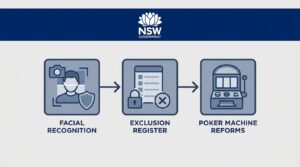
New South Wales has unveiled a landmark package of gambling reforms that will require facial recognition technology at the entrance of every gaming room in the state and establish a centralized exclusion register for poker machines. The measures, announced by the NSW Government, target the estimated $8 billion lost annually by NSW residents to poker machines and represent one of the most aggressive harm-minimisation frameworks attempted in any Australian jurisdiction. These reforms place NSW at the forefront of technology-driven gambling regulation, though questions remain about implementation timelines and industry readiness.
What the NSW Poker Machine Overhaul Actually Includes
Before unpacking the strategic implications, here is what the reform package delivers at a structural level:
- A mandatory statewide self-exclusion register, replacing the current fragmented, venue-by-venue system that critics have long called ineffective
- Facial recognition technology required at all gaming-room entry points to enforce exclusions in real time
- Cashless gaming card trials designed to enable pre-commitment spending limits and improve transaction traceability
- Enhanced data-sharing obligations between venues, regulators, and the exclusion register
- The reforms apply across clubs and hotels operating poker machines in NSW, covering roughly 85,000 registered machines statewide
Why Facial Recognition Changes the Enforcement Equation
Self-exclusion programs have existed in Australian states for years. But enforcement has been, at best, inconsistent. Venues relied on staff to visually identify excluded patrons, a method that failed routinely in busy rooms and across shift changes. Facial recognition removes that human bottleneck.
The technology scans individuals as they enter a gaming area and cross-references their biometric data against the exclusion register. If a match is detected, entry is denied. That sounds straightforward on paper. In practice, deploying biometric surveillance across thousands of venues raises significant privacy, accuracy, and cost concerns (a distinction regulators have been slow to address in public consultation documents).
Still, the NSW Government appears to have concluded that the public health cost of problem gambling outweighs the friction of biometric deployment. The state accounts for a disproportionate share of Australia’s total poker machine losses, and political pressure from community groups and crossbench MPs has intensified over the past two years.
Cashless Gaming Cards and the Data Trail
Arguably the most commercially disruptive element of the package is the cashless gaming card. These cards would require players to load funds digitally before playing, enabling pre-set spending limits and creating a traceable record of gambling activity. Anonymous cash play, which currently dominates poker machine use, would be curtailed.
For venues, this shift introduces new compliance infrastructure. For regulators, it opens a data pipeline that has never existed at this scale in Australian gambling. And for players, it forces a level of financial self-awareness that the current system deliberately avoids.
The NSW Government’s gambling reform agenda positions the cashless card as both a harm-reduction tool and an anti-money-laundering measure. Cash-intensive poker machine venues have long been flagged by AUSTRAC as potential vectors for illicit fund flows, and digital traceability addresses that vulnerability directly.
Industry Response: Compliance Costs and Operational Disruption
ClubsNSW and the Australian Hotels Association have signalled cautious engagement with the reforms, though neither organisation has endorsed the full package without reservation. The capital expenditure required to install facial recognition systems across every gaming room in the state is substantial. Smaller regional clubs, already operating on thin margins, face the steepest burden.
There is also the question of technology procurement. Which vendors will supply the facial recognition systems? What accuracy thresholds will regulators mandate? And who bears liability when the system fails to flag an excluded individual, or incorrectly denies entry to someone not on the register?
None of these details have been finalised publicly.
Estimated Compliance Impact by Venue Type
| Venue Type | Approx. Number in NSW | Key Compliance Challenge | Relative Cost Burden |
|---|---|---|---|
| Large registered clubs | ~1,100 | System integration with existing security infrastructure | Moderate |
| Small to mid-size clubs | ~800 | Capital expenditure on new biometric hardware | High |
| Hotels with gaming rooms | ~1,600 | Retrofitting entry points not designed for screening technology | High to very high |
Reframing Gambling Harm Through Behavioural Design
What makes these reforms distinctive is not just the technology but the underlying behavioural logic. Traditional gambling regulation has focused on supply-side controls: machine caps, operating-hour restrictions, signage requirements. These measures treat the environment. The NSW package treats the individual’s interaction with that environment.
Facial recognition at entry points creates a friction point, a moment of pause before engagement. Cashless cards introduce a cognitive checkpoint: loading money onto a card is a deliberate act, unlike feeding notes into a slot. Pre-commitment limits force prospective thinking rather than reactive spending. Each of these mechanisms draws on principles well understood in behavioural economics and, more broadly, in neuro-linguistic programming frameworks that emphasise how environmental cues and decision architecture shape human behaviour.
NLP practitioners have long argued that behaviour change is most durable when it operates at the level of identity and environment rather than willpower alone. The NSW reforms, whether intentionally or not, align with this principle. By restructuring the physical and transactional environment around poker machines, the government is attempting to alter the default behavioural pathway. A player who must present a registered card, pass a biometric scan, and acknowledge a pre-set limit before touching a machine is operating in a fundamentally different decision context than one who walks in with cash and sits down anonymously.
This shift from reactive regulation to proactive behavioural design may prove more consequential than any single technology deployed. It signals a philosophical pivot: rather than managing the consequences of problem gambling, the state is trying to interrupt the conditions that produce it. Whether the execution matches the ambition remains the open question.
Frequently Asked Questions
When will facial recognition be required in NSW gaming rooms?
The NSW Government has announced the reforms but has not confirmed a final implementation date. Phased rollouts are expected, with larger venues likely required to comply first.
Will the exclusion register be voluntary or mandatory?
The statewide register will support voluntary self-exclusion. However, third-party exclusion mechanisms, where family members or counsellors can initiate a request, are also under discussion.
How accurate is facial recognition technology in these settings?
Modern facial recognition systems report accuracy rates above 99% under controlled conditions. Real-world performance in variable lighting, crowded venues, and across diverse demographics can differ, and regulators have not yet published the minimum accuracy benchmarks venues must meet.
Do other Australian states use similar technology?
Tasmania has trialled facial recognition in selected venues. No other state has mandated it at the scale NSW is proposing, which makes this reform a national test case.



