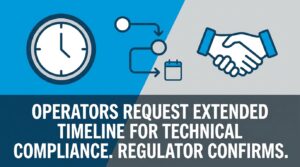
A regulatory authority has confirmed that licensed operators have formally requested additional time to complete the technical preparations required under new compliance frameworks. The extension request signals that the operational burden of meeting updated standards is heavier than initially anticipated, raising questions about whether original implementation timelines were realistic. While the regulator has acknowledged the requests, no official revised deadline has been disclosed. The development affects multiple operators across the regulated market and could reshape near-term enforcement priorities.
What the Extension Requests Reveal About Market Readiness
Before diving into the specifics, it is worth framing the broader picture. When multiple operators independently seek more time, the signal is not about individual shortcomings. It points to systemic friction between regulatory ambition and technical reality.
- Technical integration gaps are wider than projected: Operators are struggling to align legacy systems with new requirements, suggesting the compliance architecture demands deeper infrastructure changes than surface-level adjustments.
- Regulatory timelines may have underestimated vendor dependencies: Many operators rely on third-party technology providers whose own development cycles don’t always match regulatory calendars.
- The requests came from operators, not from industry lobby groups, which lends them a degree of operational credibility rather than political positioning.
- Enforcement posture is now uncertain: If the regulator grants extensions, it sets a precedent. If it doesn’t, operators face the prospect of non-compliance penalties despite demonstrable good-faith efforts.
- Market confidence could shift depending on how transparently the regulator communicates its next steps.
Why Technical Preparations Are Proving More Complex Than Expected
Regulatory compliance in digitally operated markets is rarely a matter of flipping a switch. Operators typically need to modify reporting pipelines, update player-facing interfaces, reconfigure data storage protocols, and in some cases rebuild backend architectures entirely. Each of these layers introduces its own dependencies, testing cycles, and failure points.
And while regulators often consult with industry stakeholders before setting deadlines, the gap between consultation and execution tends to widen once engineering teams begin actual implementation. What looks feasible in a policy document can become a six-month development sprint in practice.
One factor that arguably compounds the challenge is the absence of standardised technical specifications across jurisdictions. Operators active in multiple regulated markets must juggle overlapping but non-identical requirements (a distinction regulators have been slow to harmonise). That fragmentation eats into development bandwidth and forces prioritisation decisions that can delay compliance in any single market.
Regulatory Response: Silence, Flexibility, or Enforcement?
The regulator’s acknowledgment that operators have asked for more time is itself notable. It suggests a willingness to engage rather than simply enforce. But acknowledgment is not the same as approval.
Three scenarios are plausible. First, the regulator could grant a blanket extension, resetting the compliance clock for all licensees. Second, it could offer case-by-case deferrals, requiring operators to demonstrate progress before receiving additional time. Third, it could hold firm on the original deadline and treat non-compliance as a supervisory matter. Each path carries different implications for market stability and operator planning.
What remains less clear is whether the regulator has the internal capacity to evaluate individual extension requests at scale. Supervisory resources are finite, and a wave of deferral applications could itself become a bottleneck.
How Operators Can Navigate the Uncertainty
For operators caught between incomplete technical work and an ambiguous regulatory timeline, the strategic calculus is delicate. Waiting for formal guidance before acting is risky. Moving too aggressively on untested systems introduces its own operational hazards.
Industry professionals managing compliance programmes in this environment should consider several practical steps rooted in structured decision-making and adaptive planning. Applying principles from cognitive reframing, teams can shift from viewing the extension period as a delay to treating it as an opportunity to stress-test implementations more thoroughly. This mental repositioning, grounded in how professionals process uncertainty and pressure, can materially improve both the quality of technical outputs and team morale during high-stakes delivery windows.
Anchoring decisions to measurable milestones rather than external deadlines helps insulate teams from the paralysis that regulatory ambiguity often creates. Breaking the remaining compliance work into discrete, testable components allows progress to continue regardless of whether the deadline shifts. Leaders who communicate this framing clearly to their engineering and compliance teams tend to see faster iteration cycles and fewer last-minute errors. The language used internally matters: framing the situation as “we have space to get this right” rather than “we’re behind” changes how teams allocate attention and effort. That distinction, subtle as it sounds, has tangible effects on delivery quality.
Operators should also document every step of their compliance journey. If enforcement action does follow, a well-documented record of good-faith effort and proactive engagement with the regulator serves as the strongest available defence.
Broader Market Implications
| Scenario | Likelihood | Impact on Operators |
|---|---|---|
| Blanket deadline extension | Moderate | Reduces immediate pressure; may slow urgency across the sector |
| Case-by-case deferrals | Moderate to High | Creates uneven competitive conditions; rewards operators with stronger regulatory relationships |
| No extension granted | Lower | Forces rapid, potentially incomplete compliance; increases risk of supervisory action and operational disruption |
Still, the fact that operators felt compelled to request extensions publicly rather than quietly absorb the risk tells us something about the scale of the challenge. This is not a marginal timing issue.
Frequently Asked Questions
Why are operators asking for more time?
The technical preparations required under the updated regulatory framework are proving more complex than originally anticipated, involving deep infrastructure changes rather than simple configuration updates.
Has the regulator granted an extension?
Not yet. The regulator has confirmed receiving the requests but has not publicly announced a revised timeline or formal decision.
What happens if operators miss the original deadline?
That depends entirely on the regulator’s enforcement posture. Operators could face supervisory scrutiny, financial penalties, or licence conditions. Those who can demonstrate documented, good-faith compliance efforts are likely to be treated differently from those who simply ignored the deadline. At least on paper.
Does this affect all licensed operators equally?
No. Larger operators with dedicated compliance and engineering teams may be closer to readiness. Smaller licensees, particularly those reliant on gambling regulatory compliance platforms and third-party providers, face steeper challenges given their more limited internal resources.



