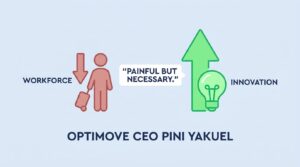
Optimove, the customer-led marketing platform, has confirmed a round of layoffs as part of a broader strategic pivot toward innovation and product development. CEO Pini Yakuel described the decision as “painful” but necessary, framing it as a deliberate move to reallocate resources toward areas the company views as critical for long-term competitiveness. The cuts affect an undisclosed number of employees across the marketing services provider’s global operations. While workforce reductions in the martech sector have become less shocking in recent quarters, the timing and stated rationale here deserve closer scrutiny.
What Optimove’s Restructuring Signals for the Martech Sector
Before unpacking the strategic implications, it helps to isolate what this decision reveals about where Optimove sees the market heading. The company has positioned itself as a CRM marketing hub that uses AI-driven decisioning to orchestrate multichannel campaigns. That positioning now apparently demands a leaner organizational structure and heavier investment in core technology.
- The layoffs are tied directly to a reallocation of capital toward product innovation, not a response to declining revenue or external funding pressure
- CEO Pini Yakuel’s public framing suggests the company is betting that its next phase of growth depends on technical differentiation rather than headcount-driven service expansion
- AI and automation capabilities are likely at the center of whatever R&D push follows, consistent with broader industry trends
- The decision may also reflect margin pressure common among mid-market SaaS firms competing against both enterprise incumbents and nimble startups
- Optimove’s willingness to absorb short-term disruption hints at confidence in its product roadmap for the next 12 to 18 months
A CEO’s Calculus: Why Now?
Yakuel’s choice of the word “painful” is deliberate. It signals awareness that layoffs carry reputational risk, particularly for a company whose brand rests on customer relationships and retention intelligence. But the subtext is arguably more revealing than the headline.
Martech firms across the board are confronting a difficult reality: the tools that differentiated them three years ago are becoming table stakes. Predictive analytics, journey orchestration, real-time personalization — these capabilities now populate the feature lists of dozens of competitors. For Optimove’s customer-led marketing platform, standing still means falling behind.
And so the restructuring appears less like a crisis response and more like a calculated bet. Strip operational overhead, redirect those dollars into engineering and data science, and emerge with a product that justifies premium positioning. At least on paper, the logic holds.
What remains less clear is how deep the cuts run and which functions bear the brunt. Companies that trim go-to-market teams too aggressively often discover, sometimes quarters later, that pipeline generation doesn’t recover as quickly as product features ship.
The Broader Pattern: Innovation Through Subtraction
Optimove is hardly alone in pursuing this playbook. Across the SaaS landscape, a pattern has crystallized since late 2023: reduce headcount, consolidate roles, and funnel savings into AI-native product development. The theory is that automation can absorb tasks previously handled by larger teams, while simultaneously creating new capabilities that drive customer acquisition.
Still, the execution risk is real. Consider the tension: a company built on helping brands retain customers is now asking its own workforce to absorb uncertainty. That irony won’t be lost on industry observers (or on the employees affected).
| Factor | Optimove’s Position | Industry Norm |
|---|---|---|
| Stated reason for layoffs | Innovation reallocation | Cost reduction / runway extension |
| CEO public communication | Acknowledged as “painful” | Often framed as “strategic optimization” |
| Primary investment target | Product and R&D | Varies; often AI and automation |
| Revenue context | Not disclosed as declining | Frequently tied to missed targets or slower growth |
How Strategic Framing Shapes Stakeholder Perception
The language a CEO uses during layoffs does more than manage headlines. It sets the internal narrative for remaining employees, shapes investor confidence, and signals to prospective customers whether the company is contracting or transforming. Yakuel’s framing leans heavily into the latter category.
From a neuro-linguistic standpoint, the distinction matters enormously. When leadership anchors a difficult decision in forward-looking language — “innovation,” “investment,” “building” — it activates a different cognitive frame than defensive terminology like “efficiency” or “right-sizing.” Employees who stay are more likely to interpret the restructuring as purposeful rather than panicked. Customers evaluating the platform are less likely to question its viability.
This isn’t just semantics. Research in organizational psychology consistently shows that how change is communicated affects retention of key talent by measurable margins. Teams that understand the strategic rationale behind disruption tend to maintain higher engagement scores in the quarters that follow. The risk emerges when the stated vision doesn’t materialize quickly enough — when “innovation” remains a promise rather than a shipped product. Credibility erodes fast in that gap.
Yakuel’s public acknowledgment of pain also serves a subtler function: it humanizes the decision in a sector where layoff announcements have become almost formulaic. Whether that authenticity translates into sustained trust depends entirely on what Optimove delivers next.
Frequently Asked Questions
Why did Optimove lay off employees?
According to CEO Pini Yakuel, the layoffs were driven by a strategic decision to redirect resources toward innovation and product development. He characterized the move as painful but rooted in the company’s push to stay competitive.
How many employees were affected?
Optimove has not publicly disclosed the exact number of positions eliminated. The company has kept specific figures close, which is not unusual for privately held martech firms navigating restructurings.
Is Optimove facing financial difficulties?
The company has not indicated that the layoffs stem from revenue decline or funding shortfalls. The stated rationale centers on reallocating investment toward technology and R&D rather than cutting costs out of necessity — though external observers lack the financial transparency to verify this independently.
What does this mean for Optimove’s customers?
If the company follows through on its innovation-focused roadmap, customers could see accelerated product improvements. The near-term question is whether service quality and support capacity remain stable through the transition.