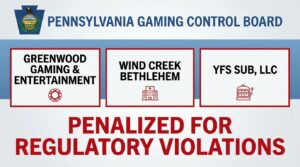
The Pennsylvania Gaming Control Board (PGCB) has levied financial penalties against three gaming operators — Greenwood Gaming and Entertainment, Wind Creek Bethlehem, and YFS Sub — for a range of regulatory infractions. The enforcement actions, disclosed through the board’s consent agreement process, underscore the state’s continued vigilance over compliance in one of the nation’s largest legal gambling markets. Each case involves distinct violations, but together they signal a regulatory posture that is tightening rather than relaxing as Pennsylvania’s gaming sector matures.
What the Latest PGCB Penalties Reveal About Compliance Risks
Pennsylvania generated more than $5.8 billion in gross gaming revenue in fiscal year 2023-24, making it one of the top-performing regulated markets in the United States. That scale brings scrutiny. The three penalties announced here reflect different operational failures, but the throughline is clear: regulators are not treating compliance lapses as minor paperwork issues.
- Greenwood Gaming and Entertainment, operator of Parx Casino, was penalized for violations tied to its operational procedures — a reminder that even the state’s highest-grossing casino is not insulated from enforcement.
- Wind Creek Bethlehem, owned by the Poarch Band of Creek Indians, faced penalties related to its gaming floor operations, reinforcing that tribal-affiliated commercial operators are held to the same state-level standards.
- YFS Sub, a less prominent name in the state’s gaming landscape, was also subject to a consent agreement, though the specifics of its violations point to procedural shortcomings rather than systemic misconduct.
- All three cases were resolved through consent agreements, meaning the operators accepted the penalties without contesting the findings — a pragmatic route, but one that still carries reputational weight.
Greenwood Gaming: Scale Doesn’t Equal Immunity
Greenwood Gaming and Entertainment operates Parx Casino in Bensalem, Bucks County, which consistently ranks as Pennsylvania’s top-earning casino property. The facility’s dominance in the market makes any regulatory action against it particularly notable. Even so, the PGCB has not historically shown deference to revenue leaders when compliance gaps surface.
The penalty against Greenwood reflects the board’s expectation that high-volume operators maintain proportionally robust internal controls. When a property processes the transaction volume that Parx does daily, even small procedural failures can compound into material regulatory exposure. That math is not lost on the board.
Wind Creek Bethlehem Faces State-Level Accountability
Wind Creek Bethlehem occupies the former Bethlehem Steel site in the Lehigh Valley, a property with both commercial significance and cultural resonance. Operated by Wind Creek Hospitality, the gaming and resort arm of the Poarch Band of Creek Indians, the casino operates under a Pennsylvania commercial license and is therefore fully subject to PGCB jurisdiction.
This distinction matters. Tribal gaming operations on sovereign land are regulated under federal compacts, but Wind Creek Bethlehem sits on state-regulated ground. The penalty here reinforces that there is no jurisdictional ambiguity — at least on paper — when a tribal entity operates within Pennsylvania’s commercial framework. Whether other states draw the same bright line is a different question entirely.
YFS Sub and the Quiet Cost of Procedural Failures
YFS Sub attracts less public attention than its co-penalized operators, but the enforcement action against it carries its own lesson. Smaller or less visible operators sometimes assume that regulatory bandwidth is consumed by the larger players. That assumption is wrong.
The PGCB’s willingness to pursue consent agreements across the spectrum — from the state’s largest casino to a comparatively lower-profile entity — suggests a deliberate strategy. Regulators appear to be signaling that enforcement is not proportional to market share. A violation is a violation, regardless of the operator’s footprint.
How Consent Agreements Function in Pennsylvania Gaming Enforcement
Consent agreements are the PGCB’s primary tool for resolving compliance violations without a full adjudicatory hearing. They function, in practice, as negotiated settlements: the operator acknowledges the violation, accepts a financial penalty, and typically commits to corrective measures. The board avoids a protracted legal process; the operator avoids the unpredictability of a public hearing.
But these agreements are not sealed. They become part of the public record, and for publicly traded or institutionally backed operators, the reputational dimension can matter as much as the dollar amount. Institutional investors and licensing authorities in other jurisdictions routinely review enforcement histories during due diligence (a detail that compliance officers understand far better than marketing departments do).
| Operator | Property | Violation Type | Resolution |
|---|---|---|---|
| Greenwood Gaming and Entertainment | Parx Casino, Bensalem | Operational procedure violations | Consent agreement with financial penalty |
| Wind Creek Bethlehem | Wind Creek Bethlehem, Lehigh Valley | Gaming floor operational infractions | Consent agreement with financial penalty |
| YFS Sub | — | Procedural compliance shortcomings | Consent agreement with financial penalty |
What This Means for Pennsylvania’s Regulatory Direction
Pennsylvania’s gaming market has expanded rapidly since the legalization of online gambling and sports betting. With that expansion comes a wider surface area for compliance risk. The PGCB has responded not by loosening oversight but by maintaining — and arguably intensifying — its enforcement cadence. Operators entering or expanding within the state should treat these penalties as a calibration signal, not background noise.
Still, one pattern deserves attention. The board’s reliance on consent agreements, while efficient, raises a question about deterrence. If penalties are routinely absorbed as a cost of doing business, does the mechanism lose its edge? The answer likely depends on whether penalty amounts scale with the severity and frequency of violations over time.
Frequently Asked Questions
What is a consent agreement in Pennsylvania gaming regulation?
A consent agreement is a negotiated resolution between the PGCB and a licensed operator. The operator accepts the findings and pays a penalty without going through a formal hearing. These agreements are publicly disclosed and become part of the operator’s regulatory record.
Does this affect the operators’ licenses?
Not directly. Consent agreements typically involve financial penalties and corrective commitments rather than license suspensions or revocations. However, repeated violations could influence future licensing decisions — both in Pennsylvania and in other jurisdictions where the operator holds or seeks licenses.
Why does the PGCB penalize operators for procedural violations?
Procedural compliance forms the backbone of gaming regulation. Even seemingly minor infractions can indicate weaknesses in internal controls that, left unaddressed, could lead to more serious issues such as fraud, money laundering, or consumer harm. Regulators treat these as leading indicators, not trivial missteps.
Are these penalties unusually large?
The PGCB calibrates penalties based on the nature of the violation, the operator’s compliance history, and the corrective actions proposed. Without the specific dollar figures for these particular agreements, it is difficult to benchmark them — but Pennsylvania has historically imposed penalties ranging from modest fines to six-figure amounts depending on circumstances.



