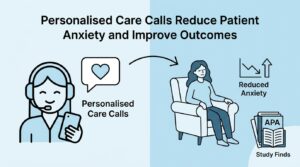
A peer-reviewed study published by the American Psychological Association has found that personalised care calls and proactive patient outreach significantly reduce anxiety levels while improving clinical outcomes. The research, which examined structured telephonic interventions across multiple healthcare settings, offers fresh evidence that relatively low-cost communication strategies can yield measurable psychological and medical benefits. For hospital administrators and health system executives weighing investments in patient engagement infrastructure, the findings carry direct operational implications.
What the Study Reveals for Healthcare Decision-Makers
Before diving into the specifics, the broader takeaway deserves framing: this is not about call centres or customer service scripts. It is about clinical communication redesigned around individual patient needs, delivered at moments when uncertainty and fear are highest. The distinction matters.
- Anxiety reduction was statistically significant among patients who received personalised outreach compared to control groups receiving standard post-discharge communication.
- Proactive calls — initiated by the care team rather than triggered by patient complaints — correlated with fewer emergency readmissions in the study cohort.
- Patient satisfaction scores improved, but more importantly, adherence to prescribed treatment plans rose in tandem with the intervention.
- The cost per intervention remained modest relative to the downstream savings from avoided readmissions and reduced acute care utilisation.
- Providers who adopted structured call frameworks reported better continuity of care documentation, a secondary benefit that often goes unmentioned
How Personalised Outreach Differs from Routine Follow-Up
Most health systems already conduct some form of post-discharge follow-up. A nurse calls, checks a box, asks if the patient has questions. That model, while better than silence, treats communication as administrative rather than therapeutic. The APA-published study draws a sharp line between these two approaches.
Personalised care calls, as defined in the research, involve tailored scripts informed by the patient’s diagnosis, psychological profile, and social determinants of health. The caller — typically a trained care coordinator — addresses specific concerns the patient raised during their stay, follows up on medication comprehension, and screens for early signs of emotional distress. In practice, this means a five-minute call can function as a clinical intervention rather than a courtesy check.
That shift matters because anxiety in post-acute patients is not merely a comfort issue. Elevated anxiety has been linked to delayed wound healing, medication non-adherence, and increased cortisol levels that complicate recovery from cardiac and surgical procedures. Treating communication as a clinical tool, then, is less a philosophical position than an evidence-based one.
The Psychology Behind Why It Works
From a neuro-linguistic programming perspective, the effectiveness of personalised care calls aligns with well-established principles of rapport, anchoring, and reframing. When a care coordinator uses the patient’s own language to describe their condition and recovery plan, the interaction activates a sense of being understood — what NLP practitioners call “pacing” before “leading.” The patient feels met where they are, psychologically, before being guided toward the next step in their care journey.
Anchoring plays a role too. By associating the phone call with reassurance and competence (rather than billing inquiries or automated reminders), the healthcare system creates a positive emotional anchor. Subsequent interactions with the institution carry residual trust. Patients who feel psychologically safe are more likely to disclose symptoms early, ask clarifying questions about medications, and engage with follow-up appointments — all behaviours that reduce costly complications.
Reframing is arguably the most powerful mechanism at work. A patient discharged after cardiac surgery may interpret chest tightness as a sign of failure or relapse. A personalised call that reframes normal post-operative sensations within an expected recovery timeline can prevent a panic-driven ER visit. The clinical value of that single reframe — measured in avoided ambulance dispatches, imaging costs, and bed occupancy — is substantial. And yet, it requires no technology more sophisticated than a telephone and a well-trained human voice.
Even the timing of calls reflects NLP-informed strategy. Reaching patients during the 48-to-72-hour window after discharge targets the period of peak uncertainty, when the hospital’s structured environment has been replaced by the patient’s home, often without immediate clinical support.
Operational Realities and Scalability Questions
Sceptics will rightly ask whether this model scales. A five-minute personalised call is one thing for a 200-bed community hospital; it is another for a system discharging thousands of patients weekly across dozens of facilities. The study acknowledges this tension without fully resolving it.
What the data does suggest is that risk-stratified targeting — focusing personalised outreach on patients with the highest anxiety indicators or readmission risk scores — captures most of the benefit at a fraction of the cost of universal deployment. Health systems already using predictive analytics for readmission prevention could layer this intervention onto existing workflows without building new infrastructure from scratch.
Key Metrics from the Study
| Metric | Standard Follow-Up | Personalised Care Calls |
|---|---|---|
| Patient-reported anxiety (post-discharge) | Moderate to high | Significantly reduced |
| 30-day readmission rate | Baseline | Lower than control group |
| Treatment adherence | Variable | Improved across cohort |
| Average call duration | 2–3 minutes | 5–7 minutes, with tailored content |
Frequently Asked Questions
What makes a care call “personalised” versus standard?
Personalised calls use patient-specific information — diagnosis details, expressed concerns during hospitalisation, medication regimen — to guide the conversation. Standard calls tend to follow a generic checklist regardless of the patient’s condition or emotional state.
Does this approach require specialised staff?
Not necessarily specialised, but trained. Care coordinators or nurses with brief training in motivational interviewing and structured communication frameworks can deliver these calls effectively. The study did not require doctoral-level clinicians for the intervention.
How quickly do results appear?
Anxiety reduction was measurable within the first week post-discharge. Readmission impacts emerged over the standard 30-day window, though longer-term data would strengthen the case considerably.
Where This Leaves Health System Strategy
The study lands at a moment when patient experience metrics are increasingly tied to reimbursement, and when labour shortages make every staff hour a strategic allocation decision. Personalised outreach is not free — but the evidence now suggests that failing to invest in it carries its own, less visible costs. Whether health systems treat this as a clinical programme or a patient satisfaction initiative will likely determine how effectively they implement it.



