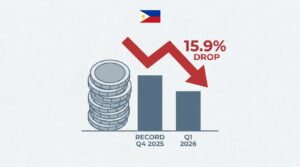
The Philippine Amusement and Gaming Corporation (PAGCOR) has reported a 15.9% quarter-on-quarter decline in gross gaming revenue for the first three months of 2026, with total GGR settling at PHP 87.63 billion (roughly $1.52 billion). The pullback follows what was, by every measure, a historic peak: PHP 104.24 billion in Q4 2025. Both land-based and digital segments contributed to the cooling, though the severity of the decline varied across verticals. For an industry that spent much of 2025 riding an upward trajectory, the Q1 figures raise questions about whether the Philippines’ gaming boom is entering a consolidation phase or simply catching its breath.
What the Q1 2026 Numbers Actually Tell Us
Before reading into the decline too aggressively, it helps to frame the data against seasonal patterns and the extraordinary performance that preceded it. A brief overview of the strategic takeaways:
- Sequential, not annual, decline: The 15.9% drop is measured quarter-on-quarter. Year-on-year comparisons, when available, may paint a different picture entirely.
- Record Q4 2025 created a high baseline: PHP 104.24 billion was an all-time high for the Philippine gaming sector, making some degree of reversion statistically likely.
- Q1 is historically softer for gaming revenues in the Philippines, partly due to post-holiday spending fatigue and regulatory calendar effects
- Both land-based and digital sectors contracted: This wasn’t a story of one channel cannibalizing another. The pullback was broad-based.
- Revenue still exceeded PHP 87 billion: Even at the reduced level, Q1 2026 output remains elevated by historical standards, suggesting structural demand hasn’t collapsed.
Sector Breakdown: Land-Based vs. Digital Performance
The contraction was not evenly distributed. Land-based casino operations, which account for the bulk of Philippine GGR, saw a sharper sequential decline than the digital segment. Integrated resorts in Entertainment City and Clark continued to draw traffic, but spending per visitor appears to have softened after the holiday surge. VIP and mass-market table game revenues both pulled back, though mass-market hold rates remained comparatively resilient.
Digital gaming, including licensed e-gaming and online platforms regulated by PAGCOR’s licensing and regulatory framework, also recorded a decline. Still, the digital segment’s share of total GGR held steady or ticked slightly upward, a pattern consistent with the broader migration of gaming activity toward online channels across Southeast Asia.
That shift matters because it suggests the structural composition of Philippine gaming revenue is evolving even during a down quarter.
Revenue Snapshot: Q4 2025 vs. Q1 2026
| Metric | Q4 2025 | Q1 2026 | Change |
|---|---|---|---|
| Total GGR (PHP billions) | 104.24 | 87.63 | -15.9% |
| Total GGR (USD approx.) | $1.81B | $1.52B | -15.9% |
| Land-based share | Majority | Majority (slightly reduced) | Marginal shift toward digital |
| Digital gaming trend | Strong growth | Declined, but held share | Relative resilience noted |
Why the Decline Doesn’t Signal a Structural Downturn
Quarterly contractions following record peaks are common in cyclical industries, and gaming is no exception. The Philippine market has several demand-side tailwinds that remain intact: rising Chinese and Korean tourist volumes, ongoing infrastructure investment in Entertainment City, and a regulatory environment that (at least on paper) continues to favor controlled expansion.
PAGCOR itself has been undergoing institutional reform, with its dual role as both regulator and operator drawing scrutiny from legislators and industry stakeholders. The agency’s transition toward a purely regulatory function, if completed, could reshape how revenue is generated and reported in future quarters. But that process is gradual, and its effects on Q1 2026 numbers were likely minimal.
What remains less clear is whether the VIP segment’s softness reflects broader macroeconomic headwinds in key source markets, particularly mainland China, or simply a normalization after an unusually strong Q4. Junket activity in the region has been under pressure since 2022, and the Philippines has not been immune to that trend.
Regulatory and Market Context Shaping the Outlook
The Philippine government’s stance on gaming has grown more nuanced in recent years. President Marcos Jr.’s administration has maintained a generally supportive posture toward licensed gaming, while simultaneously cracking down on unauthorised offshore operators (a distinction regulators have been slow to enforce consistently). The closure of several unlicensed POGO operations in 2024 and 2025 removed a layer of grey-market activity that had inflated earlier revenue figures.
And while the crackdown improved the legitimacy of the sector, it also meant that some revenue previously captured in aggregate reporting simply disappeared. Analysts tracking Philippine GGR should account for this when comparing current figures to pre-2024 baselines.
Regional competition is another factor. Singapore’s integrated resorts are expanding. Vietnam’s gaming framework is maturing. Cambodia continues to attract cross-border play. The Philippines isn’t operating in a vacuum, and its ability to sustain growth depends partly on how effectively it differentiates its offering.
How Stakeholders Should Read the Q1 Signal
For operators, the Q1 dip is a reminder that capital deployment decisions shouldn’t be anchored to a single record quarter. Revenue planning models need to account for seasonal variance and the post-peak normalization that Q1 2026 represents. For regulators, the data reinforces the importance of maintaining a stable licensing environment that encourages long-term investment rather than short-term speculation.
Investors in Philippine-listed gaming companies should watch two things closely: whether Q2 2026 shows a rebound toward the PHP 90–95 billion range, and whether PAGCOR’s institutional reforms produce any changes in how revenue is classified or distributed. Both will shape the narrative for the rest of the year.
Frequently Asked Questions
How much did Philippine gaming revenue decline in Q1 2026?
Total gross gaming revenue fell 15.9% quarter-on-quarter, from PHP 104.24 billion in Q4 2025 to PHP 87.63 billion in Q1 2026, equivalent to approximately $1.52 billion.
Is the decline in Philippine GGR a sign of long-term trouble?
Not necessarily. The drop followed an all-time record quarter, and Q1 is historically a softer period for the industry. Structural demand drivers, including tourism growth and infrastructure investment, remain broadly intact. The more telling indicator will be Q2 performance.
What role does PAGCOR play in the Philippine gaming industry?
PAGCOR functions as both the primary regulator and a direct operator of gaming facilities, though legislative efforts are underway to separate these roles. It licenses casinos, e-gaming platforms, and other gaming operations across the country.
Did digital gaming also decline in Q1 2026?
Yes, but digital gaming’s share of total GGR held steady or increased slightly, suggesting the channel is more resilient than land-based operations during periods of broader revenue contraction.



