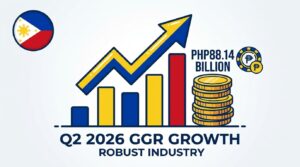
The Philippine gaming industry generated PHP88.14 billion in gross gaming revenue during the second quarter of 2026, reflecting continued momentum across both land-based and online segments. The Philippine Amusement and Gaming Corporation (PAGCOR), which regulates and licenses gaming operations in the country, reported the figures as part of its quarterly disclosure cycle. The result signals that the Philippines remains one of Southeast Asia’s fastest-growing regulated gaming markets, with revenue streams diversifying beyond traditional casino floors into digital and offshore channels.
What the Q2 2026 Numbers Tell Us About Philippine Gaming
Before diving into the specifics, it helps to frame what this quarter’s performance means in strategic terms. The PHP88.14 billion figure isn’t just a revenue milestone; it reflects structural shifts in how gaming revenue is being captured, taxed, and reinvested across the Philippine economy.
- Land-based casino operations continue to anchor overall GGR, with Entertainment City in Manila and Clark Freeport Zone properties driving a significant share of the total.
- Online gaming and Philippine Offshore Gaming Operators (POGOs), despite regulatory tightening, still contribute measurably to the revenue mix.
- PAGCOR’s own gaming operations and licensing fees remain a critical fiscal tool for the Philippine government, channelling billions into social development programs.
- The quarter-on-quarter trajectory suggests that tourism-linked gaming spend has recovered to or exceeded pre-pandemic baselines
- Regulatory clarity under PAGCOR’s evolving framework appears to be attracting, rather than deterring, licensed operators willing to invest in long-term infrastructure.
Revenue Composition: Where the Money Flows
Breaking down the PHP88.14 billion requires looking at the three primary revenue pillars that PAGCOR tracks. Casino operations within integrated resorts account for the largest share, buoyed by high-roller traffic from mainland China, South Korea, and Japan. Electronic gaming machines (EGMs) scattered across smaller venues and community-based operations form a second, steadier layer. And then there’s the digital segment, which has grown in complexity as the regulator has moved to license and monitor online platforms more aggressively.
What remains less clear is how much of the online segment’s growth reflects genuine market expansion versus a migration of previously unlicensed activity into the regulated fold. PAGCOR has been tightening oversight of offshore and online operators since 2023, and some of the revenue gains may simply be newly visible rather than newly created.
| Revenue Segment | Estimated Share of Q2 2026 GGR | Trend |
|---|---|---|
| Integrated Resort Casinos | Largest contributor | Steady growth, driven by VIP and mass-market segments |
| Electronic Gaming Machines | Moderate share | Stable, with geographic expansion into provincial areas |
| Online and Offshore Gaming | Growing share under tighter regulation | Increasing, though subject to ongoing policy shifts and enforcement actions against unlicensed operators |
PAGCOR’s Expanding Role as Regulator and Revenue Engine
PAGCOR occupies an unusual dual role in the Philippine gaming landscape (a distinction that has drawn both praise and criticism from governance advocates). It simultaneously operates its own casinos and regulates private-sector licensees. This structure means that PAGCOR’s quarterly results carry weight not just as industry data but as a fiscal indicator for the national government, which depends on PAGCOR remittances to fund infrastructure, health, and education programs.
In recent quarters, the agency has signalled a gradual shift toward a purely regulatory function, with plans to divest its operated properties. But progress on that front has been incremental. The PHP88.14 billion in Q2 GGR underscores why: the revenue is simply too significant for a clean, fast separation. PAGCOR’s licensing and regulatory framework continues to shape how both domestic and foreign operators structure their Philippine market entry.
How Tourism Recovery Feeds the Casino Floor
Philippine gaming revenue doesn’t exist in a vacuum. It tracks closely with inbound tourism figures, particularly from Northeast Asian markets. The Department of Tourism reported strong visitor arrivals in the first half of 2026, and casino operators in Entertainment City have noted higher average spend per visitor compared to 2024 levels. Still, the composition of that tourism has shifted. Mass-market players now represent a larger proportion of table game revenue than the VIP junket segment, which contracted sharply after regulatory crackdowns in Macau rippled across the region.
That shift matters because mass-market revenue tends to be more stable, less volatile, and less dependent on credit-driven play. For operators, it means lower margins per transaction but a more predictable revenue curve.
Regulatory Pressure and the POGO Question
No discussion of Philippine gaming revenue is complete without addressing the POGO sector. Once a booming, loosely regulated industry catering primarily to Chinese bettors, POGOs have faced successive waves of enforcement action. Some operators have been shut down. Others have rebranded or restructured under new licensing categories. The government’s stance has hardened considerably, with President Marcos Jr. ordering a ban on unlicensed offshore operators in 2024.
Yet the revenue data suggests that licensed online gaming operations, including those serving offshore markets under PAGCOR-issued permits, continue to generate meaningful GGR. The question is whether the regulatory framework can sustain this balance between enforcement and revenue capture without creating gaps that unlicensed operators exploit.
Frequently Asked Questions
What does GGR mean in the context of Philippine gaming?
Gross gaming revenue refers to the total amount wagered minus the winnings paid out to players. It is the standard metric used by PAGCOR and the broader industry to measure the financial performance of gaming operations across all segments.
How does PAGCOR use the revenue it generates?
PAGCOR remits a substantial portion of its income to the Philippine government. These funds support national programs in health, education, and infrastructure development, making gaming revenue a direct fiscal input for public services.
Are POGOs still operating in the Philippines?
Licensed offshore gaming operators continue to function under PAGCOR oversight, though the sector has contracted significantly following enforcement actions and a presidential directive targeting unlicensed entities. The regulatory landscape for offshore gaming remains in flux, with further policy changes expected.
Is the Philippine gaming market growing compared to regional peers?
Yes. The Philippines has positioned itself as a leading gaming destination in Southeast Asia, competing with markets like Singapore and emerging jurisdictions in Japan. Its combination of integrated resorts, a large domestic population, and proximity to high-spending Asian tourism markets gives it structural advantages that few regional competitors can match easily.



