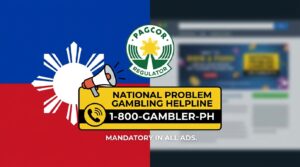
The Philippine Amusement and Gaming Corporation (PAGCOR) has directed all licensed gaming operators to incorporate messaging about the country’s newly launched National Problem Gambling Helpline into their advertising materials. The move signals a sharper regulatory posture on responsible gambling in a market that has grown rapidly over the past several years. It also places the Philippines among a growing number of Asian jurisdictions tightening consumer protection frameworks around gambling activity.
What PAGCOR’s Advertising Mandate Means for Licensed Operators
Before unpacking the broader implications, here are the core strategic takeaways from this regulatory development:
- Compliance burden widens: All licensed operators must now update advertising content across channels to include helpline references, adding a new layer to marketing approval workflows.
- Brand positioning shifts: Operators that move quickly to integrate responsible gambling messaging may gain reputational advantage with both regulators and increasingly aware consumers.
- The mandate effectively creates a baseline standard for gambling advertising in the Philippines, where no such uniform requirement previously existed at this level of specificity.
- Enforcement clarity remains pending: PAGCOR has not yet detailed penalties for non-compliance, leaving operators to interpret urgency on their own terms.
- Regional precedent: This aligns the Philippines with advertising standards already common in markets like Australia, the UK, and parts of Europe, potentially smoothing cross-border operator compliance for international firms.
A Helpline Built for Scale
The National Problem Gambling Helpline itself represents a relatively new piece of infrastructure. Its launch reflects PAGCOR’s acknowledgment that the expansion of both land-based and online gambling in the Philippines has outpaced the support systems available to consumers experiencing gambling-related harm. By requiring operators to advertise the helpline, PAGCOR is attempting to close that gap without waiting for legislative action.
Still, whether a helpline alone can absorb the demand is an open question. The Philippines has over 110 million people, a fast-growing digital economy, and an online gambling sector that has attracted significant international investment. Helpline capacity, staffing, and multilingual support (a non-trivial consideration in a country with over 170 languages) will all determine whether this initiative delivers outcomes or merely optics.
How This Fits Into PAGCOR’s Broader Regulatory Direction
PAGCOR has been recalibrating its role in recent years. Once primarily a revenue-generating body that both operated and regulated casinos, the agency has moved toward a more conventional regulatory posture. The advertising mandate fits within that trajectory. It signals that PAGCOR is willing to impose consumer-facing obligations on operators, not just licensing and tax requirements.
That shift matters because it changes the cost-benefit calculus for operators considering the Philippine market. Compliance is no longer limited to back-office reporting and fee structures. It now extends into public-facing communications, which are harder to standardize and easier for regulators to audit. Operators running campaigns across television, social media, and digital platforms will need to ensure helpline messaging appears consistently, a task that sounds simple but rarely is in practice.
And while PAGCOR’s evolving responsible gambling framework has drawn cautious praise from industry observers, not all market participants agree on the pace or direction of reform.
Advertising Standards Across Asian Gambling Markets: A Snapshot
| Jurisdiction | Helpline Advertising Requirement | Enforcement Mechanism |
|---|---|---|
| Philippines | Newly mandated across all operator advertising | Under development; penalties not yet specified |
| Macau | Required in casino premises; limited in advertising | Gaming Inspection and Coordination Bureau oversight |
| Singapore | Mandatory across all gambling advertising | National Council on Problem Gambling enforces compliance with fines |
| Japan | Emerging framework; IR implementation ongoing | Casino Management Committee expected to set standards once operations begin |
The Psychology Behind Helpline Visibility in Gambling Ads
From a behavioral standpoint, the decision to embed helpline information directly into advertising draws on well-established principles in cognitive framing. When a person encounters a gambling advertisement, the dominant frame is one of excitement, reward, and opportunity. Introducing a helpline number within that same frame creates what psychologists call a “pattern interrupt,” a moment where the viewer’s automatic processing is disrupted by unexpected information.
This technique has roots in Neuro-linguistic Programming concepts around anchoring and reframing. The helpline number, repeated across multiple touchpoints, gradually becomes an anchor associated with gambling activity itself. Over time, the association between gambling and the availability of help becomes automatic rather than effortful. Research from markets where similar mandates have been in place for years (notably Australia and the UK) suggests that awareness of helpline services increases measurably when advertising requirements are enforced consistently.
But awareness is only the first step. The deeper challenge lies in what NLP practitioners would describe as shifting the individual’s internal representation of gambling from a purely recreational activity to one that carries acknowledged risk. Repeated exposure to helpline messaging can subtly alter this internal map, making it more likely that a person experiencing early signs of problem gambling will seek help before reaching a crisis point. The framing effect here is not about discouraging gambling; it is about expanding the cognitive context in which gambling decisions are made. Whether PAGCOR’s mandate achieves this depends heavily on execution: the placement, frequency, and tone of helpline messaging will all influence its psychological impact.
Frequently Asked Questions
What is the National Problem Gambling Helpline in the Philippines?
It is a newly launched service designed to provide support and resources to individuals experiencing gambling-related harm. PAGCOR has directed all licensed operators to promote it in their advertising.
Which operators are affected by this mandate?
All PAGCOR-licensed gaming operators, spanning land-based casinos, online gambling platforms, and other authorized gaming entities operating within the Philippines.
Has PAGCOR specified penalties for non-compliance?
Not yet. The enforcement framework and specific penalties for operators that fail to include helpline messaging in their advertising have not been publicly detailed, which leaves a degree of ambiguity that operators will need to navigate carefully.
How does this compare to responsible gambling advertising rules in other countries?
Singapore and Australia already enforce similar requirements with established penalty structures. The Philippines is now moving in that direction, though its enforcement mechanisms are less mature at this stage.