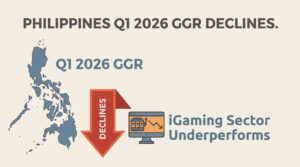
The Philippine Amusement and Gaming Corporation (PAGCOR) reported a decline in gross gaming revenue for the first quarter of 2026, driven primarily by sluggish output from the country’s igaming segments. While land-based casino operations held relatively steady, the digital side of the business dragged overall numbers downward, raising questions about the sustainability of the Philippines’ once-booming online gambling ecosystem. The downturn marks a notable shift for a jurisdiction that had positioned itself as Southeast Asia’s most aggressive igaming growth market.
What the Q1 Numbers Reveal About the Philippines’ Gaming Landscape
Before diving into the specifics, it’s worth framing the broader picture. The Philippines has spent the better part of a decade cultivating its gaming industry as a pillar of national revenue, with PAGCOR serving as both regulator and operator. That dual role has always invited scrutiny, but the revenue trajectory had, until recently, quieted most critics. This quarter’s results reopen some of those conversations.
- iGaming revenue contraction was the single largest contributor to the overall GGR dip, reflecting tighter regulatory enforcement and shifting operator economics
- Land-based casino operations in Entertainment City and Clark maintained more stable performance, though growth was flat rather than robust
- The offshore gaming segment (formerly known as POGOs) continues to shrink following years of crackdowns, deportations, and license cancellations
- PAGCOR’s revenue remittance to the national government faces potential downward pressure if Q2 follows a similar trajectory
- Regional competition from jurisdictions like Cambodia and emerging frameworks in Japan could be siphoning operator attention and capital
iGaming’s Drag on Total Revenue
The Philippines’ igaming sector, once a magnet for foreign operators seeking access to Asian player pools, has been contracting under a combination of regulatory tightening and geopolitical pressure. The government’s decisive move to wind down Philippine Offshore Gaming Operators (POGOs) beginning in 2024 removed a significant revenue stream. What replaced it, a restructured framework under the Internet Gaming Licensee (IGL) model, has not yet generated comparable volumes.
That gap is now visible in the numbers.
Fewer licensed operators, stricter anti-money laundering requirements, and enhanced due diligence protocols have collectively slowed the pace of igaming activity. And while these measures address legitimate concerns around illicit finance and social harm (a distinction regulators have been slow to enforce in prior years), they carry a near-term revenue cost that PAGCOR is absorbing in Q1 2026. Whether the IGL framework can scale quickly enough to offset POGO losses remains, arguably, the central question for the Philippine gaming sector this year.
Land-Based Casinos: Stable but Not Surging
Brick-and-mortar operations across the Philippines’ major gaming hubs offered a more reassuring, if unspectacular, picture. PAGCOR’s licensed integrated resort casinos in Manila’s Entertainment City continued to draw both domestic and international visitors, though VIP gaming volumes showed signs of softening. Mass-market table games and electronic gaming machines performed closer to expectations.
Still, flat performance in a quarter that typically benefits from seasonal tourism flows is not exactly a vote of confidence. Operators in the region have noted that high-roller traffic from mainland China, once the lifeblood of Asian VIP gaming, has not returned to pre-pandemic patterns. Beijing’s ongoing capital outflow restrictions and its broader crackdown on cross-border gambling continue to suppress what was historically the most lucrative player segment for Philippine casinos. The result: a market caught between two frameworks, one regulatory and one geopolitical, neither of which it fully controls.
How Regional Dynamics Are Reshaping Competitive Pressure
The Philippines does not operate in isolation. Japan’s integrated resort development in Osaka, expected to begin operations in the coming years, has already started redirecting investor attention. Cambodia, despite its own regulatory challenges, has attracted operators looking for lighter-touch jurisdictions. Even Vietnam’s pilot casino programs for domestic players have introduced a new variable into the regional calculus.
For the Philippines, the competitive moat has traditionally been scale and regulatory familiarity. But as neighboring markets mature their own frameworks, that advantage erodes incrementally. Operators weighing capital allocation across Asia are increasingly diversifying rather than concentrating exposure in a single jurisdiction. This is not a crisis for the Philippines, but it is a trend that compounds the effects of a soft quarter.
Key Metrics to Watch in Q2 2026
| Metric | Q1 2026 Trend | Q2 Outlook |
|---|---|---|
| Total GGR | Declined | Dependent on igaming recovery and tourism seasonality |
| iGaming / IGL Revenue | Below expectations | New license approvals could provide modest uplift |
| VIP Gaming Volume | Soft | Unlikely to recover without shifts in Chinese policy |
| Mass-Market Gaming | Stable | Steady, with potential upside from domestic tourism campaigns |
| PAGCOR Government Remittance | Under pressure | At risk if current trajectory holds through mid-year |
Regulatory Credibility Versus Revenue Ambition
There is a tension at the heart of the Philippines’ current gaming policy that this quarter’s results bring into sharper focus. The government has made a deliberate choice to prioritize regulatory credibility, shutting down POGOs, tightening AML enforcement, and raising compliance standards for igaming licensees. These are defensible, even commendable, policy decisions. But they come at a cost measured in pesos.
PAGCOR’s ability to maintain its revenue contributions to the national budget while simultaneously raising the compliance bar will test the agency’s operational dexterity. In practice, the path forward likely involves accelerating IGL license issuance to qualified operators, deepening partnerships with established international gaming companies, and leveraging the Philippines’ geographic and demographic advantages to attract a broader player base. None of that happens overnight. And the Q1 results suggest the transition period may be bumpier than initially projected.
Frequently Asked Questions
What caused the decline in Philippine GGR for Q1 2026?
The primary driver was underperformance in the igaming sector, compounded by the ongoing wind-down of POGO operations and the slower-than-expected ramp-up of the replacement IGL licensing framework. Land-based casinos held relatively steady but did not grow enough to offset digital losses.
Are POGOs still operating in the Philippines?
The Philippine government has been systematically closing POGO operations since 2024. A small number of restructured entities now operate under the IGL model, but the sector is a fraction of its former size.
How does this affect PAGCOR’s contributions to the government?
PAGCOR remits a significant portion of gaming revenue to the national treasury. A sustained decline in GGR would reduce these contributions, potentially affecting funding for government programs that rely on gaming revenue allocations. The agency has not yet revised its full-year projections.
Will the Philippines remain competitive in Asian gaming?
The Philippines retains structural advantages including established infrastructure, a large English-speaking workforce, and regulatory experience. But rising competition from Japan, Cambodia, and Vietnam means standing still is not an option.



