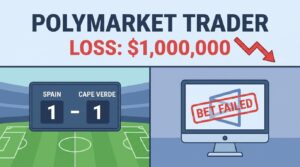
A cryptocurrency trader wagered $1 million on Spain to beat Cape Verde in their FIFA World Cup 2026 opener and lost everything. The match, played at Mercedes-Benz Stadium in Atlanta, ended 0-0, a result almost nobody predicted. The position, placed on decentralised prediction platform Polymarket, had been tracking toward a modest return of roughly $1,085,943 before the final whistle turned it to dust.
What a Single Draw Means for Prediction Markets and High-Stakes Crypto Betting
This wasn’t a speculative flutter on a longshot. It was a calculated, heavily concentrated bet on the reigning European champions dispatching a nation making its World Cup debut. The odds, at least on paper, overwhelmingly favoured Spain. That confidence, shared by the broader market, is precisely what made the outcome so devastating.
- A $1 million position was fully liquidated after Spain failed to beat Cape Verde in a Group H fixture that ended 0-0
- The bet was placed on Polymarket’s decentralised prediction platform, where outcomes are binary and positions settle instantly
- Spain dominated the match statistically, recording 27 shots to Cape Verde’s far fewer, yet could not convert
- The potential payout of approximately $1,085,943 reflected tight implied odds, meaning the trader accepted minimal upside for what seemed like a near-certainty
- The loss highlights concentration risk in prediction markets, where even overwhelming favourites carry non-trivial upset probability
How the Match Unfolded
Spain controlled possession throughout. Twenty-seven shots, sustained pressure, tactical superiority on nearly every metric that matters in football analytics. Cape Verde, a small island nation off West Africa’s coast competing in their first-ever World Cup match, absorbed wave after wave and held firm. The scoreboard read 0-0 at full time.
That single number tells the whole story for the trader.
In prediction markets, there is no partial credit. Binary outcome contracts settle one way or the other. A draw counts as “Spain did not win,” and the position collapses to zero. No hedge, no partial recovery, no extra time to hope for a late goal. The architecture of these markets is unforgiving by design, which is part of their appeal to sophisticated participants and part of their danger when conviction outpaces probability.
Why a Near-Certainty Still Carried Real Risk
The implied probability embedded in the payout structure tells us something important. A $1 million stake returning $1,085,943 implies the market priced Spain’s win probability at roughly 92%. That leaves an 8% chance of exactly what happened. Eight percent is not zero. It is, in fact, the kind of tail risk that professional traders in traditional finance spend entire careers learning to respect.
Yet prediction markets attract a different breed of participant. Crypto-native traders often operate with higher risk tolerance, drawn to the transparency and immediacy of blockchain-settled contracts. The absence of intermediaries, margin calls, or cooling-off periods means positions can be enormous relative to a participant’s portfolio. Whether this particular trader could absorb a seven-figure loss or whether it represented a catastrophic drawdown remains unknown (and Polymarket’s pseudonymous structure means it may stay that way).
Prediction Markets Under the Microscope
Polymarket has grown rapidly since its emergence as a leading decentralised prediction platform, attracting significant volume around political events, sports, and macroeconomic outcomes. The platform operates on the Polygon blockchain, allowing users to trade outcome shares in a manner structurally similar to options contracts but without the regulatory scaffolding that governs traditional derivatives exchanges.
This incident will likely amplify ongoing debates about risk controls, or the lack of them, on decentralised platforms. Traditional sportsbooks impose maximum bet limits, offer cash-out features, and in some jurisdictions face regulatory requirements around responsible gambling. Decentralised platforms, by contrast, generally impose no such guardrails. A user with sufficient capital can take a position of virtually any size.
Still, the counterargument is straightforward: these are permissionless markets serving adults who understand the terms. The contract was transparent. The risk was quantifiable. The trader chose to accept it.
Behavioural Patterns Behind Outsized Bets
From a behavioural standpoint, this episode illustrates several cognitive patterns that consistently appear in high-stakes decision-making. Anchoring bias likely played a role: Spain’s dominant form in recent tournaments, their squad depth, and their status as European champions all created a mental framework where defeat or even a draw seemed almost inconceivable. When the perceived probability of an outcome is very high, the human mind tends to round it up to certainty. That rounding error, small as it seems, is where fortunes disappear.
There is also the question of outcome framing. A return of roughly $85,000 on a $1 million stake looks modest in percentage terms. But the framing shifts when you consider the alternative: total loss. Experienced decision-makers in fields ranging from trading to military strategy use pre-mortem analysis, deliberately imagining the scenario where things go wrong before committing resources. The discipline of asking “what does this look like if I’m wrong?” is arguably the single most underused tool in speculative markets. In this case, “wrong” meant a clean $1 million gone in 90 minutes of football.
Confirmation bias compounds the problem. When every data point, from squad rankings to historical head-to-head records, supports a particular outcome, contradictory signals get filtered out. Cape Verde’s defensive resilience in qualifying, their tactical discipline under pressure, the unpredictability inherent in any tournament opener: these factors existed but were easy to dismiss when the narrative so strongly favoured Spain.
Frequently Asked Questions
How do prediction markets like Polymarket work?
Users buy shares representing outcomes of real-world events. If your chosen outcome occurs, shares pay out at $1 each. If it doesn’t, they’re worth nothing. Trades settle on-chain, typically on the Polygon network, and there’s no central authority managing the process.
Can you lose more than your initial stake on Polymarket?
No. Unlike leveraged derivatives, prediction market positions are fully collateralised. You can lose your entire stake, as this trader did, but not more than that.
Was this the largest single loss recorded on Polymarket?
Polymarket does not publish official loss records, and pseudonymous trading makes comprehensive tracking difficult. A $1 million wipeout on a single sporting event is, however, among the most notable publicly observed losses on the platform.
Are prediction markets regulated?
Regulatory status varies by jurisdiction. Polymarket reached a settlement with the U.S. Commodity Futures Trading Commission in 2022 and subsequently restricted access for U.S.-based users. The broader regulatory landscape for decentralised prediction platforms remains unsettled in most markets.
What Happens Next in Group H
Spain’s draw doesn’t eliminate them, but it complicates their path. Cape Verde, meanwhile, earned a result that will resonate far beyond the group stage standings. For the trader, the World Cup continues without their stake. For prediction markets, the episode serves as a very public, very expensive reminder: in binary outcomes, the gap between 92% and 100% is where the money burns.



