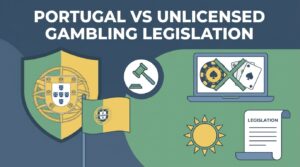
Portugal’s Minister of Economy, Manuel Castro Almeida, has confirmed that the coalition government will introduce a far-reaching legislative package this summer targeting unlicensed online gambling operations. At a high-level administrative assembly in Lisbon, the minister described the spread of black-market digital platforms as a “plague” siphoning revenue from the domestic economy and eroding state-backed player-protection frameworks. The forthcoming measures will expand regulatory oversight, tighten financial and administrative sanctions, and integrate active prevention mechanisms into Portugal’s digital infrastructure.
What Portugal’s Crackdown Means for the European iGaming Landscape
Castro Almeida’s language was unusually blunt for a ministerial address, and that tone matters. It signals not just policy intent but political will, which in European gambling regulation has often been the missing ingredient. Below are the strategic takeaways from this announcement:
- Revenue protection at the core: The government explicitly frames unlicensed operators as an economic drain, suggesting enforcement will be measured partly by recovered tax revenue and channelisation rates.
- Digital infrastructure integration: Embedding prevention tools directly into national digital systems goes beyond traditional blocklists, potentially involving ISP-level filtering, payment processor obligations, and DNS-based interventions.
- The legislative package arrives during a period when several EU member states are independently tightening their own iGaming frameworks, creating a patchwork of national enforcement that could eventually push Brussels toward harmonisation discussions.
- Sanctions escalation: Sharpened financial penalties indicate the government views existing deterrents as insufficient. Operators caught serving Portuguese consumers without a licence may face consequences that extend beyond fines into asset seizure territory.
- Player protection is being positioned as a public health matter, not merely a regulatory checkbox, which could influence how future advertising restrictions and responsible gambling mandates are drafted.
Why Now? The Scale of Portugal’s Black-Market Problem
Portugal legalised and regulated online gambling in 2015 through its Regime Jurídico dos Jogos e Apostas Online (RJO), administered by the Serviço de Regulação e Inspeção de Jogos (SRIJ). At the time, the framework was considered progressive. But the regulated market has struggled with channelisation ever since. Unlicensed platforms, many operating from jurisdictions with minimal oversight, have continued to attract Portuguese players through aggressive marketing, higher odds, and the absence of responsible gambling friction.
Castro Almeida’s characterisation of the problem as a “plague” reflects frustration that has been building across multiple administrations. Licensed operators have long argued that Portugal’s tax regime (a turnover-based model for sports betting, among the highest effective rates in Europe) pushes margins thin enough that competing with unregulated rivals becomes structurally difficult. Whether the summer legislation will also revisit tax calibration remains an open question the minister did not address.
Active Prevention: A Technical Shift in Enforcement Philosophy
The most technically significant element of the announcement is the concept of “active prevention” embedded in digital infrastructure. Traditional enforcement against unlicensed gambling relies on reactive measures: identifying rogue sites, issuing blocking orders, and pursuing legal action. That cycle is slow. Operators spin up mirror domains faster than regulators can shut them down.
What Portugal appears to be proposing is something closer to a real-time filtering architecture. This could involve mandatory cooperation from internet service providers, integration with banking and payment systems to block transactions to unlicensed platforms, and possibly algorithmic detection of gambling-related traffic patterns. Spain has experimented with similar approaches through its Dirección General de Ordenación del Juego (DGOJ), and Italy’s Agenzia delle Dogane e dei Monopoli maintains one of Europe’s most aggressive blocklists. Still, no EU member state has fully solved the whack-a-mole problem.
The effectiveness of Portugal’s approach will hinge on implementation speed and cross-border cooperation (a distinction regulators have been slow to enforce across the EU’s fragmented digital single market).
How Operators and Stakeholders Should Read This
For licensed operators in Portugal, the announcement is arguably welcome. Stronger enforcement against unlicensed competitors levels the playing field, at least on paper. But the details will matter enormously. If the legislation imposes new compliance burdens on licensed operators as part of the prevention framework, the net effect could be mixed.
Unlicensed operators targeting Portuguese consumers should treat this as an escalation notice. The political framing as a societal plague, combined with the promise of sharper sanctions, suggests enforcement actions will carry reputational and financial weight designed to deter, not just inconvenience.
Broader Implications for EU Gambling Policy
Portugal’s move does not exist in isolation. Across Europe, governments are recalibrating their relationship with digital gambling. The Netherlands imposed significant fines on unlicensed operators in 2023 and 2024. Germany’s interstate treaty continues to face implementation challenges. And the European Commission, while maintaining that gambling regulation remains a member-state competency, has signalled interest in consumer protection standards that could eventually touch cross-border enforcement.
Portugal’s summer package could become a reference point. If the active prevention model delivers measurable results in channelisation and tax recovery, expect other member states to study it closely.
Reframing the Narrative: From Regulation to Public Responsibility
One dimension worth examining is the psychological framing Castro Almeida employed. By labelling unlicensed gambling a “plague,” the minister shifted the discourse from a technical regulatory matter to a public responsibility issue. This kind of reframing has practical consequences. It builds broader political support for enforcement spending, makes it harder for opposition parties to argue against the measures, and positions the government as a protector rather than a restrictor. In behavioural terms, the framing anchors public perception around harm rather than liberty, which tends to accelerate legislative timelines and reduce resistance from stakeholders who might otherwise lobby for softer approaches.
The language also serves a signalling function to the European regulatory community. When a minister publicly escalates rhetoric to this degree, it creates expectations that the resulting legislation will be substantive. Anything perceived as watered-down would carry political cost. That dynamic, arguably, makes the eventual package more likely to include genuinely aggressive provisions rather than incremental adjustments.
For industry participants, understanding this framing is essential. The conversation in Lisbon is no longer about market access or competitive dynamics. It is about public health, economic sovereignty, and digital security. Operators who engage with Portuguese regulators on those terms will find a more receptive audience than those who lead with commercial arguments.
Frequently Asked Questions
When will Portugal’s new gambling legislation take effect?
The government has indicated the legislative package will be presented this summer. Exact implementation timelines have not been disclosed, and parliamentary review could extend the process into late 2025.
Does this affect licensed online gambling operators in Portugal?
Licensed operators are not the target. However, new compliance requirements tied to the active prevention framework could introduce additional obligations. The net impact depends on the legislation’s final text.
What penalties could unlicensed operators face?
Castro Almeida referenced sharpened financial and administrative sanctions, though specific penalty amounts or enforcement mechanisms have not yet been published. Existing Portuguese law already permits site blocking and financial penalties; the new package is expected to go further.
How does Portugal’s approach compare to other EU countries?
Several member states maintain active blocklists and payment-blocking regimes. Portugal’s proposed integration of prevention tools into national digital infrastructure, if implemented as described, would represent one of the more technically ambitious enforcement models in Europe.