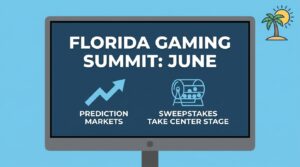
Prediction markets and sweepstakes have secured spots on the agenda for a gaming industry event scheduled for June 10–11 in Florida, signaling that these fast-growing verticals are commanding serious attention from operators, regulators, and legal professionals alike. The inclusion reflects a broader shift in how the U.S. gaming landscape is absorbing new product categories that sit outside traditional sports betting and casino frameworks. For an industry still working through the regulatory implications of event-based contracts and promotional sweepstakes models, the timing is pointed.
Why Florida’s Gaming Agenda Signals a Strategic Pivot
The decision to feature both prediction markets and sweepstakes at a major industry gathering is not incidental. These two categories have generated outsized regulatory debate over the past 18 months, and their formal inclusion in conference programming suggests the industry is moving past the question of whether these models belong in the gaming conversation and toward how they should be governed.
- Prediction markets, once confined to academic research and niche platforms, are now attracting mainstream capital and consumer interest following high-profile regulatory decisions at the federal level
- Sweepstakes models continue to operate in a legal gray zone across multiple U.S. states, drawing scrutiny from attorneys general and gaming commissions who view some operators as unlicensed gambling providers
- Florida’s positioning as the host state matters: the Seminole Tribe’s compact, the state’s complex gambling law history, and its large consumer base make it a bellwether for how emerging gaming products gain or lose traction
- Industry conferences increasingly serve as soft-launch venues for regulatory frameworks, where stakeholders pressure-test compliance strategies before formal rulemaking begins
The Prediction Market Question Regulators Haven’t Settled
Prediction markets allow participants to buy and sell contracts tied to the outcome of real-world events, from elections to economic indicators. The Commodity Futures Trading Commission (CFTC) has been the primary federal body grappling with oversight, but its jurisdiction remains contested. Kalshi, one of the most prominent platforms in the space, has pushed aggressively to list event contracts across categories that traditional futures exchanges have never touched.
And while the CFTC approved certain event contracts, it blocked others (notably political event markets, a distinction that drew legal challenges and public debate). State-level gaming regulators, meanwhile, have largely stayed on the sidelines. That gap between federal commodity law and state gambling statutes creates an environment where operators face fragmented compliance obligations depending on how their product is classified.
Whether prediction markets are financial instruments or gambling products is arguably the defining jurisdictional question for this segment. The answer determines which regulator has authority, what consumer protections apply, and how revenue is taxed.
Sweepstakes: Operating in Plain Sight, Regulated in Patches
Sweepstakes casinos occupy a different but equally contentious space. These platforms typically offer games resembling slot machines or table games, using virtual currency models that allow players to redeem winnings for cash prizes. The legal theory underpinning most sweepstakes operations rests on the argument that no purchase is necessary to participate, which, at least on paper, removes the “consideration” element required to classify an activity as gambling under most state laws.
Not everyone buys that argument. Several state regulators have moved to restrict or shut down sweepstakes operations, and class-action litigation has targeted some of the larger platforms. Still, the model has proven remarkably durable. Consumer adoption has surged, particularly in states where legal online casino gaming remains unavailable.
Key Regulatory Pressure Points
| Category | Primary Regulator | Core Legal Tension | Current Status |
|---|---|---|---|
| Prediction Markets | CFTC (federal) | Financial instrument vs. gambling product | Partial approvals; ongoing litigation over event categories |
| Sweepstakes Casinos | State AGs / Gaming Commissions | Virtual currency model vs. consideration requirement | Enforcement varies widely by state; no federal framework exists |
| Traditional Sports Betting | State Gaming Commissions | Licensing and market access | Live in 38+ states with established regulatory structures |
What the Florida Conference Tells Us About Industry Direction
Conference agendas are curated signals. When organizers allocate panel time and speaker slots to prediction markets and sweepstakes, they are responding to demand from attendees who need actionable intelligence on these verticals. The June event in Florida will likely draw compliance officers, in-house counsel, and C-suite executives who are either already operating in these spaces or evaluating entry.
The subtext is harder to miss than the headline: traditional gaming operators can no longer afford to treat these categories as peripheral curiosities. Capital is flowing in. Consumers are engaging. And the regulatory apparatus, fragmented as it is, will eventually consolidate around frameworks that either legitimize or restrict these models at scale.
Framing the Opportunity Through Strategic Awareness
For executives evaluating these markets, the challenge is less about product-market fit and more about regulatory timing. Entering a prediction market or sweepstakes vertical before clear rules exist carries risk, but waiting until frameworks are fully baked means competing against entrenched first movers. This tension between early-mover advantage and compliance exposure defines the strategic calculus for most operators right now.
Understanding the regulatory landscape requires more than legal analysis. It demands pattern recognition across state legislatures, federal agencies, and judicial rulings that collectively shape the operating environment. Executives who develop fluency in how these signals interact will be better positioned to act decisively when windows open. Those who rely solely on reactive compliance will find themselves perpetually one cycle behind.
The most effective leaders in this space tend to reframe uncertainty not as a barrier but as an information advantage. When regulation is unsettled, the organizations that invest in scenario planning, stakeholder mapping, and proactive engagement with regulators gain leverage that compounds over time. Florida’s June summit offers one such engagement point, but the real work happens in the months that follow.
Frequently Asked Questions
What are prediction markets?
Prediction markets are platforms where participants trade contracts based on the outcome of future events. Prices reflect the collective probability assessment of the crowd, and contracts settle at a fixed value depending on whether the event occurs. They have roots in academic research but have expanded rapidly into consumer-facing products.
Are sweepstakes casinos legal?
It depends on the state. Most sweepstakes platforms argue their model is lawful because no purchase is required to play, removing the legal element of “consideration.” Some states disagree, and enforcement actions have been taken against specific operators. There is no unified federal standard governing these platforms.
Why is Florida significant for gaming industry events?
Florida has one of the most complex gambling regulatory environments in the country, shaped by the Seminole Compact, voter-approved amendments, and ongoing litigation. Its large population and tourism economy make it a critical market, and events held there naturally attract stakeholders with direct exposure to these dynamics.



