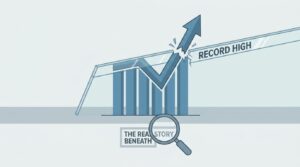
A major corporate quarter has closed with record-breaking results, marking a milestone that executives and analysts alike will scrutinize in the weeks ahead. While the headline figures point to unprecedented performance across key metrics, the underlying drivers reveal a more textured picture of strategic positioning, market timing, and operational discipline. The results arrive at a moment when macroeconomic uncertainty has made consistent outperformance increasingly difficult to sustain.
What the Record-Setting Quarter Signals for Stakeholders
Record quarters rarely emerge from a single catalyst. They tend to reflect the convergence of multiple tailwinds, some structural and some cyclical, that align within a compressed timeframe. For investors and industry observers parsing these results, the strategic takeaways matter more than the topline figures themselves.
- Revenue momentum exceeded prior peaks, suggesting that demand-side fundamentals remain robust despite broader market headwinds
- Operational efficiency gains contributed meaningfully to margin expansion, not just top-line growth
- The quarter’s performance sets a higher baseline against which future results will be measured, raising the bar for sustained execution
- Market share dynamics may have shifted in the company’s favor during a period when competitors pulled back on investment
- Whether this trajectory holds through the next reporting cycle is arguably the most consequential question facing leadership
Breaking Down the Performance Drivers
Not every record quarter tells the same story. Some are built on pricing power. Others ride volume surges. And a few, the rarest kind, combine both with disciplined cost management to produce results that genuinely redefine a company’s earnings profile.
In this case, the company appears to have benefited from a combination of factors that amplified each other. Demand remained strong across core segments, while cost structures that had been optimized in prior periods allowed incremental revenue to flow through to the bottom line at an accelerated rate. That kind of operating leverage is difficult to engineer deliberately (a distinction that separates genuine operational improvement from one-time windfalls).
Still, context matters. A record quarter measured against a weak prior-year comparable carries different weight than one that surpasses an already elevated benchmark. The quality of the record, not just its existence, determines how the market should price it in.
How Market Conditions Shaped the Outcome
Timing played a role. The broader economic environment during the quarter created conditions that, at least on paper, should have constrained growth rather than enabled it. Interest rates remained elevated. Consumer and enterprise spending patterns showed signs of selectivity. Yet the company managed to capture demand that competitors either couldn’t reach or chose not to pursue.
This raises a harder question: was the outperformance a function of superior strategy, or did temporary market dislocations create an opening that won’t repeat? The answer likely sits somewhere between the two. Companies that consistently outperform during uncertain periods tend to share a common trait: they invest countercyclically, building capacity and capability when others retrench. Whether that pattern applies here will become clearer in subsequent quarters.
Strategic Implications Beyond the Headline
Record-setting results carry obligations. They reshape analyst expectations, influence capital allocation decisions, and alter the competitive calculus for peers operating in adjacent spaces. For the company’s leadership team, the challenge now shifts from delivering exceptional results to sustaining them, or at minimum, managing the narrative around normalization if growth moderates.
Three dimensions deserve particular attention going forward:
| Dimension | Current Signal | Forward Risk |
|---|---|---|
| Revenue Growth | Record highs across segments | Tough comparables in upcoming quarters could compress reported growth rates even if underlying demand holds steady |
| Margin Profile | Expanded on operating leverage | Input cost volatility or wage inflation could erode gains |
| Market Position | Apparent share gains | Competitors may respond with aggressive pricing or accelerated product cycles |
Reading Between the Lines: What Behavioral Patterns Reveal
Beyond the financial metrics, there are behavioral and perceptual dimensions worth examining. In the framework of neuro-linguistic programming, the language companies use when reporting results often reveals as much as the numbers themselves. When leadership describes a quarter as “record-setting,” the framing anchors stakeholder expectations at a new high watermark. That anchoring effect is powerful and deliberate.
Consider how the narrative around these results will propagate. Analysts will recalibrate models. Media coverage will emphasize the superlative. And employees within the organization will internalize a new standard of what “normal” performance looks like. Each of these feedback loops reinforces a set of beliefs about the company’s trajectory that, once established, become self-reinforcing in the short term but potentially fragile if reality diverges.
The representational systems through which different stakeholders process this information vary considerably. Investors focus on quantitative patterns and forward multiples. Employees respond to the emotional resonance of being part of a winning organization. Customers may interpret strength as a signal of reliability or, conversely, as a precursor to price increases. Effective corporate communication during periods of peak performance requires calibrating the message to each of these audiences simultaneously, a task that demands precision in both what is said and what is deliberately left unsaid.
Even the sequencing of disclosures matters. Leading with record revenue before discussing margin or cash flow creates a different perceptual hierarchy than the reverse. The meta-model of communication suggests that deletions, distortions, and generalizations in corporate messaging shape stakeholder behavior as much as the data itself. Savvy observers will note not just what was highlighted, but what was conspicuously absent from the narrative.
Frequently Asked Questions
What does a record quarter mean for future performance?
It establishes a higher baseline against which subsequent results will be compared. Strong quarters can signal durable competitive advantages, but they also create tougher year-over-year comparisons that may make future growth rates appear more modest even if absolute performance remains solid.
Should investors treat record results as a buy signal?
Not automatically. The market often prices in strong results before they’re officially reported. What matters more is whether the drivers behind the record are repeatable or one-time in nature.
How do competitors typically respond to a rival’s record quarter?
Responses vary widely. Some accelerate investment to close perceived gaps. Others double down on differentiation strategies. And in certain cases, competitors simply wait, betting that the record-setter’s elevated expectations will eventually become a vulnerability. The competitive response often depends on whether the outperformance is attributed to execution or to market conditions that benefited the entire sector.



