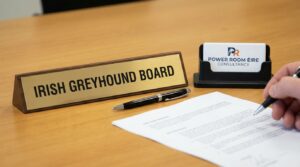
Sharon Power, a well-known figure in Ireland’s betting and gaming sector, has been appointed to the board of Rásaíocht Con Éireann (RCÉ), the Irish Greyhound Board. Power will retain her position at Power Room Éire, her betting and gaming consultancy, alongside the new board role. The appointment signals a continued push by Irish authorities to bring industry-specific expertise into the governance of state-sponsored racing and gaming bodies.
What Power’s Board Appointment Means for Irish Greyhound Racing
The decision to bring a specialist from the commercial betting and gaming world onto the RCÉ board carries several strategic implications. At a time when greyhound racing in Ireland faces both reputational scrutiny and financial pressure, appointments like this suggest a deliberate pivot toward professionalising governance structures. Here are the key takeaways:
- Power’s dual role bridges commercial betting consultancy and semi-state governance, a combination that could accelerate modernisation of RCÉ’s approach to wagering partnerships and digital engagement
- The appointment reflects a broader trend across European racing jurisdictions: recruiting board members with direct operator-side or regulatory experience rather than relying solely on traditional sporting backgrounds
- Retaining her consultancy role means Power brings live market intelligence to the boardroom, though it also raises questions about potential conflicts of interest that the board will need to manage transparently
- For the Irish betting industry, having a familiar voice at the governance table of a major racing body could smooth future negotiations around media rights, data fees, and integrity frameworks
Who Is Sharon Power?
Sharon Power operates Power Room Éire, a consultancy focused on betting and gaming strategy across the Irish market. Her work spans regulatory advisory, operator engagement, and industry advocacy. She has built a reputation as a connector between the commercial realities of licensed betting and the policy frameworks that govern them.
That profile matters here. RCÉ has historically drawn its board members from agricultural, sporting, and political circles. Bringing in someone whose daily work involves understanding odds compilation, customer acquisition costs, and compliance architecture represents a shift in how the organisation views its own future.
The Greyhound Industry’s Governance Challenge
Irish greyhound racing has not had an easy decade. A 2019 RTÉ Investigates documentary exposed welfare failings that triggered public outrage and political pressure. Since then, RCÉ has invested in welfare reforms, traceability systems, and rebranding efforts. But the financial model remains under strain.
Betting turnover on greyhound racing, while still substantial, faces competition from an expanding menu of online wagering products. The sport’s ability to negotiate favourable terms with bookmakers (a distinction regulators have been slow to enforce in the broader racing context) depends partly on the commercial sophistication of its leadership. And that is precisely where Power’s appointment fits.
Still, governance reform in semi-state bodies rarely moves at the pace outsiders expect. Whether one new board member can meaningfully shift strategic direction depends on internal dynamics that no press release captures.
How Does This Compare to Other Racing Jurisdictions?
Across the UK and France, racing governance bodies have increasingly sought directors with betting industry credentials. The British Horseracing Authority, for instance, has drawn board members from major operator groups and technology firms. Ireland’s greyhound sector, smaller and more politically sensitive, has been slower to follow that template.
| Jurisdiction | Racing Body | Betting Industry Representation on Board |
|---|---|---|
| Ireland (Greyhounds) | RCÉ | Now includes Sharon Power (betting/gaming consultancy) |
| UK (Horseracing) | BHA | Multiple members with operator or tech backgrounds |
| France (Horseracing) | France Galop | PMU integration provides built-in commercial perspective |
| Ireland (Horseracing) | HRI | Some commercial representation, primarily from breeding and ownership sectors |
Navigating Dual Roles: Opportunity and Scrutiny
Power’s decision to maintain her consultancy while serving on the board is not unusual in Irish public life, but it does invite a particular kind of attention. Board members of semi-state bodies are expected to declare interests and recuse themselves from relevant decisions. In practice, the line between general expertise and specific commercial interest can blur.
The question is not whether Power has the credentials. She does. The question is whether RCÉ’s governance framework is robust enough to manage the inherent tension of having an active industry consultant shaping policy that affects her own market.
Broader Implications for Ireland’s Betting Landscape
Ireland’s gambling regulatory environment is itself in transition. The long-awaited Gambling Regulation Bill, which proposes establishing a dedicated gambling regulator, remains a work in progress. Against that backdrop, appointments like Power’s take on added significance. They represent informal bridges between an industry that has operated with considerable autonomy and a state apparatus that is slowly tightening its grip.
For operators, the signal is cautiously positive. Having someone who understands both the commercial pressures of running a betting business and the political realities of semi-state governance could lead to more pragmatic policymaking around greyhound racing’s commercial partnerships. Yet pragmatism and regulatory independence don’t always pull in the same direction.
Frequently Asked Questions
What is RCÉ?
Rásaíocht Con Éireann, or RCÉ, is the statutory body responsible for governing and developing the greyhound racing industry in Ireland. It oversees everything from race scheduling and stadium management to welfare standards and integrity controls.
Will Sharon Power leave her consultancy?
No. Power has confirmed she will continue operating Power Room Éire alongside her new board responsibilities.
Why does this appointment matter for the betting industry?
It places someone with direct commercial betting experience inside the governance structure of a major racing body, potentially influencing how greyhound racing engages with bookmakers on data rights, media distribution, and wagering product development. That kind of influence, even at board level, tends to compound over time.
Are there conflict of interest safeguards?
Semi-state board members in Ireland are subject to ethics legislation requiring disclosure of interests. How rigorously those safeguards are applied varies by organisation, and RCÉ has not publicly detailed its specific protocols for managing Power’s dual role.



