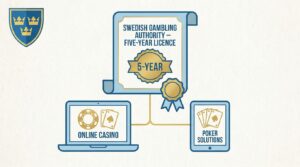
The Swedish Gambling Authority (Spelinspektionen) has awarded a five-year licence to a gaming supplier, covering its online casino and poker solutions for the regulated Swedish market. The approval signals continued regulatory confidence in the country’s licensing framework and opens a fresh runway for the supplier to expand its footprint across one of Europe’s most tightly governed gambling jurisdictions. While the specific supplier name was not disclosed in the reference material, the licence scope — spanning both casino and poker verticals — suggests a platform-level operator rather than a niche content provider.
What This Licence Approval Means for the Swedish Market
Sweden’s gambling regulatory environment has undergone significant transformation since the country re-regulated its market in January 2019. The framework replaced a state monopoly model with a licensing regime designed to channel consumer demand toward regulated operators and suppliers. Spelinspektionen, the authority responsible for issuing and enforcing these licences, has maintained a reputation for rigorous vetting — and for pulling licences when compliance falls short (a distinction that separates it from several other European regulators).
A five-year licence duration is notable. It represents the maximum term available under Swedish gambling law, and its issuance typically reflects the regulator’s assessment that the applicant meets stringent requirements around responsible gambling, anti-money laundering controls, and technical integrity. Here are the strategic takeaways from this development:
- Market access secured for a full cycle: A five-year window gives the supplier commercial stability and the ability to negotiate long-term partnerships with Swedish-licensed operators.
- Dual-vertical coverage matters: Licensing for both online casino and poker under a single approval reduces regulatory friction and positions the supplier as a one-stop platform partner.
- Swedish licences carry reputational weight across the EU — holding one often accelerates approval processes in other regulated markets.
- Compliance bar remains high: Spelinspektionen’s enforcement record means ongoing obligations around player protection, data handling, and AML will be closely monitored throughout the licence term.
Sweden’s Regulatory Posture: Tighter Than Most
The Swedish model is arguably one of the more demanding in Europe. Operators and suppliers must demonstrate not only technical capability but also a proactive approach to responsible gambling. Spelinspektionen has issued fines and sanctions against several high-profile operators in recent years for breaches related to bonus restrictions, self-exclusion system failures, and inadequate due diligence on customer funds. The regulator’s willingness to act has shaped a market where compliance is not aspirational — it is operational.
That rigour has consequences. Some smaller suppliers have avoided the Swedish market entirely, viewing the cost of compliance as disproportionate to the revenue opportunity. Yet for those who secure and maintain a licence, the competitive field is narrower and the commercial relationships tend to be stickier.
How Dual-Vertical Licensing Reshapes Supplier Strategy
Covering both online casino and poker under one licence is not merely administrative convenience. It reflects a broader industry shift toward integrated platform delivery. Operators increasingly prefer suppliers who can consolidate their technology stack rather than managing separate vendor relationships for each product vertical.
Poker, in particular, occupies an interesting position in the Swedish market. While slots and live casino dominate revenue share, poker retains a loyal player base and offers operators a differentiation lever in a crowded landscape. A supplier licensed to deliver both verticals can pitch a more compelling proposition to operators seeking breadth without multiplying their compliance overhead.
Still, the real test comes after the licence is granted. Spelinspektionen’s online casino and poker regulatory framework demands continuous reporting, and the authority has shown little hesitation in conducting audits mid-cycle.
The Broader European Context
Sweden does not exist in a regulatory vacuum. Across Europe, jurisdictions are converging on stricter supplier licensing requirements. The Netherlands, Germany, and Italy have all tightened their frameworks in the past three years, and suppliers with a Swedish licence often find that their compliance infrastructure translates well to these parallel regimes.
What remains less clear is whether Spelinspektionen will adjust its approach as the European market matures. There have been industry discussions — though no formal proposals — around harmonising certain technical standards across Nordic regulators. If that materialises, suppliers already licensed in Sweden would hold a structural advantage.
| Aspect | Detail |
|---|---|
| Licence Duration | Five years (maximum under Swedish law) |
| Scope | Online casino and poker solutions |
| Regulator | Spelinspektionen (Swedish Gambling Authority) |
| Market Re-regulation Date | January 2019 |
| Key Compliance Areas | Responsible gambling, AML, technical integrity, data protection |
Strategic Implications for Operators and Competitors
For operators already active in Sweden, a newly licensed supplier expands the pool of compliant technology partners. That matters in a market where switching costs are high and regulatory risk is shared between operator and supplier. Any operator integrating an unlicensed supplier’s technology in Sweden faces direct regulatory exposure — a risk most boards are unwilling to carry.
Competitors, meanwhile, face a narrowing window. The Swedish market is not unlimited in size, and operator partnerships tend to consolidate around a handful of trusted suppliers. Each new entrant with a valid licence intensifies the competition for integration deals, particularly in the poker vertical where fewer suppliers operate.
And while the commercial opportunity is real, the margin pressure in regulated markets is persistent. Compliance costs, taxation (Sweden levies an 18% tax on gross gaming revenue), and responsible gambling obligations all compress supplier margins compared to less regulated environments.
Frequently Asked Questions
What does a Swedish gambling supplier licence cover?
It authorises a company to provide gambling software and solutions to operators licensed in Sweden. The scope varies — in this case, it covers both online casino and poker products, which is broader than many single-vertical approvals.
How long does the licensing process typically take?
Spelinspektionen does not publish fixed timelines, but industry participants have reported processes ranging from several months to over a year, depending on the complexity of the application and the regulator’s current workload.
Why is a five-year term significant?
It is the maximum duration available. Shorter terms are sometimes issued where the regulator wants to reassess sooner. A full five-year grant suggests strong confidence in the applicant’s compliance posture.
Can the licence be revoked before it expires?
Yes. Spelinspektionen retains the authority to suspend or revoke licences at any point if compliance failures are identified. The regulator has exercised this power against operators in the past, and suppliers are held to equivalent standards.



