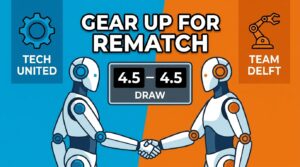
The inaugural RoboCup tournament between Tech United Eindhoven and Team Delft ended in a deadlocked 4.5–4.5 draw, setting the stage for what promises to be a fiercely competitive rematch at the 2023 edition. Both squads, rooted in the Netherlands’ leading technical universities, have spent months refining their autonomous systems and strategic algorithms. The result was more than a tie on paper; it signalled a shift in how competitive robotics balances offensive capability with defensive resilience.
What the Draw Revealed About Competitive Robotics
A perfectly split scoreline in any competition raises questions. In robotics, where outcomes hinge on sensor calibration, real-time decision-making, and mechanical reliability under pressure, a draw carries particular weight. The 4.5–4.5 result suggested that neither team held a decisive technological edge, a rarity in a field where marginal hardware or software advantages tend to compound quickly across match segments.
That parity matters because it forces both teams back to fundamentals. Rather than iterating on a winning formula, each squad faces the harder challenge of identifying which incremental improvements will break the equilibrium. And while both programs draw from deep engineering talent pools at Eindhoven University of Technology and TU Delft, their design philosophies diverge in ways that shaped the first contest and will likely define the second.
Strategic Takeaways from the Inaugural Matchup
Beyond the scoreline, several dynamics from the first tournament carry implications for how autonomous robotics competitions are evolving globally. Here are the key strategic signals worth tracking:
- Defensive algorithms matched offensive innovation: Neither team could sustain scoring runs, indicating that reactive AI systems have caught up with proactive ones in structured competition environments.
- Mechanical reliability proved decisive in tight moments: Several half-point outcomes hinged not on strategy but on hardware consistency during extended play sequences.
- The draw itself boosted visibility for Dutch robotics programs, attracting sponsorship interest that had previously concentrated on Asian and North American teams.
- Talent pipeline effects: Both universities reported increased enrollment inquiries in robotics-adjacent programs following the tournament’s media coverage.
- Rule interpretations around autonomous decision boundaries were tested in at least two disputed segments, prompting organizers to review adjudication protocols ahead of 2023.
How Both Teams Are Preparing Differently
Tech United has historically leaned into robust, modular hardware platforms that prioritize durability over agility. Their robots tend to be heavier, more stable, and built for sustained performance across long match windows. Team Delft, by contrast, has favoured lighter frames with more sophisticated sensor arrays (a distinction that becomes critical when reaction speed determines half-point outcomes).
For the rematch, early indications suggest Tech United is investing in improved computer vision systems, aiming to close the perception gap without sacrificing their structural advantages. Team Delft appears focused on refining multi-agent coordination, the ability of their robots to operate as a cohesive unit rather than as individual performers executing parallel tasks.
Which approach yields the edge remains genuinely uncertain.
The Broader Landscape: Why Dutch Robotics Punches Above Its Weight
The Netherlands accounts for a disproportionate share of top-tier RoboCup competition entrants relative to its population and research funding levels. Part of this stems from tight integration between university labs and industry partners in the Eindhoven–Delft–Rotterdam corridor. Part of it reflects a cultural willingness to treat robotics competitions not as academic exercises but as genuine R&D proving grounds.
Corporate sponsors have taken notice. Several Dutch automation firms reportedly increased their support for both teams following the draw, viewing the rematch as a marketing opportunity and a live testing environment for proprietary components. Still, neither team has disclosed specific sponsorship figures for the 2023 cycle, leaving the financial dimension of this rivalry somewhat opaque.
Reframing Competition Through a Performance Mindset
What separates elite robotics teams from competent ones often mirrors patterns seen in high-performance human athletics. The mental frameworks that engineers bring to competition design, specifically how they handle ambiguity, setbacks, and the pressure of parity, arguably shape outcomes as much as technical specifications do.
Teams that anchor their preparation in outcome-focused visualization tend to build systems optimized for narrow victory conditions. Those that adopt a process-oriented mindset, concentrating on system reliability and adaptability rather than specific score targets, often perform better under the unpredictable conditions of live competition. The 4.5–4.5 draw is instructive here: both teams executed well enough to avoid losing, but neither structured their approach around the kind of adaptive risk-taking that breaks deadlocks.
Cognitive flexibility in engineering teams, the ability to pivot strategy mid-competition when sensor data contradicts pre-match assumptions, correlates strongly with tournament success across multiple RoboCup seasons. Teams that rehearse failure scenarios and build decision trees for degraded-performance situations tend to recover faster from in-match disruptions. This psychological resilience, embedded into both the human operators and the autonomous decision layers of the robots themselves, may prove to be the differentiator in 2023.
Goal-setting research in performance psychology suggests that teams benefit from what practitioners call “process goals” layered beneath outcome targets. For a robotics squad, this might mean defining success not as winning a match segment but as achieving a specific sensor-fusion accuracy rate under competitive conditions. Tech United and Team Delft both have the technical talent to win. The question is which team has built the mental architecture to handle the pressure of a rivalry that now carries genuine stakes.
Frequently Asked Questions
What was the final score of the inaugural tournament?
The first meeting between Tech United and Team Delft ended in a 4.5–4.5 draw, with neither team able to establish a decisive advantage across the full competition.
When is the rematch scheduled?
The two teams are set to face each other again at the 2023 tournament. Specific dates and venue details are determined by the organizing body’s competition calendar.
Why does this rivalry matter beyond robotics?
It serves as a live benchmark for autonomous systems development, attracts corporate R&D investment, and drives student enrollment in engineering programs at both universities. The competitive pressure accelerates innovation in ways that lab-only research rarely matches.