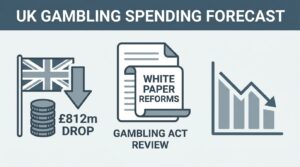
Consumer spending on gambling across the United Kingdom faces a projected decline of £812 million if proposals outlined in the government’s white paper, High Stakes: Gambling Reform for the Digital Age, are fully implemented. The figure, drawn from regulatory impact assessments tied to the reform package, signals a significant contraction in industry revenue and a deliberate policy shift toward reducing gambling-related harm. For operators, investors, and regulators alike, the number carries weight far beyond its headline value.
What the £812m Decline Actually Means for the Industry
Before unpacking the strategic implications, it helps to frame the scale. An £812m reduction in consumer spending doesn’t simply translate to lost profits for operators. It ripples through tax receipts, employment levels, sponsorship deals, and the broader leisure economy. Here are the key takeaways:
- Revenue compression across verticals: Online slots, casino products, and betting terminals are expected to absorb the largest share of the spending decline, reflecting the white paper’s focus on high-stake, high-frequency products.
- Affordability checks will reshape player behaviour: Proposed financial risk checks are designed to intervene before significant losses accumulate, which in practice means operators lose access to a segment of high-spending customers.
- The reduction may not be evenly distributed. Smaller operators with thinner margins could face disproportionate pressure compared to diversified, multinational firms.
- Tax revenue implications for HM Treasury: Lower consumer spending directly reduces the yield from gambling duties, creating a fiscal trade-off that policymakers have so far been reluctant to quantify publicly.
- Advertising and sponsorship budgets will tighten: With less revenue flowing in, marketing spend across football, horse racing, and digital channels is likely to contract, affecting media and sports organisations that depend on gambling partnerships.
Inside the White Paper’s Core Proposals
Published by the Department for Culture, Media and Sport, the white paper represents the most comprehensive overhaul of UK gambling regulation since the Gambling Act 2005. Its proposals span online protections, land-based reforms, and a restructured role for the Gambling Commission as the sector’s primary regulator. Among the most consequential measures are mandatory affordability checks for online gamblers, a statutory levy on operators to fund research, prevention, and treatment, and new stake limits for online slot games set at £5 per spin for those aged 25 and over (£2 for under-25s).
Each of these interventions targets a specific mechanism through which consumer spending accumulates. Stake limits cap the velocity of loss. Affordability checks cap its depth. And the statutory levy redirects a portion of remaining revenue away from operators entirely.
That combination is what produces the £812m figure. Not one policy alone, but the compounding effect of several.
How Operators Are Recalibrating
Major UK-licensed operators have already begun adjusting their strategies. Some have accelerated international expansion to offset anticipated domestic revenue losses. Others are investing in safer gambling tools, partly out of compliance necessity and partly to position themselves favourably with regulators ahead of licensing reviews.
Still, the transition is uneven. Entain, Flutter Entertainment, and bet365 have the scale and geographic diversification to absorb a domestic contraction. Smaller, UK-focused firms face a harder path. Several mid-tier operators have flagged concerns about the cumulative regulatory burden in earnings calls and investor briefings throughout 2023 and 2024.
One question lingers beneath the surface: whether reduced legal spending simply disappears, or whether a portion migrates to unlicensed, offshore platforms beyond the Gambling Commission’s reach (a distinction regulators have been slow to enforce with measurable results).
The Behavioural Dimension: Why Framing Matters
Beyond the financial mechanics, the white paper’s impact depends heavily on how consumers perceive and respond to the new rules. This is where behavioural science and neuro-linguistic programming principles intersect with policy design. Regulatory interventions don’t operate in a vacuum. They interact with deeply embedded cognitive patterns around risk, reward, and loss aversion.
When affordability checks interrupt a gambling session, the framing of that interruption matters enormously. A message that reads “you have reached your spending limit” triggers a different psychological response than one stating “protecting your finances.” The first anchors the player in restriction. The second reframes the intervention as protective, activating a different emotional register. Operators designing compliance systems face a genuine tension here: how to satisfy regulatory requirements without alienating customers, and how to use language that encourages reflection rather than frustration.
Research in behavioural economics suggests that people respond more strongly to perceived losses than equivalent gains. If stake limits and spending checks are framed as losses of freedom, resistance increases. But if they are positioned as tools for maintaining control, acceptance rises. The language used in pop-up warnings, account notifications, and even marketing communications will shape whether the £812m reduction lands as a smooth transition or a disruptive shock to consumer habits.
Arguably, the operators who invest most thoughtfully in behavioural design will retain more of their customer base through the transition. Those who treat compliance as a checkbox exercise risk accelerating player attrition, either to competitors with better user experiences or to the unregulated market altogether.
Frequently Asked Questions
Where does the £812m figure come from?
It derives from impact assessments associated with the government’s white paper proposals, modelling the combined effect of stake limits, affordability checks, and other consumer protection measures on total gambling expenditure in the UK.
Will all gambling sectors be affected equally?
No. Online products, particularly slots and casino games, are expected to bear the brunt. Land-based betting shops and lottery products face comparatively lighter impacts, though they are not immune. The distribution depends on which specific measures proceed to implementation and on what timeline.
Does reduced spending mean reduced harm?
That is the policy intention, but the relationship between aggregate spending and individual harm is not perfectly linear. Some of the spending reduction will come from recreational gamblers who pose low risk, while the effectiveness of interventions targeting problem gamblers depends on implementation quality and enforcement rigour.
When will these changes take effect?
Several measures are already being phased in through Gambling Commission consultations and licence condition updates. Full implementation of the white paper’s proposals is expected to unfold over multiple years, with some elements still subject to parliamentary and regulatory processes.
A Market Between Two Frameworks
The £812m projection sits at the intersection of public health ambition and commercial reality. For the government, it represents the cost of correcting a regulatory framework that, at least on paper, had failed to keep pace with digital gambling’s expansion. For operators, it quantifies the revenue they must either replace or learn to live without.
What neither side has fully addressed is the enforcement gap. Reducing licensed spending only achieves its public health objectives if consumers don’t simply redirect that spending elsewhere. And the UK’s capacity to police unlicensed operators remains, by most accounts, under-resourced relative to the scale of the challenge.



