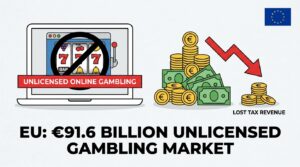
Unlicensed online gambling operations targeting consumers across the European Union surged to €91.6 billion in 2025, according to new data presented by the European Casino Association (ECA). The figure marks a roughly 14% year-on-year jump, a pace that has caught the attention of regulators and lawmakers alike. Presented during a roundtable at the European Parliament hosted by MEP Lukas Mandl, the findings suggest that unauthorised channels now command a dominant share of the EU-27 online gambling market. And the fiscal consequences are staggering: an estimated €22.9 billion in direct tax revenue that member states simply never collected.
What the €91.6 Billion Figure Actually Tells Us
Before unpacking the strategic implications, it’s worth grounding the number. A few core takeaways from the ECA’s presentation stand out for anyone tracking the intersection of digital regulation and gambling policy across Europe:
- Scale of the unauthorised market: At €91.6 billion, unlicensed operators are no longer a fringe problem. They arguably represent the market’s centre of gravity in several EU jurisdictions.
- Tax revenue gap: The €22.9 billion in foregone fiscal receipts dwarfs the enforcement budgets of most national gambling regulators combined.
- Year-on-year growth of 14% outpaces the licensed sector’s expansion in nearly every measurable dimension.
- Parliamentary engagement: The fact that this data was presented inside the European Parliament, not at an industry trade show, signals a shift in how seriously EU institutions are treating the issue.
- Consumer protection frameworks designed for licensed operators have no reach over these unauthorised platforms, leaving millions of EU residents exposed to unregulated environments.
A Revenue Hole That Keeps Widening
The €22.9 billion tax shortfall is not an abstract projection. It represents money that would have flowed into public coffers had these operations been conducted under licensed frameworks. For context, that sum exceeds the entire annual GDP of several smaller EU member states. Whether those funds would have been earmarked for healthcare, education, or gambling harm reduction programs varies by jurisdiction, but the aggregate loss is difficult to dismiss.
What remains less clear is how national regulators plan to close the gap. Some member states have pursued aggressive domain-blocking strategies. Others have leaned on payment processing restrictions. Yet the 14% growth rate suggests that neither approach, at least on paper, is keeping pace with the problem.
Why Enforcement Hasn’t Kept Up
Several structural factors explain the persistent gap between regulatory ambition and market reality. The fragmented nature of EU gambling regulation is perhaps the most significant. Each member state operates its own licensing regime, its own enforcement apparatus, and its own definition of what constitutes an unauthorised operator. That patchwork creates seams. Unlicensed platforms exploit them routinely, shifting domains, payment methods, and marketing channels faster than any single national authority can respond.
There’s also a demand-side dimension that regulators have been slow to address (a distinction that matters more than most policy discussions acknowledge). Consumers gravitate toward unlicensed platforms for reasons that go beyond ignorance: higher odds, fewer restrictions on bet sizes, and the absence of mandatory affordability checks all function as competitive advantages for operators willing to operate outside the rules. Blocking supply without understanding demand has, in practice, produced limited results.
Cross-Border Coordination: Still More Aspiration Than Reality
The ECA’s decision to present these figures at a European Parliament roundtable rather than a national forum was deliberate. It underscores a growing consensus that the problem cannot be solved country by country. But EU-level gambling regulation remains politically sensitive. Member states guard their regulatory sovereignty over gambling markets with particular intensity, and the European Commission has historically been reluctant to push for harmonisation in this sector.
Still, the sheer scale of the revenue loss may be shifting the calculus. When the number reaches €22.9 billion, finance ministries start paying attention in ways that gambling regulators alone cannot compel.
The Consumer Protection Dimension
Beyond fiscal impact, the growth of unlicensed operations carries direct consequences for player safety. Licensed operators across the EU are subject to increasingly stringent responsible gambling requirements: deposit limits, self-exclusion registers, identity verification, and in some jurisdictions, real-time affordability monitoring. None of these protections apply to unlicensed platforms.
The result: a market caught between two frameworks. One tightly regulated, increasingly costly to operate within, and shrinking in relative terms. The other entirely unregulated, growing rapidly, and invisible to the consumer protection infrastructure that EU policymakers have spent years building.
| Metric | Licensed EU Market | Unlicensed EU Market (2025 Est.) |
|---|---|---|
| Market Size | Varies by member state | €91.6 billion |
| Year-on-Year Growth | Single-digit in most jurisdictions | ~14% |
| Tax Revenue Contribution | Subject to national tax regimes | €0 (estimated €22.9bn foregone) |
| Consumer Protections | Mandatory under national law | None enforceable |
Reframing the Narrative: What Drives Behavioural Shifts Toward Unlicensed Platforms
Understanding why consumers migrate to unlicensed operators requires looking beyond enforcement failures. Behavioural patterns in gambling are shaped by perception, accessibility, and the framing of risk, principles well understood in neuro-linguistic programming and behavioural economics more broadly. When a licensed platform imposes a mandatory cooling-off period or rejects a deposit as part of an affordability check, the consumer doesn’t necessarily interpret that as protection. They experience it as friction. And friction, in digital environments, drives users toward alternatives that remove it.
Unlicensed platforms understand this instinctively. Their user interfaces are designed to minimise perceived barriers. Language choices on these sites tend to emphasise freedom, control, and immediacy, words that activate a sense of personal agency. By contrast, licensed operators are increasingly required to deploy language that foregrounds risk, limitation, and caution. The psychological gap between these two experiences is widening, and it maps almost perfectly onto the market share divergence the ECA’s data reveals.
Effective policy responses will need to account for this behavioural asymmetry. Simply making licensed platforms safer without making them more appealing creates a vacuum that unauthorised operators are only too willing to fill. Some regulators have begun experimenting with “positive friction” design, interventions that protect consumers without triggering the reactance that pushes them toward unregulated alternatives. Whether these approaches can scale across 27 member states with different cultural attitudes toward gambling is another question entirely.
Frequently Asked Questions
How does the ECA define “unlicensed” online gambling?
The ECA’s framework covers operators that offer gambling services to EU consumers without holding a valid licence in the jurisdiction where the consumer is located. This includes offshore platforms, mirror sites, and operators whose licences have been revoked or suspended.
Why can’t EU countries simply block these websites?
Many do attempt domain blocking, but unlicensed operators frequently rotate domains, use VPNs, and shift to alternative payment channels. The technical cat-and-mouse game has proven difficult for regulators to win at scale, particularly without cross-border coordination mechanisms.
Is the European Commission likely to intervene?
Gambling regulation has traditionally been left to individual member states under the principle of subsidiarity. The Commission has issued recommendations but has not pursued binding EU-wide legislation. The growing fiscal impact may alter that political dynamic, though no formal legislative proposal is currently on the table.
What can consumers do to verify if an operator is licensed?
Most national regulators maintain public registers of licensed operators. Consumers can check these databases before depositing funds. But awareness of these tools remains low across much of the EU population, which is part of the problem.



