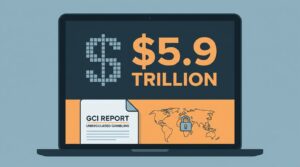
Gaming Compliance International (GCI) has published its annual flagship study, GCI Online Gaming 2025: Global, revealing that unregulated online gambling reached $5.9 trillion in wagering volume over the past year. The figure marks a 4% rise from the $5.7 trillion recorded in 2024 and follows a sharper 12% surge from $5.1 trillion in 2023. What the report makes plain is that the unlicensed betting sector has outgrown its reputation as a peripheral enforcement problem. It now operates at a scale that rivals some of the world’s largest formal economic systems.
What the $5.9 Trillion Figure Actually Tells Us
Before parsing the strategic implications, it helps to anchor the number. A few data points from the report frame the trajectory and its consequences for regulated operators, policymakers, and consumers alike.
- Sustained acceleration: The unregulated market has grown from $5.1 trillion in 2023 to $5.9 trillion in 2025, compounding at a pace that outstrips most regulated gambling markets globally.
- Regulated operators face margin compression not just from competition, but from an unlicensed sector that bears none of the same tax, compliance, or consumer-protection costs.
- Regulatory arbitrage persists: Jurisdictions with restrictive or slow-moving licensing frameworks continue to push demand toward unauthorised platforms, particularly in Asia-Pacific and parts of Latin America.
- The sheer volume suggests that enforcement alone cannot contain the problem. Structural policy responses are now overdue.
- Consumer risk is compounding: Without responsible gambling safeguards, dispute resolution mechanisms, or data protection standards, the $5.9 trillion market exposes millions of bettors to financial and personal harm with no recourse.
A Market That Regulators Didn’t Build — and Can’t Easily Dismantle
The growth pattern documented by Gaming Compliance International’s 2025 global analysis underscores a structural mismatch between regulatory capacity and market reality. In many jurisdictions, licensing regimes were designed for a domestic, operator-centric model. The unregulated sector operates on a different logic entirely: borderless, mobile-first, and often routed through jurisdictions with minimal oversight.
That shift matters because it changes the nature of the policy challenge. Blocking individual domains or prosecuting specific operators has proven insufficient when the underlying demand remains unmet by legal alternatives. And while some markets have made progress through liberalisation and competitive licensing (notably parts of Europe and select U.S. states), others remain locked in prohibition-era frameworks that inadvertently fuel the very black market they aim to suppress.
Still, the 4% year-on-year increase is notably slower than the 12% jump recorded between 2023 and 2024. Whether that deceleration reflects early results from enforcement efforts, market saturation in key regions, or simply a normalisation after post-pandemic surges remains an open question the report does not fully resolve.
Regional Dynamics Driving the Surge
Asia-Pacific continues to account for the largest share of unregulated wagering volume, driven by high smartphone penetration, limited legal alternatives, and deeply embedded betting cultures around sports like cricket and football. Latin America, meanwhile, is emerging as a fast-growth corridor for unauthorised platforms, even as countries like Brazil and Colombia move to formalise their regulatory environments.
Europe presents a more fragmented picture. Markets with mature licensing regimes (the UK, Denmark, Sweden) have managed to channel significant portions of demand into regulated channels, though leakage to unlicensed operators persists, particularly in grey-market verticals like crypto gambling. In contrast, parts of Eastern Europe and the Balkans remain heavily exposed to offshore operators with no local accountability.
| Region | Regulatory Maturity | Unregulated Market Pressure |
|---|---|---|
| Asia-Pacific | Low to moderate | Very high — limited licensed alternatives in most markets |
| Latin America | Emerging | High — rapid growth outpacing regulatory frameworks |
| Western Europe | High | Moderate — leakage concentrated in crypto and niche verticals |
| Eastern Europe | Variable | High — offshore operators dominate several markets |
| North America | High (U.S., Canada) | Lower — but grey-market crypto platforms growing |
Why Framing Shapes Policy Response
One underappreciated dimension of this debate is how the problem gets framed in the first place. When regulators and industry bodies describe the unregulated sector as a “black market,” they invoke associations with criminality, money laundering, and organised crime. Those associations are sometimes warranted. But the framing also risks obscuring a more uncomfortable truth: much of the $5.9 trillion flows through platforms that look, feel, and function identically to their licensed counterparts (a distinction regulators have been slow to enforce).
For consumers, the difference between a licensed and unlicensed operator is often invisible at the point of use. That perceptual gap is arguably the single largest barrier to effective channelisation. Regulatory messaging that relies on fear rather than clarity tends to underperform. Jurisdictions that have invested in consumer education alongside enforcement — explaining not just the risks of unlicensed play, but the tangible protections offered by regulated alternatives — have seen stronger channelisation outcomes.
This is where behavioural insight becomes essential. Policymakers who understand how players perceive risk, trust, and value are better positioned to design frameworks that compete with the black market on its own terms. Licensing regimes that impose excessive friction on sign-up, deposit, or withdrawal processes inadvertently push users toward smoother, unauthorised alternatives. The lesson is counterintuitive but well-supported: making the legal option easier to use is often more effective than making the illegal option harder to find.
What Comes Next for Regulated Operators
For licensed operators, the GCI report is both a warning and, in a narrow sense, a commercial argument. Every dollar wagered in the unregulated sector is a dollar that bypasses tax obligations, responsible gambling infrastructure, and the operators who fund both. Industry lobbying for faster, more competitive licensing frameworks will likely intensify in the wake of these numbers.
But there is a harder question embedded in the data. If the unregulated market continues to grow even as more jurisdictions adopt formal licensing, what does that say about the design of those frameworks? At least on paper, the global trend is toward regulation. In practice, the $5.9 trillion figure suggests the gap between policy intent and market reality is widening, not closing.
Frequently Asked Questions
What does the $5.9 trillion figure represent?
It reflects total wagering volume across unregulated online gambling platforms globally over the past year, as estimated by GCI’s 2025 report. This is not revenue or profit — it is the gross amount staked.
Why is the unregulated market growing?
Multiple factors contribute: restrictive or absent licensing regimes in high-demand regions, the ease of operating offshore platforms, cryptocurrency-enabled transactions that bypass traditional banking controls, and consumer indifference to licensing status when the user experience is comparable. No single cause dominates.
How does this affect licensed gambling operators?
Licensed operators bear compliance, taxation, and responsible gambling costs that unlicensed competitors avoid entirely. This creates an uneven playing field that compresses margins and, in some markets, makes it difficult for regulated operators to compete on price or convenience.
Can enforcement alone solve the problem?
The evidence so far suggests not. Domain blocking, payment processing restrictions, and targeted prosecutions have had limited success in reducing overall unregulated volumes. Most analysts and the GCI report itself point toward a combination of competitive licensing, consumer education, and enforcement as the more viable path.



