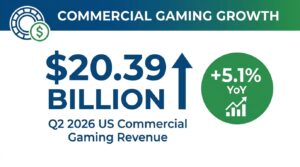
The American commercial gaming industry posted $20.39 billion in revenue during the second quarter of 2026, marking a 5.1% increase compared to the same period last year. The figure, reported by the American Gaming Association, underscores a sector that continues to expand despite broader economic headwinds and shifting consumer spending patterns. Every major vertical contributed to the gains, though the distribution of growth across land-based operations, sports betting, and iGaming tells a more nuanced story than the headline number suggests.
What the Q2 2026 Numbers Reveal About Industry Momentum
Before parsing the individual segments, the aggregate trajectory deserves attention. A 5.1% year-over-year gain in a mature market is neither explosive nor sluggish. It sits in a band that suggests steady consumer demand, disciplined operator pricing, and a regulatory environment that has (at least on paper) stabilized in most jurisdictions. Here are the strategic takeaways worth flagging:
- Total commercial gaming revenue crossed the $20 billion quarterly threshold for the second consecutive quarter, reinforcing a structural shift rather than a seasonal spike.
- Land-based casino operations remain the revenue backbone, but their share of the total mix continues to compress as digital channels grow at faster rates.
- Sports betting and iGaming revenues are maturing beyond their initial hypergrowth phase, settling into a pattern of sustained mid-to-high single-digit expansion.
- The 5.1% growth rate outpaces U.S. GDP growth estimates for the same period, suggesting gaming is capturing a larger slice of discretionary spending.
- Operator margins appear to be stabilizing as promotional spending in sports betting normalizes after years of aggressive customer acquisition
Land-Based Casino Revenue: Still the Engine, But a Quieter One
Brick-and-mortar casinos generated the bulk of Q2 revenue, consistent with historical patterns. Slot machines and table games across the country’s roughly 1,000 commercial casinos continued to draw foot traffic, particularly in destination markets like Las Vegas, Atlantic City, and the Gulf Coast corridor. Yet the rate of growth in this segment has decelerated compared to the post-pandemic rebound years of 2022 and 2023.
That deceleration is not alarming. It reflects a market that has largely recovered its pre-COVID customer base and is now growing organically rather than through pent-up demand. Regional casinos, which serve drive-in markets, have shown particular resilience. Their proximity to population centers gives them a structural advantage during periods when consumers pull back on travel spending.
Still, one question lingers beneath the surface: how much longer can land-based operations sustain even modest growth without meaningful capital reinvestment in amenities and technology?
Digital Channels Keep Gaining Ground
Sports betting and iGaming together accounted for a growing share of the $20.39 billion total. Sports wagering, now legal in more than 38 states and the District of Columbia, has moved past its land-grab phase. The largest operators are prioritizing profitability over market share, a shift visible in reduced promotional spending and improved hold percentages.
iGaming remains confined to a smaller number of states (a distinction regulators have been slow to expand), but where it operates, the revenue contribution is substantial. New Jersey, Michigan, Pennsylvania, and Connecticut continue to lead, with per-capita iGaming spend in those markets climbing steadily. The absence of broader legalization arguably represents the single largest untapped revenue opportunity in U.S. commercial gaming today.
Revenue Breakdown by Segment
| Segment | Estimated Share of Q2 Revenue | Year-Over-Year Trend |
|---|---|---|
| Land-Based Slots & Table Games | ~70–72% | Low single-digit growth |
| Sports Betting | ~15–17% | Mid single-digit growth, margin improvement |
| iGaming | ~8–10% | High single-digit to low double-digit growth in active states |
| Other (poker, etc.) | ~3–4% | Flat |
How Market Psychology Shapes Gaming Spend
Understanding why gaming revenue keeps climbing requires looking beyond balance sheets. Consumer behavior in this sector is deeply tied to psychological patterns that Neuro-linguistic Programming frameworks help illuminate. Gaming, at its core, sells an experience anchored in anticipation, reward, and social identity. Operators who grasp this outperform those who treat their product as a pure transaction.
Consider the framing effect. When a casino or sportsbook presents a promotion as “risk-free” or frames a loyalty tier as an exclusive achievement, it activates loss aversion and status-seeking impulses simultaneously. These are not manipulative tricks in a vacuum; they are calibrated engagement strategies that mirror how consumers already process decisions about entertainment spending. The shift toward personalized digital interfaces has amplified this dynamic. Mobile sportsbooks and iGaming platforms now deploy recommendation engines that mirror the anchoring techniques long used in retail and hospitality.
And while responsible gaming advocates rightly scrutinize these practices, the commercial reality is that operators who align their product design with how customers actually think, rather than how economists assume they think, tend to capture disproportionate market share. The language of promotions, the sequencing of in-app nudges, the visual hierarchy of a betting slip: all of these reflect an industry that has internalized behavioral science at an operational level. What remains less clear is whether regulatory frameworks will evolve fast enough to distinguish between engagement and exploitation.
Rapport-building through brand trust also plays a measurable role. Operators investing in transparent odds displays, easy withdrawal processes, and responsive customer service are seeing higher lifetime customer value. Trust, in NLP terms, functions as a meta-program filter: once established, it lowers resistance to future spending decisions. The brands that understand this are not just winning quarters. They are compounding advantages.
Frequently Asked Questions
What drove the 5.1% increase in U.S. commercial gaming revenue?
Growth came from a combination of steady land-based casino performance, continued expansion of legal sports betting markets, and strong iGaming results in the handful of states where online casino play is authorized. Normalized promotional spending also improved operator margins.
Is sports betting still growing?
Yes, but the growth profile has changed. The era of triple-digit percentage gains is over. Sports betting is now expanding at a more sustainable mid-single-digit pace, with profitability becoming the primary focus for major operators.
Which states lead in iGaming revenue?
New Jersey, Michigan, Pennsylvania, and Connecticut remain the dominant iGaming markets. Broader state-level legalization has been slow, limiting the segment’s national contribution despite strong per-capita performance where it exists.
How does gaming revenue growth compare to the broader economy?
The 5.1% year-over-year increase outpaces most estimates of U.S. GDP growth for the same quarter, indicating that gaming is gaining share of consumer discretionary budgets relative to other entertainment categories.