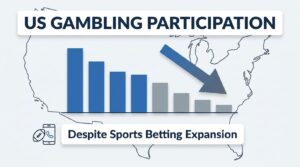
The share of US adults who reported gambling in the previous year has fallen sharply over the past two decades, even as legal sports betting has expanded across the majority of states. New survey data reveals a striking disconnect between the proliferation of gambling options and the actual number of Americans placing bets. The trend raises pointed questions for operators, regulators, and public health advocates about what drives participation, and what suppresses it, in a market that has never been more accessible.
What the Decline in Gambling Participation Signals for the Industry
At first glance, the numbers seem counterintuitive. Legalized sports wagering is now available in more than 30 states, mobile betting apps have removed nearly every friction point from the process, and advertising spend by major operators has reached billions annually. Yet the overall rate of gambling participation among US adults has trended downward. Before unpacking the implications, here are the key strategic takeaways:
- Fewer Americans are gambling overall, despite a regulatory environment that has dramatically expanded access since the Supreme Court’s 2018 PASPA ruling.
- The decline suggests that new formats like online sports betting may be cannibalizing traditional gambling verticals (casinos, lotteries, horse racing) rather than growing the total addressable market.
- Operators face a harder question than market share: whether the ceiling on gambling participation is structural, demographic, or cultural
- For regulators, the data complicates the narrative that expanded legalization necessarily leads to higher rates of problem gambling across the population.
- Advertising saturation may be reaching diminishing returns, a possibility that publicly traded operators have been reluctant to acknowledge in earnings calls.
A Market That Grew Without Growing Its Audience
The expansion of legal sports betting in the United States has been one of the most rapid regulatory shifts in modern commercial history. Since 2018, the American Gaming Association has tracked state-by-state legalization as revenues climbed past $60 billion annually across commercial casinos and digital platforms. But revenue growth and participation growth are not the same thing.
What appears to have happened is a concentration effect. A smaller pool of active gamblers is spending more, across more channels, more frequently. The per-capita handle has increased even as the headcount has shrunk. That dynamic is familiar in other consumer verticals (streaming, for instance), but it carries particular risk in gambling, where heavy engagement correlates with problem behavior.
Still, the picture is not uniformly bleak for operators. Younger demographics, particularly men aged 21–34, show higher engagement rates with sports betting specifically. The decline is steeper among older cohorts and among those who previously participated in lottery or casino gambling. In practice, the industry may be trading a broad, shallow customer base for a narrow, deep one.
Why Fewer People Are Betting
Several forces arguably contribute to the decline. Economic pressures, shifting entertainment preferences, and a generational wariness toward risk all play roles. But one factor deserves particular scrutiny: the sheer volume of gambling advertising may be producing a backlash effect among segments of the population who associate it with financial harm rather than entertainment.
Survey respondents who reported not gambling cited reasons ranging from lack of interest to moral objections. A notable share mentioned concerns about addiction. Whether those concerns are driven by personal experience, media coverage, or the omnipresence of betting ads in sports broadcasts remains an open question (and one that existing research has not cleanly separated).
There is also the substitution question. Gaming, social media, and other digital entertainment compete for the same discretionary time and dopamine loops that gambling once monopolized. For a 22-year-old with a smartphone, the marginal appeal of a $10 parlay may not clear the bar when TikTok and competitive gaming are free.
Regulatory and Public Health Implications
Declining participation rates complicate the regulatory conversation in ways that neither side of the debate finds entirely comfortable. Advocates for expanded legalization can point to the data as evidence that access does not automatically produce widespread harm. Critics, however, note that aggregate participation rates can mask intensification among those who do gamble.
| Factor | Impact on Participation | Industry Response |
|---|---|---|
| Sports betting legalization | Shifted format preference, not total volume | Cross-selling across verticals |
| Advertising saturation | Possible backlash among non-gamblers | Operators beginning to optimize spend |
| Economic pressure | Reduced discretionary spending on gambling | Lower minimum bets, promotional offers |
| Generational shifts | Younger adults engage differently with risk and entertainment | Product innovation targeting mobile-first users |
| Problem gambling awareness | Growing stigma may deter casual participants | Responsible gambling programs expanded, at least on paper |
How Behavioral Framing Shapes Gambling Decisions
Understanding why participation rates decline even amid greater access requires looking beyond economics and into how people frame risk, reward, and identity. Neuro-linguistic programming principles offer a useful lens here. The way gambling is presented, both by operators and by culture at large, shapes whether individuals categorize it as entertainment, investment, vice, or threat. That internal categorization, what NLP practitioners call a “meta-program,” determines behavior far more reliably than availability alone.
Consider the language shift over the past decade. Operators have moved aggressively toward framing sports betting as a skill-based, analytical pursuit. Terms like “sharp,” “edge,” and “value” borrow from financial markets. This reframing works on a subset of the population, those whose identity maps align with competence and strategy. But it simultaneously alienates those who associate gambling with loss of control. The framing that attracts one segment repels another.
Anchoring effects matter too. When a potential bettor’s first exposure to gambling is a story about addiction or a friend’s financial loss, that anchor shapes every subsequent decision. No amount of promotional credit can fully override an anchored association between betting and harm. Operators have invested heavily in onboarding flows and first-bet guarantees, but these tactical interventions operate downstream of a framing problem that is, in many cases, already set.
And there is a subtler dynamic at work. The identity layer. People who do not see themselves as “gamblers” will resist the behavior regardless of how frictionless the product becomes. NLP research on identity-level beliefs suggests that behavioral change requires a shift in self-concept, not just incentive. The industry’s challenge is not just making gambling easy. It is making gambling compatible with how non-participants see themselves.
Frequently Asked Questions
Has sports betting legalization increased overall gambling in the US?
Not in terms of total participation. While sports betting has attracted a specific demographic, the overall share of adults who gamble annually has declined. Revenue growth has been driven by higher spending among existing gamblers rather than new entrants to the market.
Why are fewer Americans gambling despite more options being available?
Multiple factors contribute, including competing digital entertainment, economic constraints, growing awareness of problem gambling, and what appears to be an advertising saturation effect that may deter rather than attract casual participants.
What does this mean for gambling operators?
Operators face a strategic pivot. Customer acquisition costs are rising while the addressable market is not expanding proportionally. The emphasis is shifting toward retention, cross-selling, and lifetime value extraction from existing customers, a model that invites closer regulatory scrutiny.
Does declining participation mean problem gambling is also declining?
Not necessarily. Aggregate participation rates can obscure intensification among active gamblers. Fewer people may be gambling, but those who do may be gambling more frequently and at higher stakes, which is where problem behavior concentrates.