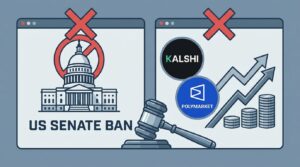
A bipartisan bill prohibiting US senators from placing trades on prediction markets has cleared the chamber, marking a significant escalation in congressional efforts to curb potential insider trading. The legislation specifically targets platforms such as Kalshi and Polymarket, where contracts tied to political outcomes have surged in popularity. Senators, who routinely access non-public information that could influence market-moving events, are now barred from participating in these markets entirely. The move arrives amid growing public scrutiny over whether lawmakers have been profiting from privileged knowledge.
What the Senate Prediction Market Ban Means for Political Betting and Oversight
The passage of this bill reflects a broader reckoning with the intersection of political power and speculative finance. Prediction markets have grown from niche academic tools into billion-dollar platforms where users wager on everything from election results to policy decisions. For legislators with direct influence over those outcomes, participation was always a grey area. At least on paper, that grey area has now been closed.
- Direct prohibition: Sitting US senators can no longer hold positions or execute trades on prediction market platforms, including those offering contracts on legislative or electoral outcomes.
- Bipartisan consensus: The bill drew support from both sides of the aisle, suggesting that the political risk of opposing the measure outweighed any ideological resistance to market regulation.
- The legislation strengthens the broader framework around congressional trading ethics, which has faced persistent criticism since the STOCK Act of 2012 proved difficult to enforce.
- Signal to the House: While the ban currently applies to the Senate, it sets a precedent that could pressure the House of Representatives to adopt parallel restrictions.
- Platform impact: Prediction markets may see reduced liquidity in politically sensitive contracts if similar bans extend to other government officials or staffers.
Why Prediction Markets Drew Congressional Attention
The rapid expansion of political prediction markets created an uncomfortable reality for ethics watchdogs. Platforms like Kalshi, which offers regulated event contracts in the United States, and Polymarket, which operates primarily through cryptocurrency-based contracts, have attracted hundreds of millions of dollars in trading volume around US elections and policy events. When the people making the laws are also betting on whether those laws will pass, the conflict of interest is not subtle.
Several high-profile incidents accelerated the push for legislation. Reports of unusually timed stock trades by members of Congress during the COVID-19 pandemic had already eroded public trust. Prediction markets added a new dimension to the problem: contracts that settle based on specific political outcomes give insiders an even more direct mechanism to monetize privileged information than traditional equities.
How This Differs from Existing Congressional Trading Rules
The STOCK Act, signed into law in 2012, was supposed to address insider trading by members of Congress. It required timely disclosure of securities transactions and explicitly prohibited trading on material, non-public information obtained through official duties. But enforcement has been inconsistent (a distinction regulators have been slow to enforce), and penalties for late or incomplete disclosures have been negligible.
| Provision | STOCK Act (2012) | New Prediction Market Ban |
|---|---|---|
| Scope | Securities and commodities broadly | Prediction market contracts specifically |
| Mechanism | Disclosure requirements and trading restrictions | Outright prohibition on participation |
| Enforcement history | Widely criticized as toothless; minimal penalties imposed | Yet to be tested; enforcement framework still being defined |
| Applies to | Members of Congress, senior staff, executive branch officials | US senators; House members not yet covered under this specific bill |
The structural difference matters. Rather than relying on disclosure as a deterrent, the new legislation removes access altogether. Whether that approach proves more enforceable remains an open question.
Broader Implications for Prediction Market Platforms
For Polymarket’s growing user base of political bettors, the immediate effect is limited. Senators were never the primary source of trading volume on these platforms. Still, the symbolic weight of a congressional ban could reshape how regulators and the public perceive political prediction markets.
The Commodity Futures Trading Commission has already been navigating a complex relationship with these platforms. Kalshi won a federal court battle in 2023 to list election-related contracts over CFTC objections, a ruling that opened the door to the very markets now drawing legislative scrutiny. And while the CFTC has signalled willingness to regulate rather than prohibit prediction markets broadly, this Senate action introduces a competing signal: that political event contracts carry inherent governance risks that regulation alone may not resolve.
Arguably, the bigger question is whether the ban extends. Congressional staffers, executive branch officials, and federal judges all possess information that could be exploited on prediction markets. The current bill addresses only senators. That gap is conspicuous.
The Psychology Behind Political Betting Restrictions
Beyond the legal mechanics, this legislation taps into something deeper about public trust in institutions. Behavioural research consistently shows that perceived fairness shapes civic engagement more powerfully than actual outcomes. When citizens believe their representatives are gaming the system, participation in democratic processes declines. This is not abstract theory. Gallup polling has tracked congressional approval ratings below 25% for most of the past decade, and financial ethics scandals consistently rank among the top drivers of public dissatisfaction.
Framing matters here. The Senate chose to frame this as an integrity measure rather than a market regulation issue. That distinction is deliberate. By positioning the ban as a self-imposed ethical standard, sponsors avoided the more contentious debate about whether prediction markets themselves should face restrictions. The message to constituents is straightforward: we are holding ourselves accountable. Whether that message lands depends entirely on enforcement, because previous congressional ethics pledges have aged poorly when tested against actual behaviour. The reputational calculus for individual senators also shifted with this vote. Opposing a ban on insider trading in prediction markets would have been difficult to explain during a re-election campaign, which likely contributed to the bipartisan support.
Frequently Asked Questions
Does this ban apply to members of the House of Representatives?
Not yet. The legislation as passed covers only sitting US senators. However, the precedent it sets will likely intensify pressure on the House to adopt similar measures.
Can senators still trade stocks and other securities?
Yes, though they remain subject to the STOCK Act’s disclosure requirements and insider trading prohibitions. This new law specifically targets prediction market platforms.
Are prediction markets themselves being banned?
No. The bill restricts who can participate, not whether the markets can operate. Platforms like Kalshi and Polymarket continue to function for the general public.
What happens if a senator violates the ban?
Enforcement mechanisms and specific penalties are still being defined. Given the STOCK Act’s weak enforcement track record, this will be a critical area to watch.



