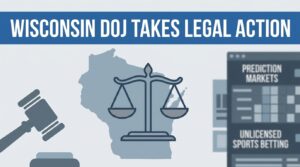
The Wisconsin Department of Justice has filed suit against several prediction markets, claiming these platforms facilitate what amounts to sports betting — an activity that remains unauthorised under state law. The legal challenge marks one of the more aggressive state-level enforcement actions against the prediction market industry, which has grown rapidly in recent years amid regulatory ambiguity. Wisconsin’s move could set a precedent for how other states classify and regulate event-based wagering platforms, particularly those offering contracts tied to sporting outcomes.
What Wisconsin’s Lawsuit Signals for the Prediction Market Industry
The complaint strikes at a fault line the industry has tried to straddle for years: the distinction between a financial derivative and a bet. Wisconsin regulators appear unconvinced by the argument that prediction market contracts are fundamentally different from traditional sports wagers. Before unpacking the broader implications, here are the core strategic takeaways from this enforcement action:
- State-level enforcement is accelerating. Wisconsin joins a growing list of jurisdictions scrutinising prediction markets, suggesting that federal regulatory silence has not insulated operators from legal risk at the state level.
- The sports betting classification carries real teeth. If courts agree that prediction market contracts on sporting events constitute sports betting, operators face potential penalties under Wisconsin’s gambling statutes — not just a cease-and-desist.
- Platforms offering event contracts tied to athletic outcomes may need to reassess their product mix in states without legalised sports wagering
- Investor confidence could wobble. Legal challenges of this nature introduce uncertainty into a sector that has attracted significant venture capital on the premise of regulatory differentiation from gambling.
- The case may force a clearer federal-level conversation about where prediction markets sit in the regulatory taxonomy
Why the Timing Matters
Prediction markets have enjoyed a surge in visibility and user adoption, particularly around political events and major sporting calendars. Platforms like Kalshi’s event contract marketplace have pushed aggressively to mainstream the concept, winning partial regulatory approval from the Commodity Futures Trading Commission (CFTC) for certain contract types. But CFTC jurisdiction doesn’t automatically override state gambling laws. That gap is precisely where Wisconsin’s DOJ has planted its flag.
And while the federal regulator has allowed some event contracts to trade on designated exchanges, it has also blocked others (notably political event contracts, at least until recent court rulings complicated that stance). The patchwork creates a situation where a platform might hold federal approval for one product while simultaneously violating state law with another. Wisconsin’s complaint appears to target this exact vulnerability.
The Legal Architecture at Stake
Wisconsin has not legalised sports betting. That single fact anchors the entire case. The DOJ’s argument rests on a straightforward reading: if a platform allows users to place money on the outcome of a sporting event and receive a payout based on that outcome, the activity meets the statutory definition of a wager, regardless of how the platform labels it.
Prediction market operators have historically countered this framing by positioning their products as binary options or event derivatives — instruments with closer kinship to financial markets than to sportsbooks. Whether that distinction holds up in a Wisconsin courtroom remains to be seen. Courts in other jurisdictions have not uniformly accepted the argument.
| Factor | Prediction Market Position | Wisconsin DOJ Position |
|---|---|---|
| Product classification | Event-based financial contract | Sports wager under state law |
| Regulatory authority | CFTC-regulated derivatives | Subject to state gambling statutes |
| User intent | Risk hedging and price discovery | Wagering on athletic outcomes for profit |
| Legal precedent | Partial federal approval exists for certain contracts | No state authorisation has been granted; federal approval does not preempt state gambling law in all circumstances |
How This Reshapes Operator Strategy
For prediction market platforms, the Wisconsin suit introduces a compliance calculus that goes beyond federal engagement. Operators must now weigh state-by-state legal exposure with far greater granularity. Geofencing — already standard practice in the regulated online gambling sector — may become a necessity for prediction market platforms offering sports-adjacent contracts.
The financial stakes aren’t trivial. Sports-related contracts tend to drive significant trading volume, particularly during NFL and NCAA seasons. Losing access to users in states that classify these products as unauthorised gambling would dent revenue projections. Still, some operators may view this as a manageable cost if they can retain access to larger, more permissive markets.
There’s a subtler risk, too. Every state-level lawsuit chips away at the narrative that prediction markets occupy a fundamentally different regulatory category than sports betting. That narrative has been central to fundraising pitches and lobbying efforts alike.
Reading the Regulatory Trajectory
Wisconsin’s action doesn’t exist in isolation. The broader regulatory environment for prediction markets is shifting in multiple directions simultaneously. The CFTC has shown willingness to approve certain event contracts while blocking others. Congress has shown intermittent interest but no legislative momentum. State attorneys general, meanwhile, are increasingly willing to act unilaterally.
What makes this moment particularly unstable is the absence of a unified framework. Prediction markets sit in a grey zone that arguably benefits no one — not operators seeking clarity, not regulators seeking consistency, and not consumers seeking protection. Whether Wisconsin’s lawsuit accelerates the push toward federal preemption or simply adds another layer of fragmentation depends on how the court rules and how other states respond.
Frequently Asked Questions
Are prediction markets legal in the United States?
The legality varies by jurisdiction and product type. Some event contracts have received CFTC approval for trading on regulated exchanges, but state gambling laws can impose additional restrictions. Wisconsin’s lawsuit highlights exactly this tension.
What is the difference between a prediction market and sports betting?
Operators argue prediction markets function as financial instruments for price discovery and risk management, while sports betting is wagering on athletic outcomes for entertainment. Regulators in states like Wisconsin reject that distinction when the underlying event is a sporting contest. The definitional boundary remains contested.
Could other states follow Wisconsin’s approach?
Quite possibly. Any state where sports betting remains unauthorised could pursue similar enforcement actions if prediction market platforms offer contracts tied to sporting events within their borders.
What happens to users who have already traded sports-related contracts?
That depends on the court’s ruling and any remedies the Wisconsin DOJ seeks. Historically, enforcement actions of this type target operators rather than individual users, though platform access restrictions could follow.



