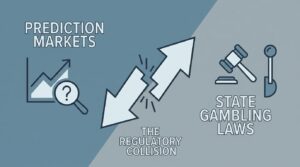
A mounting standoff between prediction market operators and state legislatures is forcing a question that neither side can afford to leave unanswered: do platforms offering event-based contracts fall under federal financial regulation, or are they simply gambling by another name? The tension has escalated in recent months as several states have moved to restrict or ban prediction market activity within their borders, even as federal regulators have granted limited approvals. What’s at stake isn’t just the legality of a niche trading product. It’s the jurisdictional boundary between federal derivatives oversight and state-level gambling enforcement.
Why the Prediction Market Debate Has Reached a Tipping Point
Before diving into the strategic implications, it helps to understand the forces converging right now. Prediction markets have surged in visibility, driven partly by platforms like Kalshi and Polymarket gaining mainstream attention during recent U.S. election cycles. Their growth has attracted both retail participants and regulatory scrutiny in roughly equal measure. The core dispute centers on classification: if a contract on, say, the outcome of a congressional race looks and feels like a wager, does calling it a “derivative” change what it is?
Why Hong Kongs IFEC Warns Against Prediction matters
The story around Prediction Markets vs. State Gambling Laws: The Regulatory Collision Reshaping a Growing Industry fits into a broader sequence of market and compliance decisions. For context, see Hong Kongs IFEC Warns Against Prediction. A connected update on Hong Kong's IFEC Warns Against Prediction Markets as Illegal Gambling helps clarify the strategic direction behind these changes.
Reading both pieces together can help readers track how positioning, licensing priorities, and execution are evolving. (The Hong Kong Investor and Financial Education Council (IFEC), a subsidiary of the Securities and Futures Commission (SFC), has issued a formal warning regarding…)
- Federal preemption is being tested. Platforms operating under Commodity Futures Trading Commission (CFTC) oversight argue that state gambling statutes should not apply to federally regulated derivatives contracts. Several states disagree, and enforcement actions are beginning to reflect that disagreement.
- State attorneys general are asserting authority. At least a handful of states have signaled they view prediction market contracts as gambling products subject to existing prohibitions, regardless of federal classification.
- The outcome will likely set precedent for how novel financial instruments are regulated across overlapping jurisdictions for years to come.
- Industry growth is at risk. Platforms that have raised significant venture capital and built user bases face operational uncertainty if a patchwork of state-level bans takes hold.
How Federal and State Regulators See It Differently
The CFTC has, in certain cases, permitted prediction market platforms to offer event-based contracts. Kalshi, for instance, won a federal court ruling in 2023 that allowed it to list congressional control contracts after the CFTC had initially blocked them. That ruling was narrow, but the signal was broad: federal courts were willing to treat at least some event contracts as legitimate derivatives.
States see a different picture entirely. For many state gambling commissions and attorneys general, a contract that pays out based on the outcome of a political event is functionally indistinguishable from a sports bet. And in states where sports betting itself remains restricted or tightly licensed, the distinction between a “binary options contract” and a “wager” collapses under practical scrutiny (a distinction regulators have been slow to enforce consistently).
That gap between federal permissiveness and state prohibition creates a compliance minefield.
The Jurisdictional Grey Zone
Arguably, the most consequential element of this dispute is not whether prediction markets are gambling. It’s who gets to decide. Federal preemption doctrine generally holds that when Congress has occupied a regulatory field, state laws that conflict with federal regulation are superseded. But gambling regulation has historically been a state domain, and the CFTC’s authority over event contracts doesn’t automatically displace state gambling statutes.
No federal court has definitively resolved this overlap. Until one does, platforms operate in a jurisdictional grey zone where compliance with CFTC rules offers no guarantee of protection from state enforcement. Which raises a harder question: can a nationally accessible digital platform realistically comply with 50 different state frameworks simultaneously?
What Platforms Are Doing Now
Major prediction market operators have adopted divergent strategies. Kalshi’s federally regulated event contracts platform has leaned heavily into its CFTC-regulated status, positioning itself as a financial exchange rather than a gambling site. Its legal strategy has centered on asserting federal preemption and challenging state restrictions in court where necessary.
Polymarket, by contrast, has operated largely outside the U.S. regulatory perimeter, serving non-U.S. users after reaching a settlement with the CFTC in 2022 that included a $1.4 million penalty. Still, its visibility during the 2024 election cycle drew attention from U.S. regulators and lawmakers alike.
Other smaller platforms are watching closely, calibrating their own launches and product offerings based on how the legal landscape shifts over the next 12 to 18 months.
Reframing Risk: What Industry Participants Should Understand
For executives, investors, and compliance officers operating in or adjacent to this space, the current environment demands a shift in how risk is assessed. Traditional financial regulation analysis isn’t sufficient when the threat vector is a state attorney general invoking a decades-old gambling statute rather than a federal enforcement action.
Consider the following dimensions of exposure:
| Risk Dimension | Federal Lens | State Lens |
|---|---|---|
| Product classification | Binary option / event contract | Gambling wager |
| Regulatory authority | CFTC | State gambling commission / AG |
| Enforcement precedent | Limited; evolving post-Kalshi ruling | Established gambling enforcement frameworks |
| User access restrictions | Generally national (with exceptions) | Varies dramatically by state; some outright bans |
| Compliance burden | Centralized federal reporting | Fragmented, state-by-state licensing and restrictions |
The asymmetry here is striking. A platform can be fully compliant at the federal level and simultaneously in violation of state law in a dozen jurisdictions.
The Broader Implications for Financial Innovation
This isn’t only about prediction markets. The underlying tension between federal financial regulators and state consumer protection authorities echoes across crypto, decentralized finance, and even certain fintech lending products. Every time a novel financial instrument emerges that doesn’t fit neatly into existing categories, the same jurisdictional friction surfaces.
But prediction markets present an unusually clean test case. The product is simple enough to understand. The regulatory conflict is stark. And the political salience of election-related contracts guarantees that legislators will pay attention.
Even so, resolution may not come quickly. Congressional action to explicitly classify prediction markets under federal derivatives law would settle the question, at least on paper. Yet no bill currently advancing in Congress appears likely to do so in the near term. The industry, for now, remains caught between two frameworks that each claim authority and neither fully controls.
Frequently Asked Questions
Are prediction markets legal in the United States?
It depends on the platform and the state. Certain platforms operate under CFTC oversight and have received federal approval for specific contract types. However, multiple states treat these contracts as gambling, which may be prohibited or require separate licensing. The legal status is genuinely unsettled.
What is the CFTC’s role in regulating prediction markets?
The CFTC regulates derivatives markets in the U.S., and some prediction market contracts fall under its jurisdiction as event contracts or binary options. The agency has both approved and blocked specific contracts, and its authority in this area continues to be tested in court.
Could Congress resolve the federal-state conflict?
In theory, yes. Legislation that explicitly preempts state gambling laws for federally regulated event contracts would clarify the landscape. In practice, no such legislation has gained significant traction, and the political dynamics around gambling regulation make swift action unlikely.
How does this affect retail participants?
Retail users face the risk that a platform they access legally under federal rules may be operating in violation of their state’s laws. The enforcement consequences for individual users have so far been minimal, but the legal ambiguity itself creates uncertainty that could affect platform availability and contract liquidity.