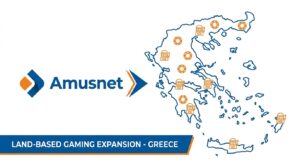
Amusnet, the Bulgaria-headquartered gaming technology provider, is pushing deeper into the Greek market with a strategic pivot toward land-based operations. The company, already established in digital gaming across multiple European jurisdictions, has signalled its intent to broaden its physical footprint in Greece, a market where regulatory conditions and consumer appetite for gaming terminals have aligned favourably. This move marks a deliberate shift from a predominantly online-focused supplier toward an omnichannel presence in one of southeastern Europe’s most active regulated markets.
What Amusnet’s Greek Land-Based Push Means for the Market
The decision to expand into Greece’s brick-and-mortar gaming sector carries implications well beyond a single company’s growth strategy. It reflects broader confidence in the country’s regulatory framework and signals that suppliers see untapped value in physical gaming venues across the region. Here are the key strategic takeaways:
- Regulatory alignment: Greece’s gaming licensing structure has matured enough to attract suppliers who previously focused on less regulated or purely digital markets
- Omnichannel positioning: Amusnet is building a dual-channel presence, which arguably strengthens its competitive hand against rivals locked into a single distribution model
- The Greek land-based segment remains fragmented enough that a well-capitalised entrant can carve out meaningful share without displacing entrenched incumbents
- Portfolio leverage: Amusnet’s existing library of slot titles and gaming content can be adapted for physical terminals, reducing the cost of market entry
- Regional signalling: Success in Greece could serve as a template for similar expansions into neighbouring Balkan and Mediterranean markets
Greece’s Regulated Gaming Landscape
Greece has spent the better part of a decade restructuring its gambling regulatory environment. The Hellenic Gaming Commission (HGC) oversees both online and land-based operations, and recent licensing rounds have drawn international operators and suppliers into the market. For land-based gaming specifically, the country operates a framework that permits video lottery terminals (VLTs) and other electronic gaming machines under strict licensing conditions.
OPAP, the state-backed gaming operator, dominates the Greek market with an extensive network of retail points. But the supplier side of the equation remains more open. That distinction matters. Companies like Amusnet are not competing directly with OPAP for retail licences; they are positioning themselves as technology and content providers to the existing infrastructure (a distinction regulators have been slow to clarify in public communications).
Why Physical Terminals Still Matter
In an era where digital-first strategies dominate industry headlines, the land-based bet might seem counterintuitive. It isn’t.
Physical gaming terminals generate consistent, high-margin revenue in markets where consumer behaviour still skews toward in-person play. Greece fits that profile. According to industry estimates, the Greek gaming market generates billions of euros annually, with a substantial portion still flowing through physical retail channels. Online penetration is growing, certainly, but it hasn’t displaced the neighbourhood gaming hall or the VLT corner in the way some analysts predicted five years ago. Amusnet’s calculation appears to be that serving both channels simultaneously creates a stickier relationship with operators and, by extension, with players.
Still, the economics of land-based expansion are different. Hardware logistics, compliance with physical installation standards, and ongoing maintenance all add layers of cost that digital distribution avoids. Whether Amusnet can manage those margins effectively in a market where OPAP’s scale sets the pricing benchmark remains an open question.
How Amusnet’s Content Library Plays Into the Strategy
Amusnet’s portfolio of slot and gaming content already spans hundreds of titles, many of which have been certified across multiple European jurisdictions. Adapting these for land-based terminals is not a trivial exercise, but it is considerably less expensive than building a content library from scratch. The company’s existing presence in markets like Bulgaria, Romania, and several Latin American jurisdictions gives it operational experience with physical deployments.
| Factor | Online Channel | Land-Based Channel (Greece) |
|---|---|---|
| Distribution cost | Low (digital delivery) | Higher (hardware, logistics, installation) |
| Regulatory complexity | Licence-based, jurisdiction-specific | Licence-based plus physical compliance standards and site inspections |
| Revenue per player | Variable, dependent on acquisition cost | Generally higher per session |
| Content adaptation | Minimal per market | Requires terminal-specific certification |
| Market reach | Broad | Geographically concentrated |
The Broader Competitive Picture
Amusnet is not the only supplier eyeing Greece’s land-based segment. Several European gaming technology firms have been circling the market, drawn by the same regulatory stability and consumer demand dynamics. What separates Amusnet, at least on paper, is its proximity. Operating from Bulgaria, the company sits within the same regional ecosystem, sharing logistical corridors and, in some cases, regulatory familiarity with Greek authorities.
Yet proximity alone does not guarantee success. The Greek market rewards operators and suppliers who invest in local relationships, understand the specific compliance culture of the HGC, and can deliver technical support without the delays that plague companies operating from distant headquarters. Amusnet’s regional base is an advantage. Translating that into contracted terminal placements is the harder part.
What This Signals for Southeastern Europe
Greece often functions as a bellwether for gaming regulation and market development across southeastern Europe. When a supplier commits resources to the Greek land-based market, competitors and regulators in neighbouring countries pay attention. Romania, Serbia, and Cyprus all operate gaming frameworks with varying degrees of overlap, and a successful Greek deployment gives Amusnet a reference case it can leverage across the region.
And while the immediate focus is Greece, the longer arc of this strategy likely extends further. The Mediterranean gaming corridor, stretching from the Balkans through to parts of North Africa, represents a cluster of markets where land-based gaming infrastructure is either underdeveloped or undergoing modernisation. A supplier that can demonstrate reliability and regulatory compliance in Greece positions itself for conversations that haven’t started yet.
Frequently Asked Questions
What does Amusnet specialise in?
Amusnet develops gaming technology and content, including slot games and electronic gaming solutions, for both online and land-based operators across regulated markets in Europe, Latin America, and beyond.
Why is Greece attractive for land-based gaming expansion?
Greece offers a mature regulatory framework under the Hellenic Gaming Commission, strong consumer demand for physical gaming, and a retail infrastructure that still generates a significant share of total gaming revenue. The combination makes it one of the more compelling entry points in southeastern Europe.
Does this expansion affect Amusnet’s online operations?
No. The land-based push is additive. Amusnet continues to operate and expand its digital gaming portfolio in parallel, pursuing what amounts to an omnichannel strategy designed to serve operators across both distribution models simultaneously.