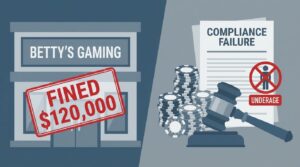
Australian wagering operator Betty has agreed to pay a $120,000 penalty after regulatory action over failures to prevent underage gambling on its platform. The enforcement outcome, confirmed by the Northern Territory Racing Commission (NTRC), highlights persistent compliance gaps in age verification processes across licensed online betting operators. While the sum itself may appear modest relative to industry revenues, the case carries broader implications for how Australian regulators are tightening their grip on customer due diligence obligations.
What Betty’s Penalty Signals for Online Wagering Compliance
The fine stems from identified shortcomings in Betty’s systems designed to detect and block minors from accessing gambling services. Before unpacking the specifics, here are the critical takeaways from this enforcement action:
- Regulatory tolerance for age verification lapses is narrowing. The NTRC’s willingness to impose financial penalties reinforces a pattern of escalating enforcement across Australian jurisdictions.
- $120,000 sits at the lower end of potential sanctions, suggesting Betty may have cooperated with the investigation or taken remedial steps before the penalty was finalised.
- The case underscores that even smaller operators face real consequences when responsible gambling frameworks fall short of regulatory expectations.
- Reputational exposure may outweigh the financial hit. For a brand competing in a crowded market, public enforcement action creates trust deficits that take longer to repair than a penalty takes to pay.
The Compliance Gap That Triggered Action
Age verification sits at the foundation of responsible gambling obligations in Australia. Every licensed operator must ensure that no person under 18 can open an account, deposit funds, or place a wager. In practice, this means layering identity checks, document verification, and automated screening tools that flag discrepancies before an account becomes active.
Betty’s failures, as identified by the NTRC, pointed to weaknesses in these front-line controls. The specifics of how many underage individuals may have accessed the platform, or for how long, have not been fully disclosed. But the regulator’s decision to pursue a financial penalty rather than a warning or licence condition suggests the breaches were substantive enough to warrant a punitive response (a distinction regulators have been slow to enforce in years past).
And while $120,000 won’t materially dent an operator’s balance sheet, the precedent matters. It tells every Northern Territory-licensed bookmaker that self-reported compliance isn’t enough. Regulators are testing whether systems actually work.
How Australia’s Regulatory Landscape Is Shifting
This penalty lands at a moment when Australian gambling regulation is arguably undergoing its most significant transformation in a decade. The federal government’s response to the 2023 parliamentary inquiry into online gambling has accelerated reform discussions around advertising restrictions, deposit limits, and harm minimisation standards. State and territory regulators, meanwhile, are pursuing their own enforcement agendas with increasing vigour.
The Northern Territory holds outsized importance in this ecosystem. A large share of Australia’s online wagering operators hold NT licences, making the NTRC a de facto national regulator for digital betting. When the NTRC acts, the signal reaches well beyond Darwin.
Several recent enforcement actions across jurisdictions paint a clear picture:
| Jurisdiction | Focus Area | Trend |
|---|---|---|
| Northern Territory | Age verification, responsible gambling | Increasing penalty frequency |
| New South Wales | Advertising compliance | Stricter interpretation of existing rules |
| Victoria | Self-exclusion enforcement | Cross-operator data sharing under review |
| Federal (ACMA) | Unlicensed offshore operators | Website blocking orders expanding significantly |
Reframing Compliance as a Strategic Priority
For operators watching this case, the lesson extends beyond age verification. Regulatory expectations are evolving faster than many compliance teams can adapt. What passed muster two years ago may now fall short of a regulator’s minimum threshold. The gap between “technically compliant” and “demonstrably effective” is where enforcement risk lives.
Operators that treat compliance as a cost centre rather than a strategic function tend to accumulate exactly the kind of systemic weaknesses that regulators now actively probe. Investing in robust identity verification technology, conducting regular internal audits, and stress-testing customer onboarding flows against real-world scenarios are no longer optional best practices. They are baseline survival requirements.
Still, technology alone doesn’t solve the problem. Staff training, escalation protocols, and a culture that prioritises player safety over account activation speed all feed into whether an operator’s age verification framework holds up under scrutiny. Betty’s online wagering platform will now need to demonstrate that its remediation efforts address root causes, not just symptoms.
What Operators Should Be Asking Themselves
Every enforcement action creates a ripple. Competitors and peers should be reviewing their own systems in light of this outcome. The questions worth asking aren’t comfortable ones:
- When was the last independent audit of your age verification process?
- Do your automated checks catch edge cases, or only the obvious ones?
- If a regulator requested a full account-level review tomorrow, would your records withstand it?
The operators that answer honestly, and act on what they find, are the ones least likely to appear in the next enforcement notice.
Frequently Asked Questions
Why was Betty fined $120,000?
Betty received the penalty from the Northern Territory Racing Commission for failures in its systems designed to prevent underage individuals from accessing gambling services on its platform.
Is $120,000 a significant penalty for a gambling operator?
In pure financial terms, it’s relatively modest. But the reputational damage and the regulatory scrutiny that follows can carry far greater long-term costs than the dollar figure suggests.
What age verification obligations do Australian betting operators have?
All licensed operators must ensure no person under 18 can register, deposit, or wager. This typically requires layered identity checks including document verification and automated screening during the account creation process. Failure to maintain effective controls can result in penalties, licence conditions, or in severe cases, licence revocation.
Does this affect other operators licensed in the Northern Territory?
Yes, at least indirectly. The NTRC’s enforcement action sets a compliance benchmark that all NT-licensed operators should measure themselves against. Ignoring it would be unwise.



