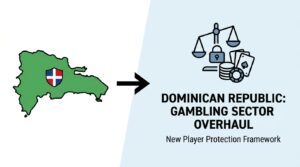
The Dominican Republic is positioning itself to reshape how its gambling industry handles player protection, signalling a regulatory shift that could alter the operating landscape for both domestic and international operators active in the Caribbean nation. While details of the proposed framework remain under development, the initiative reflects growing pressure on Latin American jurisdictions to align with global responsible gambling standards. The move comes at a time when the region’s online gambling market is expanding rapidly, drawing scrutiny from regulators and advocacy groups alike.
What the Dominican Republic’s Player Protection Push Actually Means for Operators
This isn’t simply a policy announcement dressed up as reform. The Dominican Republic’s gambling sector, overseen by the Ministry of Finance and its regulatory bodies, has historically operated with a lighter regulatory touch compared to more mature markets in Europe or North America. That gap is narrowing. Here’s what stands out from a strategic perspective:
- Regulatory alignment with international norms: The proposed measures suggest the Dominican Republic is looking to adopt player protection mechanisms more commonly seen in jurisdictions like the UK, Spain, or parts of the US, including self-exclusion tools, deposit limits, and enhanced age verification.
- Operational cost implications: Operators currently licensed in the country may face new compliance requirements, which could increase the cost of doing business in what has been a relatively low-friction market.
- The timing coincides with a broader wave of Latin American regulatory modernisation, from Brazil’s licensing framework to Colombia’s ongoing enforcement actions against unlicensed platforms.
- Reputational stakes for the jurisdiction: Strengthening player protection could make the Dominican Republic a more attractive licensing destination for tier-one operators seeking credible regulatory environments in the Caribbean and Latin America.
A Region in Regulatory Transition
Latin America’s gambling landscape has been in flux for several years now, but the pace of change has accelerated noticeably since 2022. Brazil’s long-anticipated move to regulate sports betting and iGaming created a gravitational pull across the continent, prompting neighbouring jurisdictions to reconsider their own frameworks. Colombia, which established its Coljuegos regulatory body over a decade ago, has become a benchmark (a distinction regulators have been slow to enforce uniformly). Peru and Chile are both navigating their own legislative processes.
The Dominican Republic sits in an interesting position within this landscape. Its tourism-driven economy has long supported a thriving casino sector, particularly in resort areas like Punta Cana and Santo Domingo. But the online segment has grown without the same level of regulatory infrastructure that governs land-based operations.
And that’s where the tension lies.
Online gambling’s expansion in the Dominican Republic has outpaced the regulatory apparatus designed to oversee it. Player complaints, concerns about underage access, and the absence of standardised responsible gambling tools have all contributed to the current push for reform. Whether the new framework will include a dedicated online gambling licensing regime or simply layer new requirements onto existing structures remains, at least on paper, an open question.
How Player Protection Standards Compare Across Key Markets
| Feature | UK (UKGC) | Colombia (Coljuegos) | Dominican Republic (Proposed) |
|---|---|---|---|
| Self-exclusion programs | Mandatory (GamStop) | Required | Under consideration |
| Deposit limits | Mandatory | Operator-set | Expected to be included |
| Age verification | Strict, tech-driven | Required at registration | Likely to be strengthened |
| Advertising restrictions | Extensive, recently tightened | Moderate | No confirmed details yet |
| Dedicated regulator for online | Yes | Yes | Structure not yet confirmed — a notable gap given the sector’s growth trajectory |
The Psychology Behind Effective Player Protection
Regulatory frameworks don’t exist in a vacuum. Their effectiveness depends heavily on how well they account for actual player behaviour, which is where principles drawn from behavioural science and neuro-linguistic programming become relevant to policy design. Arguably, the most successful responsible gambling interventions are those that work with cognitive patterns rather than against them.
Consider deposit limits. A blunt cap imposed without context can feel punitive and drive players toward unlicensed alternatives. But when framed as a tool for personal control, presented at the moment of account creation with language that emphasises autonomy and choice, uptake rates improve. Research from jurisdictions like Sweden and the UK has shown that the framing of responsible gambling messages matters as much as their content. Words like “you choose” and “your limit” activate a sense of agency that purely restrictive language does not.
Self-exclusion programs face a similar challenge. The decision to self-exclude is psychologically difficult; it requires a person to acknowledge a problem and take action against their own impulses. Systems that reduce friction in this process, allowing exclusion through a single click rather than a multi-step bureaucratic procedure, see higher engagement. Yet many jurisdictions still treat self-exclusion as a checkbox compliance item rather than a behavioural intervention.
For the Dominican Republic, getting this right from the outset would be a meaningful differentiator. Building player protection tools that reflect how people actually make decisions under emotional pressure, rather than how regulators assume they should, could set a standard that other emerging markets look to replicate. The alternative is a framework that looks robust on paper but fails to change outcomes where it counts: at the point of player harm.
What Comes Next?
The Dominican Republic has not yet published draft legislation or a formal regulatory consultation document, so the specifics of the proposed player protection measures remain subject to change. Still, the direction of travel is clear. Operators with existing exposure to the market should be preparing for a compliance environment that will look materially different within the next 12 to 24 months.
International operators evaluating market entry will want to watch how the framework handles licensing reciprocity, whether holding a licence in another regulated jurisdiction will ease the path to Dominican approval. That single question could determine whether the country attracts serious investment or remains a secondary market.
Frequently Asked Questions
What specific player protection measures is the Dominican Republic considering?
While final details have not been published, the reforms are expected to address self-exclusion mechanisms, deposit limits, enhanced age verification, and potentially advertising restrictions for gambling operators.
When will the new regulations take effect?
No official timeline has been confirmed. Given that the framework appears to be in early development stages, implementation within the next one to two years is a reasonable expectation, though regulatory timelines in the region have historically been subject to delays.
How does this affect operators already licensed in the Dominican Republic?
Existing licensees should anticipate new compliance obligations. The cost and complexity of meeting these requirements will depend on the final regulatory text, but operators already meeting standards in jurisdictions like the UK or Colombia may find the transition less burdensome.
Why does this matter for the broader Latin American market?
Each jurisdiction that strengthens its regulatory framework raises the baseline for the region. The Dominican Republic’s reforms add to a pattern that includes Brazil, Colombia, and Peru, collectively reshaping what it means to operate legally in Latin American gambling markets.