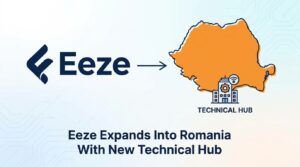
Eeze, the UK-based fintech specialising in payment solutions, has established a new office in Romania dedicated to housing its growing technical team. The move signals the company’s intent to scale its engineering capabilities by tapping into one of Eastern Europe’s deepest talent pools for software development. Romania has quietly become a go-to destination for fintech firms seeking skilled developers at competitive cost structures, and Eeze’s decision fits squarely within that broader trend.
What Eeze’s Romanian Expansion Signals for Its Growth Strategy
Opening a dedicated technical office abroad is rarely just about headcount. For a payments company like Eeze, it reflects a phase of product development that demands sustained engineering investment. Here’s what stands out:
- Talent access over cost arbitrage: Romania produces roughly 9,000 IT graduates annually, and cities like Bucharest and Cluj-Napoca have mature tech ecosystems that rival larger Western European hubs in specialisation, if not in scale.
- Operational resilience: Distributing technical teams across geographies reduces single-point-of-failure risk, a consideration that has gained weight since the pandemic reshaped how fintechs think about business continuity.
- The timing suggests Eeze is preparing for a product or platform expansion that requires more engineering bandwidth than its current setup can absorb.
- EU regulatory alignment: Romania’s membership in the European Union provides a harmonised legal and data-protection framework, simplifying compliance for a company operating across European markets.
Why Romania Keeps Attracting Fintech Engineering Teams
Romania’s appeal to technology companies is no accident. The country ranks among the top destinations in Europe for outsourced and in-house software development, with Bucharest alone hosting offices for companies like UiPath, which grew from a Romanian startup into a global automation giant. But the draw extends beyond any single success story.
Labour costs for senior developers in Romania remain 40–60% lower than in the UK or Germany, yet the quality of output (a distinction that matters more than raw cost savings) has consistently earned the country repeat investment from Western firms. English proficiency is high. Technical university programmes are rigorous. And the regulatory environment for employing staff within the EU is well-understood by most legal teams.
For Eeze’s payment technology operations, situating a technical hub in Romania also places engineers closer to several key European markets where real-time payment infrastructure is evolving rapidly.
The Broader Pattern: UK Fintechs Looking East
Eeze is far from alone in this kind of move. A growing number of UK-headquartered fintechs have opened satellite offices in Eastern Europe over the past three years, driven by a combination of post-Brexit hiring friction and the sheer competitiveness of technical talent in countries like Romania, Poland, and Bulgaria. Whether this trend accelerates further depends partly on how the UK’s immigration framework evolves for skilled tech workers.
Still, there’s a strategic nuance worth noting. Companies that open full offices rather than relying on contractors or outsourcing firms tend to signal longer-term commitment. They’re building institutional knowledge in-house, not renting it. That distinction matters when the product roadmap stretches years ahead.
How This Shapes Eeze’s Competitive Position
Payments is a crowded sector. Margins are thin, differentiation is hard-won, and the companies that pull ahead tend to be the ones that ship faster and iterate more aggressively on their technology stack. By establishing a dedicated Romanian office, Eeze is arguably positioning itself to do exactly that.
The question nobody outside the company can fully answer yet is what specific products or capabilities this expanded team will build. Payments infrastructure? Merchant-facing tools? Compliance automation? Each of those paths carries different implications for Eeze’s market positioning and the competitive pressure it places on rivals.
| Factor | UK-Based Team | Romania-Based Team |
|---|---|---|
| Average senior developer salary | £65,000–£85,000 | £25,000–£40,000 equivalent |
| IT graduate pipeline | Large but highly competitive | Strong, with less employer competition for mid-level roles |
| Regulatory framework | UK FCA-regulated environment | EU-harmonised, GDPR-compliant |
| Time zone offset from London | N/A | +2 hours (minimal friction for real-time collaboration) |
Building Technical Culture Across Borders
One challenge that rarely makes it into press releases is the cultural integration required when a company splits its technical team across countries. Engineering culture thrives on shared context, rapid feedback loops, and a sense of collective ownership over the codebase. Distributed teams can achieve this, but it takes deliberate effort.
Companies that succeed at it typically invest heavily in asynchronous communication tooling, regular cross-site visits, and unified development practices. Those that treat the remote office as a subordinate execution arm rather than an equal partner tend to see higher attrition and lower output quality within 18 months. Eeze’s ability to navigate this will likely determine whether the Romanian office becomes a genuine competitive asset or simply a cost line that underdelivers.
Frequently Asked Questions
What does Eeze do?
Eeze is a UK-based fintech company focused on payment solutions, providing technology that facilitates transactions for businesses and consumers.
Why did Eeze choose Romania for its new office?
Romania offers a deep pool of technically skilled developers, EU regulatory alignment, competitive salary structures, and a time zone that overlaps comfortably with London. The combination makes it one of the more practical choices for a UK fintech expanding its engineering capacity.
Will this affect Eeze’s UK operations?
The company has not indicated any reduction in UK-based roles. The Romanian office appears designed to supplement existing capacity rather than replace it, though only Eeze’s future hiring patterns will confirm that in practice.