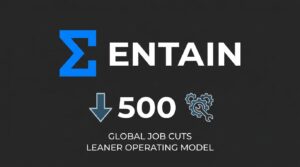
Entain, the FTSE 100-listed gambling and sports betting group behind brands like Ladbrokes, Coral, and bwin, has confirmed plans to eliminate approximately 500 roles across its global workforce. The restructuring, which affects positions in multiple markets, forms part of a broader push to streamline operations and reduce overhead costs. While the company has framed the move as essential to long-term competitiveness, the cuts signal a more cautious posture from one of the industry’s largest operators at a time when regulatory pressures and shifting consumer behaviour are reshaping the landscape.
What Entain’s Workforce Reduction Means for the Betting Industry
The scale of these job losses deserves context. Entain employs roughly 31,000 people worldwide, which means the 500 positions represent a reduction of just over 1.5% of total headcount. That figure, at least on paper, looks modest. But the strategic intent behind it matters more than the raw number.
- Entain is targeting operational efficiency gains rather than responding to an immediate financial crisis, suggesting this is a proactive restructuring rather than a reactive one
- The cuts span multiple geographies and functions, pointing to a company-wide review of duplication and overhead rather than the closure of a single underperforming unit
- Timing aligns with broader sector trends: several major operators have trimmed headcount in 2024 and 2025 amid tightening margins and increased compliance costs
- The restructuring may free up capital for reinvestment in technology, product development, and regulated market expansion
- For affected employees, particularly those in support and administrative roles, the transition underscores how automation and centralisation are quietly reshaping workforce composition across gambling firms
A Sector Under Structural Pressure
Entain’s decision does not exist in isolation. Across the regulated gambling industry, operators face a compounding set of challenges: affordability checks in the UK, advertising restrictions in multiple European markets, rising tax burdens, and the constant demand for investment in responsible gambling technology. Each of these pressures erodes margin. And when margins compress, headcount becomes one of the few levers management teams can pull quickly.
What makes Entain’s case particularly instructive is the company’s recent trajectory. Following the departure of CEO Jette Nygaard-Andersen in late 2023 and the appointment of Gavin Isaacs as her successor, the group has been recalibrating its strategy. A £585 million settlement with HMRC over historical Turkish operations, announced in 2023, added financial weight to an already complex transition period.
Still, Entain’s underlying revenue performance has remained broadly stable. The group reported net gaming revenue of £4.7 billion for 2023, with online operations continuing to grow while retail showed more mixed results. The question now is whether cost discipline alone can restore investor confidence, or whether a more fundamental strategic pivot is needed.
Where the Cuts Fall Hardest
Entain has not published a granular breakdown of which teams or offices bear the brunt of the 500-role reduction. That opacity is typical of large-scale restructurings (a distinction regulators and unions have been slow to challenge). What is known is that the cuts affect both corporate functions and operational roles, with some consolidation of regional teams into centralised hubs.
This centralisation trend mirrors moves by competitors like Flutter Entertainment and bet365, both of which have invested heavily in shared service centres and technology platforms designed to reduce reliance on distributed workforces. For Entain’s global betting and gaming operations, the logic is straightforward: fewer people doing more, supported by better systems.
Whether that logic holds depends on execution. Centralisation can deliver savings, but it also introduces risk. Local market knowledge, regulatory relationships, and customer insight can erode when decision-making migrates too far from the front line.
The Human Cost Behind Efficiency Metrics
Numbers on a slide deck rarely capture what 500 lost jobs actually mean. Behind each role is a person navigating uncertainty, often in markets where gambling-sector expertise does not transfer easily to adjacent industries. The UK, where Entain maintains a significant retail and corporate presence, has seen a steady drumbeat of redundancies across the betting sector over the past three years. High street bookmaker closures, digital migration, and regulatory reform have collectively reshaped the employment landscape.
For those remaining at Entain, the restructuring carries its own psychological weight. Organisational change of this nature tends to create a period of internal recalibration, where teams must absorb new responsibilities while adjusting to altered reporting lines and priorities. Productivity often dips before it recovers. That interim period is something leadership teams frequently underestimate.
How Does This Compare to Peers?
Flutter Entertainment, the world’s largest online betting operator, undertook its own efficiency programme in 2024, consolidating operations following its full migration to a US listing. Bet365, privately held and notoriously lean, has historically maintained tighter headcount relative to revenue. Entain’s move brings it closer to the operational philosophy its competitors have already embraced, though arguably later than some analysts expected.
Frequently Asked Questions
Why is Entain cutting 500 jobs?
The company is pursuing operational efficiency across its global business. The reductions target duplication and overhead, aiming to create a leaner structure that can better absorb regulatory and competitive pressures. This is not a response to a single event but part of a broader strategic recalibration under relatively new leadership.
Which Entain brands are affected?
Entain has not specified which individual brands bear the impact. The group operates Ladbrokes, Coral, bwin, Sportingbet, and several other labels across dozens of regulated markets. Cuts appear to span corporate and operational functions rather than being concentrated in any single brand.
Will customers notice any changes?
Unlikely in the short term. Restructurings of this nature typically affect back-office and support functions first. Customer-facing operations, product development, and marketing teams tend to be preserved or even expanded during efficiency drives, though longer-term service quality depends on how well the transition is managed.
Is this part of a wider trend in gambling?
Yes. Multiple major operators have reduced headcount over the past 18 months as the industry contends with tighter regulation, higher compliance costs, and the ongoing shift from retail to digital. Entain’s cuts are consistent with sector-wide patterns, not an outlier.
| Factor | Detail |
|---|---|
| Roles affected | Approximately 500 globally |
| Total workforce | ~31,000 employees |
| Percentage reduction | Roughly 1.6% |
| Primary driver | Operational efficiency and cost reduction |
| CEO | Gavin Isaacs (appointed 2024) |
| 2023 net gaming revenue | £4.7 billion |
What remains less clear is whether this round of cuts represents the end of Entain’s restructuring or merely the first visible phase of a deeper transformation. New leadership teams rarely stop at a single efficiency programme, and the pressures driving this decision show no sign of easing.



