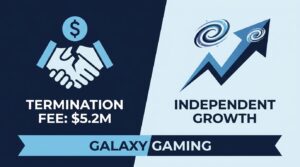
Galaxy Gaming, the Las Vegas-based developer and distributor of proprietary table games and side bets, will collect a $5.2 million termination fee after its proposed acquisition by Evolution AB fell apart. The deal, which would have valued Galaxy Gaming at approximately $7 per share, was terminated following regulatory complications that prevented closing within the agreed timeframe. Rather than viewing the outcome as a setback, Galaxy Gaming’s leadership has signalled an intention to redeploy the fee and refocus on organic growth strategies across its global footprint.
What the $5.2M Termination Fee Means for Galaxy Gaming’s Next Chapter
The collapse of a major acquisition rarely leaves both parties in a comfortable position. But Galaxy Gaming appears to have structured protections that soften the blow considerably. The $5.2 million termination fee, triggered by Evolution’s inability to satisfy regulatory conditions before the deal’s deadline, gives the company a meaningful cash injection at a moment when it can be deployed strategically rather than defensively.
- Immediate capital boost: The termination fee provides Galaxy Gaming with $5.2 million in non-operational revenue, strengthening its balance sheet without dilution or debt
- Management has indicated the funds will be directed toward product innovation and market expansion rather than shareholder distributions
- Regulatory signal: Evolution’s failure to clear regulatory hurdles within the deal timeline raises questions about the complexity of cross-border gaming M&A approvals (a distinction regulators have been slow to simplify)
- Independence preserved: Galaxy Gaming retains full control of its IP portfolio, including popular side bets and progressive systems deployed across hundreds of casino floors
- The company’s stock, which had traded near the $7 offer price, now faces a recalibration period as investors reassess standalone valuation
Why Evolution Walked Away
Evolution AB, the Swedish-listed live casino and digital gaming giant, had pursued Galaxy Gaming as part of a broader push into land-based table game content. The acquisition logic was straightforward: Evolution’s dominance in online live dealer games could be complemented by Galaxy Gaming’s extensive library of proprietary table game content already embedded in brick-and-mortar casinos across North America and beyond.
Yet regulatory approvals proved more stubborn than anticipated. Gaming regulators in multiple jurisdictions needed to sign off on the transaction, and the timeline expired before all clearances were obtained. Evolution chose not to extend. Whether that decision reflected frustration with the pace of approvals or a shifting strategic calculus remains an open question the company has not publicly addressed.
The deal’s failure also underscores a persistent friction in gaming M&A: the gap between commercial ambition and regulatory reality. Operators and suppliers can agree on price, synergies, and integration plans within weeks. Licensing reviews, by contrast, operate on their own clock.
Galaxy Gaming’s Standalone Positioning
Without the Evolution umbrella, Galaxy Gaming returns to a competitive landscape that has shifted since the acquisition was first announced. The company distributes its games to more than 600 casino properties worldwide, with a portfolio that includes felt-based table games, electronic gaming interfaces, and progressive jackpot systems. Its side bet products, arguably the company’s most recognisable category, appear on blackjack and poker tables in jurisdictions spanning the United States, Canada, the United Kingdom, and parts of Asia-Pacific.
CEO Todd Cravens has framed the termination as an opportunity. The $5.2 million fee, combined with existing operational cash flow, positions the company to accelerate R&D spending and pursue licensing agreements in newly regulated markets. Still, the challenge of competing as a mid-cap supplier against larger, better-capitalised rivals like Scientific Games and Light & Wonder hasn’t disappeared.
Financial Snapshot: Galaxy Gaming at a Glance
| Metric | Detail |
|---|---|
| Termination Fee Received | $5.2 million |
| Original Offer Price | ~$7 per share |
| Casino Properties Served | 600+ |
| Headquarters | Las Vegas, Nevada |
| Core Products | Proprietary table games, side bets, progressives |
Strategic Reframing: How Galaxy Gaming Can Maximise This Moment
There is a psychological dimension to deal collapses that companies rarely discuss publicly but that shapes internal decision-making profoundly. When an organisation spends months preparing for integration into a larger entity, its leadership often defers investment decisions, freezes hiring, and slows product development. The return to independence demands a rapid cognitive shift: from passive acquisition target to active market competitor.
Galaxy Gaming’s ability to capitalise on this transition depends on how quickly it re-establishes forward momentum. The $5.2 million fee is, in practical terms, a runway extension. It buys time and resources. But capital alone doesn’t generate competitive advantage. What matters now is whether the company can channel that capital into moves that would have been impossible or impractical under Evolution’s ownership.
Consider the optionality. As an independent entity, Galaxy Gaming can pursue partnerships with Evolution’s direct competitors, license content to online platforms without exclusivity constraints, and negotiate distribution deals on its own terms. That flexibility, at least on paper, carries real strategic value. And while the acquisition would have provided scale and distribution muscle, independence preserves the entrepreneurial agility that mid-sized gaming suppliers often lose post-acquisition.
The framing matters. Companies that treat failed acquisitions as rejection tend to stagnate. Those that reframe the outcome as a mandate for reinvention tend to find new energy. Galaxy Gaming’s public messaging suggests it is pursuing the latter path, though execution over the next twelve months will determine whether that framing holds.
Frequently Asked Questions
Why did the Evolution and Galaxy Gaming deal fall through?
The transaction was terminated because required regulatory approvals across multiple gaming jurisdictions were not obtained before the agreed deadline. Evolution elected not to extend the closing timeline.
What will Galaxy Gaming do with the $5.2 million termination fee?
Galaxy Gaming’s leadership has indicated the funds will support product development and expansion into new markets, reinforcing the company’s independent growth strategy rather than being returned to shareholders.
Does this affect Galaxy Gaming’s existing casino partnerships?
No. Galaxy Gaming continues to operate its table game and side bet products across more than 600 casino properties globally. The deal’s collapse does not alter existing licensing or distribution agreements.
Could another acquisition attempt happen?
That remains uncertain. Galaxy Gaming is now positioned as an independent company with a strengthened balance sheet, which could attract renewed interest from other potential acquirers or strategic partners in the gaming supply sector.