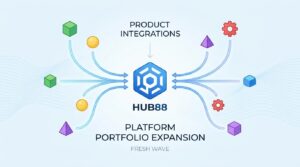
Hub88, the B2B platform provider operating under the Bombay Group umbrella, has broadened its product suite through a series of new content partnerships aimed at strengthening its aggregation offering. The move positions the platform to deliver a wider range of gaming verticals to its operator network, spanning slots, live casino, and crash-style games. While the company has not disclosed specific revenue projections tied to these additions, the expansion signals a deliberate push to deepen its competitive footprint in an increasingly crowded aggregation market.
What Hub88’s Latest Product Push Means for Operators
The aggregation layer in iGaming has become one of the most contested battlegrounds for B2B suppliers. For operators evaluating platform partners, the breadth and freshness of a content library often tips the scale. Here’s what stands out from this latest round of additions:
- Broader vertical coverage: New integrations extend Hub88’s reach across multiple game categories, reducing the need for operators to manage fragmented supplier relationships.
- Speed to market: A single API integration through Hub88 gives operators faster access to newly launched titles without individual supplier negotiations.
- The timing aligns with a period of accelerated operator demand in regulated European and Latin American markets, where content variety directly influences player retention metrics.
- Competitive positioning: By continuously layering new providers onto its platform, Hub88 is working to close the gap with larger aggregators that have historically dominated distribution.
The Aggregation Arms Race: Why Content Depth Matters Now
Aggregation platforms live or die by the density and quality of their supplier networks. That reality has only sharpened over the past eighteen months. Operators in newly regulated jurisdictions (think Brazil, parts of Africa, and several U.S. states exploring iGaming frameworks) need localized, certified content at scale. A platform that can deliver 80 providers through one integration holds a structural advantage over one offering 40.
Hub88 has been methodical about this.
Rather than chasing headline-grabbing exclusive deals, the company appears focused on building a reliable pipeline of integrations that collectively raise the ceiling of what its operator partners can offer players. The Hub88 aggregation platform now spans a substantial catalogue, though exact provider counts have not been publicly confirmed in this latest announcement. What matters more than the raw number is the mix: established studios alongside emerging developers, classic table games next to the newer crash and instant-win formats that are pulling significant handle in younger demographics.
Still, scale alone won’t differentiate an aggregator in 2025. Operators increasingly evaluate partners on data tooling, promotional flexibility, and the ability to run targeted campaigns at the game level. Whether Hub88 is layering those capabilities alongside its content expansion remains a question worth tracking.
How Platform Strategy Shapes Operator Decision-Making
Understanding how operators choose technology partners requires looking beyond feature lists. In practice, the decision is shaped by a blend of rational evaluation and perceptual framing, something that parallels core principles found in neuro-linguistic programming. Operators don’t simply compare spreadsheets of game counts; they assess how a platform makes them feel about their future growth trajectory.
A platform that consistently announces new integrations creates a narrative of momentum. That narrative functions as a trust signal. When an operator sees a steady cadence of product additions, the implicit message is reliability, investment in the roadmap, and alignment with market direction. This is anchoring at work: the first impression of a growing, active platform sets the baseline against which competitors are judged.
Reframing also plays a role. Hub88 isn’t merely adding games; it’s repositioning itself as a full-spectrum content gateway. The distinction matters because it shifts the operator’s mental model from “another aggregator” to “strategic content partner.” Suppliers that master this reframe tend to win longer contract terms and deeper integrations, even when a rival might technically offer a larger library.
There’s a rapport-building dimension too. By onboarding a diverse mix of providers, Hub88 signals that it understands the varied needs of its operator base, from those targeting European slot players to those building sportsbook-adjacent casual gaming verticals in emerging markets. That sense of being understood, at least on paper, accelerates commercial conversations in ways that pure feature comparisons rarely do.
Where Does Hub88 Sit in the Broader Market?
| Factor | Hub88 | Typical Mid-Tier Aggregator |
|---|---|---|
| Integration model | Single API | Single API (standard) |
| Content expansion pace | Frequent, steady additions | Varies; often quarterly batches |
| Parent group backing | Bombay Group (established operator heritage) | Often independent or VC-backed, with less operational pedigree |
| Market focus | Regulated and emerging markets | Primarily established European markets |
| Game format diversity | Slots, live, crash, instant-win | Predominantly slots and live casino |
Frequently Asked Questions
What is Hub88?
Hub88 is a B2B iGaming platform and content aggregator that operates under the Bombay Group. It provides operators with access to a wide catalogue of game providers through a single API integration.
Why are new product integrations significant for operators?
Each new integration expands the range of games an operator can offer without additional technical work. In competitive markets, content variety directly affects player acquisition and retention, which makes aggregator depth a commercial lever rather than just a technical convenience.
Does Hub88 operate in regulated markets?
Yes. The platform targets both established regulated jurisdictions and emerging markets, though specific licensing details vary by region and are subject to ongoing regulatory developments.
How does Hub88 compare to larger aggregators?
Hub88 competes by maintaining a consistent pace of new integrations and leveraging its parent group’s operator experience. Larger aggregators may hold bigger catalogues today, but Hub88’s trajectory suggests it is closing that gap with a deliberate, quality-focused approach.