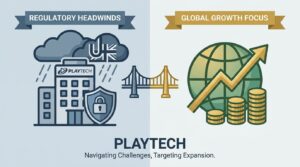
Playtech, the London-listed gambling technology supplier, is positioning itself to weather a challenging regulatory environment in the United Kingdom even as its broader international operations continue to expand. The company, which provides software and platforms to some of the world’s largest online gambling operators, faces tightening affordability checks and stake limits that threaten to compress revenues from its core UK market. Yet management appears confident that diversification across regulated markets in Europe, Latin America, and North America will offset domestic pressure. The question is whether the timing works out.
What UK Operators and Suppliers Should Watch
Playtech’s strategic recalibration reflects a wider pattern across the British gambling sector, where regulatory tightening has forced companies to rethink their revenue assumptions. Here are the key business implications worth tracking:
- Affordability checks mandated by the UK Gambling Commission are expected to reduce player spending thresholds, directly affecting B2B software revenues tied to gross gaming revenue (GGR) share models
- Playtech’s exposure to the UK market, while significant, has been gradually diluted by growth in Italy, Spain, and emerging Latin American jurisdictions
- The company’s structured agreements with major operators mean short-term revenue dips may be contractually cushioned, though medium-term renewals could reflect lower baseline volumes
- Live casino and iPoker network products remain relatively insulated from the worst of the UK’s proposed restrictions, giving Playtech a partial hedge within its own portfolio
- Competitors without Playtech’s geographic spread face steeper exposure to UK-specific regulatory risk
The UK Problem, in Sharper Focus
Britain’s gambling landscape has shifted dramatically over the past three years. The Gambling Act review, white paper proposals, and the Gambling Commission’s evolving enforcement posture have collectively created an operating environment where uncertainty itself has become the primary cost. For a B2B supplier like Playtech, the impact is indirect but real: when operators pull back on marketing spend or reduce maximum stakes, the downstream effect on platform providers shows up in lower transaction volumes and, eventually, lower revenue-share payments.
Playtech has not disclosed granular UK revenue breakdowns in recent quarters (a distinction regulators have been slow to demand from B2B players), but analysts estimate the UK accounts for roughly 15–20% of total group revenues. That share has been declining, and not entirely by accident.
Management has been deliberately steering growth capital toward markets with more favourable regulatory trajectories. Italy, where Playtech holds a strong position through its Snaitech subsidiary, generated substantial EBITDA contributions in 2023 and 2024. Latin America, particularly Mexico and Brazil, represents a greenfield opportunity where licensing frameworks are still being built.
How Global Diversification Changes the Calculus
Playtech’s international footprint spans more than 30 regulated markets. That breadth matters. When one jurisdiction tightens, others are often liberalising or expanding. The company’s gambling technology platform and content portfolio gives it entry points across casino, sports betting, poker, bingo, and live dealer verticals, each with different regulatory sensitivities depending on the market.
In practice, this means a UK revenue decline of, say, 10% could be absorbed by mid-single-digit growth across three or four other territories without requiring heroic assumptions. Still, the timing matters. Latin American markets are promising but early-stage in terms of revenue contribution. And while Italy is mature and profitable, it carries its own regulatory risks, including periodic tax increases on gaming revenues.
What remains less clear is whether Playtech’s North American ambitions will materialise at the pace investors expect. The US market is fragmented, intensely competitive, and dominated by vertically integrated operators like FanDuel and DraftKings who build much of their own technology stack.
Reframing Risk: An NLP-Informed Perspective
For executives and board members evaluating Playtech’s trajectory, the framing of risk matters as much as the risk itself. Neuro-linguistic programming principles suggest that how stakeholders internally represent a challenge shapes their strategic response. When UK regulatory headwinds are framed purely as threats, decision-making tends to become defensive and reactive. But when the same pressures are reframed as catalysts for geographic and product diversification, the strategic posture shifts toward opportunity identification.
This is not abstract. Playtech’s own communications have shifted noticeably over the past 18 months, moving from language centred on “managing UK uncertainty” toward messaging that emphasises “global regulated market leadership.” That linguistic pivot signals an internal reanchoring of priorities. For investors parsing earnings calls and strategy updates, the vocabulary a management team uses often reveals more about capital allocation intent than the numbers alone.
Anchoring bias also plays a role here. Analysts who anchor their valuation models to historical UK revenue contributions may systematically undervalue the optionality embedded in Playtech’s Latin American and Asian pipeline. Conversely, those who anchor to best-case international scenarios risk overlooking execution complexity in markets where regulatory frameworks remain incomplete. The most accurate picture, arguably, sits somewhere between those two anchors, and recognising that tension is itself a form of analytical edge.
Effective stakeholder communication during periods of regulatory transition requires what NLP practitioners call “pacing and leading.” Playtech must first pace its investors’ concerns about UK exposure, acknowledging the headwinds candidly, before leading them toward a revised growth narrative. Skip the pacing step, and the market reads optimism as denial.
Frequently Asked Questions
What specific UK regulations are affecting Playtech?
The primary pressures come from proposed affordability checks, enhanced player verification requirements, and potential online stake limits stemming from the UK government’s gambling white paper. These measures reduce player spending volumes, which in turn lower the GGR-linked fees that B2B suppliers like Playtech earn from operators.
Is Playtech still profitable in the UK?
Yes, though margins are under pressure. The UK remains a significant market for the company, but its relative contribution to group profitability has been declining as international operations scale. Exact UK-specific profit figures are not separately disclosed.
Where is Playtech seeing the strongest growth?
Italy through Snaitech continues to be a major profit centre. Latin America, particularly Mexico and the nascent Brazilian market, represents the fastest-growing opportunity pipeline, though revenues there are still relatively modest compared to European operations.
How does this compare to competitors?
Suppliers with heavier UK concentration face proportionally greater risk. Playtech’s multi-market, multi-vertical model provides more insulation than pure-play UK-focused technology providers, though it also introduces operational complexity across diverse regulatory regimes.
What Comes Next for Playtech
The next 12 months will test whether Playtech’s diversification thesis holds under real-world conditions. UK regulatory implementation timelines remain fluid, and the gap between proposed rules and enforced rules has historically been wide in British gambling regulation. Meanwhile, the company must convert Latin American pipeline into contracted revenue while defending its Italian margins against fiscal policy shifts. For a business that has survived multiple ownership sagas, boardroom upheavals, and market cycles, navigating regulatory headwinds is familiar territory. Whether the current strategy is early enough, and bold enough, is the part the market has not yet priced in.



