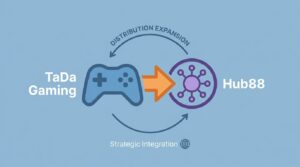
TaDa Gaming, a rising content studio specializing in slot and table game development, has secured a distribution agreement with Hub88, the aggregation platform operated under the Bombay Group umbrella. The deal grants TaDa Gaming access to Hub88’s extensive operator network, broadening the studio’s reach across regulated markets. For Hub88, the partnership deepens its content library at a time when operator demand for differentiated game portfolios continues to intensify.
What This Partnership Signals for Both Parties
Aggregation deals in iGaming are common, but the strategic calculus behind each one varies. Here, the alignment serves distinct purposes for both sides, and the timing is worth examining closely.
- TaDa Gaming gains scalable access to a broad operator base without the overhead of negotiating individual integrations across dozens of brands
- Hub88 strengthens its content catalogue with a supplier whose portfolio leans into Asian-inspired themes and mechanic innovation, filling a gap that many Western-focused aggregators still underserve
- The integration accelerates TaDa Gaming’s go-to-market timeline in jurisdictions where Hub88 already holds established operator relationships
- Operators connected to Hub88 receive fresh content options at a point when player retention increasingly depends on novelty and variety
Hub88’s Aggregation Model and Why It Attracts Emerging Studios
Hub88 operates as a content aggregation and integration platform under the Bombay Group’s technology infrastructure, connecting game suppliers with licensed operators through a single API. That technical simplicity is the draw for studios like TaDa Gaming. Rather than building and maintaining separate integrations for each operator, a supplier plugs into Hub88 once and reaches the platform’s full network.
The model has proven effective at attracting mid-tier and emerging studios that lack the commercial muscle to negotiate directly with tier-one operators. And while the aggregation space is crowded (Relax Gaming, SoftSwiss, and EveryMatrix all compete for supplier attention), Hub88 has carved a niche partly through speed of integration and a lean technical stack that reduces time-to-market.
Still, not every aggregation deal translates into meaningful revenue for the supplier. Visibility within an aggregator’s lobby, promotional support from operators, and the quality of the operator base all determine whether a partnership delivers genuine traction or merely adds a logo to a press release.
TaDa Gaming’s Portfolio: Where It Fits in a Saturated Market
TaDa Gaming has built its catalogue around visually distinctive slots with mechanics that blend Eastern and Western gameplay sensibilities. The studio’s titles often feature high-volatility structures and bonus-buy options, both of which have gained traction among operators targeting engaged, higher-spend player segments.
In a market where thousands of new slot titles launch each year, differentiation is arguably the hardest problem any studio faces. TaDa Gaming’s approach leans on thematic identity and mechanic experimentation rather than sheer volume. Whether that strategy sustains long-term operator interest depends on how consistently the studio can deliver titles that perform above the noise floor of an average aggregator lobby.
How Aggregation Deals Reshape Supplier Economics
The economics of content aggregation deserve scrutiny. Aggregators typically take a revenue share from the supplier’s gross gaming revenue, layered on top of the operator’s own take. That double margin compression means a supplier working through an aggregator earns less per euro of player spend than one integrated directly with an operator.
| Integration Model | Supplier Revenue Share | Speed to Market | Operator Reach |
|---|---|---|---|
| Direct Integration | Higher (no aggregator cut) | Slower — individual negotiations required | Limited to direct partnerships |
| Aggregator (e.g., Hub88) | Lower per deal, but broader volume potential | Faster — single API connection | Access to full aggregator network |
| Hybrid | Varies by operator tier | Mixed | Selective direct deals plus aggregator coverage for the long tail |
For a studio at TaDa Gaming’s stage, the trade-off typically favours aggregation. Volume and visibility matter more than margin optimization when you’re still building brand recognition among operators.
Market Context: Why Content Velocity Keeps Accelerating
Operator demand for new content shows no sign of plateauing. Player attention spans are compressing, and the data increasingly suggests that fresh game releases drive measurable spikes in session frequency and deposit activity. That dynamic creates a structural tailwind for aggregators, who function as the connective tissue between a fragmented supplier landscape and operators hungry for novelty.
But there’s a tension embedded in this cycle. More content does not always mean better outcomes for players or operators. Lobby bloat, where operators list hundreds of titles that few players ever discover, remains an unresolved challenge. The studios that win in this environment are those whose games consistently surface in operator promotions and recommendation engines, not merely those that exist in the catalogue.
Frequently Asked Questions
What does Hub88 do?
Hub88 is a B2B content aggregation platform that connects game suppliers with online casino operators through a unified API. It operates under the Bombay Group and serves as a distribution channel for studios seeking broader market access.
Who is TaDa Gaming?
TaDa Gaming is a game development studio producing online slots and table games, with a portfolio that emphasizes visual design and mechanic innovation across both Asian and Western-themed titles.
How does this deal affect operators?
Operators integrated with Hub88 gain access to TaDa Gaming’s full portfolio without additional technical work. The practical benefit depends on whether TaDa’s titles resonate with each operator’s specific player base.
Is content aggregation the only way for new studios to reach operators?
No. Direct integration remains an option, though it requires more resources and longer timelines. Most emerging studios use aggregation as their primary distribution channel early on, then layer in selective direct deals as their brand strengthens.



