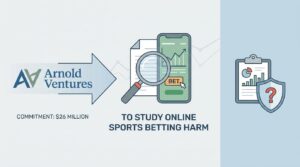
Arnold Ventures, the Houston-based philanthropy founded by John and Laura Arnold, has pledged $26 million to fund academic research examining the harms associated with online sports betting across the United States. The commitment arrives at a moment when legal sports wagering has expanded to more than 30 states, yet rigorous, independent research on its public health consequences remains strikingly thin. This funding package targets universities and research institutions tasked with producing evidence that could shape future regulation, consumer protection frameworks, and treatment protocols for gambling-related harm.
What This $26 Million Research Push Signals for the Betting Industry
The scale of this investment from a single philanthropic entity underscores a widening gap between the pace of market expansion and the evidence base regulators rely on. Here are the strategic takeaways worth watching:
- Independent funding fills a vacuum: Most existing gambling research has been funded, at least in part, by the industry itself. Arnold Ventures is positioning this initiative as free from operator influence, which gives the resulting data a different kind of credibility in policy debates.
- Regulatory pressure could follow: Peer-reviewed findings on addiction rates, financial harm, and youth exposure may hand state legislators the ammunition they need to tighten advertising rules or impose new consumer safeguards.
- The timing coincides with growing bipartisan concern in Congress about the saturation of sports betting advertising during live broadcasts.
- Operators face reputational risk: If research quantifies harm at levels higher than industry-funded studies have suggested, public sentiment and political will could shift quickly against the current laissez-faire approach in many jurisdictions.
- Treatment infrastructure for gambling disorder remains underfunded relative to the expansion of legal wagering, and this research may expose that disparity in sharper terms.
Why Independent Research Has Lagged Behind Market Growth
Since the Supreme Court struck down the Professional and Amateur Sports Protection Act (PASPA) in 2018, the U.S. sports betting market has grown into a multi-billion-dollar industry. Operators like DraftKings, FanDuel, and BetMGM have spent heavily on customer acquisition, promotional offers, and advertising partnerships with major leagues. But the research ecosystem hasn’t kept pace. Federal funding for gambling studies has been negligible compared to allocations for substance abuse or tobacco-related harm, and universities have struggled to secure grants that don’t carry industry strings.
Arnold Ventures’ commitment to gambling harm research is designed to change that dynamic. The organization has historically funded evidence-based policy work in criminal justice, health care, and education. Gambling represents a newer focus area, though one the foundation views as increasingly urgent given the velocity of state-level legalization.
The Shape of the Research Agenda
Details on specific studies remain forthcoming, but the broad contours of the research agenda point toward several critical areas. Prevalence of problem gambling among newly legal populations is one obvious target. So is the relationship between promotional incentives (risk-free bets, deposit matches) and escalating wagering behavior.
Another thread likely to receive attention: the disproportionate impact on younger adults and lower-income communities. Early data from states like New Jersey and Pennsylvania has hinted at demographic skews in who bears the heaviest losses, but sample sizes have been small and methodologies inconsistent. Arnold Ventures’ funding could support the kind of longitudinal, multi-state studies that produce more definitive answers.
And then there’s the question of advertising exposure. How much sports betting marketing reaches minors, and what effect does repeated exposure have on attitudes toward gambling? These are questions the industry would rather answer on its own terms.
How Operators and Regulators Might Respond
For the major sportsbook operators, this development creates a strategic tension. On one hand, credible independent research could validate responsible gambling programs that companies have invested in. On the other, it could reveal those programs as insufficient (a distinction regulators have been slow to enforce). The American Gaming Association has generally supported research while cautioning against conclusions drawn from incomplete data. Whether that posture holds as more rigorous studies emerge is an open question.
State regulators, meanwhile, face their own bind. Many states have structured sports betting tax revenue as a meaningful budget line item. Evidence of significant consumer harm complicates the political calculus around a revenue stream that has become, in practice, difficult to reverse.
Framing the Conversation: What Changes When Evidence Leads
One of the more subtle effects of this funding may be linguistic. The way policymakers, media, and the public talk about sports betting is still largely shaped by industry framing: entertainment, fan engagement, personal choice. Independent academic research has the potential to reframe the conversation around public health, financial vulnerability, and regulatory obligation. That shift in framing matters enormously. When tobacco research moved the dominant narrative from “personal freedom” to “public health crisis,” the regulatory consequences were transformative. Whether gambling follows a similar arc depends partly on what these studies find, and partly on how effectively the findings are communicated to lawmakers and the public.
Behavioral research consistently shows that the framing of risk shapes decision-making far more than raw data does. If the studies funded by Arnold Ventures produce findings that reframe sports betting as a public health concern rather than a lifestyle product, the downstream effects on advertising regulation, self-exclusion mandates, and even product design requirements could be substantial. Policymakers tend to act not when data exists, but when data is packaged in narratives that create political urgency. The researchers who receive this funding will need to be as skilled at translating findings for non-specialist audiences as they are at designing rigorous studies. That translation layer, often overlooked in academic settings, could determine whether $26 million produces papers or produces policy.
Frequently Asked Questions
Who is Arnold Ventures?
Arnold Ventures is a philanthropy founded by John and Laura Arnold, based in Houston, Texas. The organization funds evidence-based research and policy initiatives across multiple sectors including criminal justice, health care, education, and now gambling harm.
Why does independent gambling research matter?
Most existing research on gambling behavior has been partially or fully funded by the gambling industry, raising questions about objectivity. Independent funding removes that conflict of interest, which strengthens the credibility of findings in regulatory and legislative settings. It also opens the door to research questions that industry-funded studies may avoid entirely.
How many U.S. states have legalized online sports betting?
More than 30 states have legalized some form of sports betting since the Supreme Court’s 2018 PASPA ruling, though the specific regulatory frameworks vary significantly from state to state.
Could this research lead to new regulations?
Possibly. Rigorous, peer-reviewed evidence on gambling harm gives legislators and regulators a stronger foundation for proposing consumer protection measures, advertising restrictions, or enhanced treatment funding. Still, political and fiscal considerations will shape how quickly any state acts on new evidence.