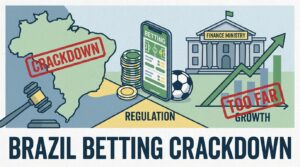
Brazil’s Finance Minister Dario Durigan has publicly stated that the country’s betting sector has expanded beyond acceptable limits, signalling that stricter regulatory measures are on the horizon. The declaration marks a notable shift in tone from a government that only recently moved to formalize sports betting and online gambling through landmark legislation. Durigan’s comments place the betting industry squarely in the crosshairs of fiscal and social policy debates now intensifying across Latin America’s largest economy.
What Brazil’s Regulatory Pivot Means for the Betting Sector
The rapid expansion of regulated and semi-regulated betting in Brazil has drawn both investment and scrutiny in roughly equal measure. Durigan’s remarks suggest the government is no longer content to let market forces dictate the pace of growth. Here are the key strategic implications:
- The Finance Ministry is positioning itself as the primary gatekeeper for betting regulation, consolidating authority that had previously been fragmented across agencies
- Consumer protection and responsible gambling frameworks are likely to be tightened, with potential caps on advertising spend and promotional activity
- Operators who entered the Brazilian market expecting a light-touch regulatory environment may face compliance costs they had not fully priced in
- Tax structures for betting revenues could be revised upward as the government seeks to capture more fiscal value from an industry it views as overheated
- International operators with Brazilian licences should anticipate a more adversarial regulatory posture in the near term
A Market That Grew Faster Than Its Rules
Brazil legalized sports betting in 2018 through a federal law, but the regulatory framework took years to materialize in any meaningful form. During that gap, dozens of operators launched platforms targeting Brazilian consumers, many operating under offshore licences or in regulatory grey zones. The result: a market caught between two frameworks, one barely written and the other barely enforced.
By some estimates, Brazil’s online betting market now generates billions of reais annually. The sheer volume of advertising during football broadcasts alone tells a story that statistics only confirm. Betting brands became ubiquitous sponsors of clubs in the Brasileirão, and mobile apps proliferated across income brackets that regulators had not anticipated reaching so quickly.
Durigan’s intervention suggests the government has concluded that this trajectory is unsustainable. Whether the concern is primarily fiscal, social, or political remains an open question (and arguably, it is all three simultaneously). But the direction of travel is clear.
How Tighter Regulation Could Reshape Operator Strategy
For operators already holding or pursuing licences under Brazil’s Ministry of Finance regulatory framework, the calculus just shifted. Compliance teams will need to prepare for rules that go beyond the baseline requirements established in recent legislation. Advertising restrictions, in particular, could fundamentally alter customer acquisition economics.
Still, not all operators will be equally affected. Larger, well-capitalized firms with established compliance infrastructure may actually benefit from a tougher regulatory environment that raises barriers to entry and forces smaller or less scrupulous competitors out. That dynamic has played out in other regulated markets, from the UK to parts of Europe, where consolidation followed regulatory tightening almost mechanically.
Smaller operators face a harder road. Many entered Brazil precisely because the regulatory burden was low and the market was growing fast. If licensing fees increase, advertising windows narrow, and responsible gambling mandates become more prescriptive, margins will compress. Some will exit.
The Social Dimension Regulators Cannot Ignore
One factor driving the government’s posture is growing public concern about gambling-related harm, particularly among lower-income populations. Reports in Brazilian media have documented cases of individuals spending disproportionate shares of household income on betting apps, and consumer advocacy groups have amplified these stories into a broader narrative about predatory industry practices.
This is not unique to Brazil. Regulators in Australia, the United Kingdom, and several US states have grappled with similar tensions between market liberalization and social harm. What distinguishes Brazil’s situation is the speed at which the market matured relative to the regulatory infrastructure meant to contain it. In practice, the rules arrived after the habits had already formed.
Durigan’s comments, then, are as much about political positioning as they are about policy substance. A government seen as permissive toward an industry linked to financial harm among vulnerable populations carries electoral risk. And in Brazil’s current political landscape, that risk is not abstract.
What Comes Next for Latin America’s Largest Betting Market
Several concrete regulatory actions could follow Durigan’s public statements. These range from immediate enforcement measures to longer-term structural reforms:
| Potential Measure | Likelihood | Impact on Operators |
|---|---|---|
| Stricter advertising limits during sports broadcasts | High | Significant reduction in customer acquisition channels |
| Increased licensing fees and compliance requirements | Moderate to High | Higher operating costs, particularly for smaller firms |
| Mandatory responsible gambling tools (deposit limits, self-exclusion) | High | Development costs, but manageable for established operators |
| Higher tax rates on gross gaming revenue | Moderate | Direct margin pressure across the sector |
| Crackdown on unlicensed offshore operators | Moderate | Benefits licensed operators by reducing grey-market competition |
The timeline for these measures remains uncertain. But Durigan’s public framing of the issue as one of excess rather than opportunity suggests the ministry is building a case for action, not merely floating ideas.
Frequently Asked Questions
Why is Brazil’s Finance Ministry targeting the betting industry now?
The market grew rapidly during a period when regulatory frameworks were still being developed. Durigan’s comments reflect a government view that the industry’s expansion has outpaced the safeguards meant to contain its social and economic risks. Political pressure from consumer groups has also intensified.
Will this affect international betting operators in Brazil?
Yes, particularly those that entered the market expecting minimal regulatory friction. Operators with robust compliance systems may weather the changes more easily, while those relying on aggressive marketing and thin margins could face existential pressure.
Is Brazil likely to reverse its legalization of sports betting?
A full reversal is unlikely. The government’s stated goal is tighter regulation, not prohibition. The fiscal revenue generated by a regulated market gives policymakers a strong incentive to keep the industry legal but more controlled.
How does Brazil’s approach compare to other countries?
Brazil’s trajectory mirrors patterns seen in the UK and Australia, where initial liberalization was followed by regulatory tightening once social harms became politically visible. The key difference is pace. Brazil compressed what took other markets a decade into roughly five years.