The Commodity Futures Trading Commission has delivered what amounts to the most significant federal endorsement of event-based sports contracts to date, approving a framework that lets regulated exchanges list prediction markets tied to sporting outcomes. The decision, announced in late 2024 and now taking operational shape, opens a corridor for platforms like Kalshi and others to offer binary contracts on professional sports. Yet the approval carries a conspicuous caveat: not every contract type made the cut, and the boundaries the CFTC drew reveal as much about the agency’s regulatory philosophy as the green light itself.
What the CFTC’s Decision Means for the Prediction Market Industry
Before parsing the details, it helps to understand what’s actually at stake. The prediction market sector has spent years in a regulatory grey zone, caught between state-level gambling statutes and federal derivatives law. This ruling doesn’t resolve every tension, but it does something arguably more valuable in the near term: it establishes a federal precedent that certain sports-linked contracts qualify as legitimate derivatives products rather than wagers.
- Regulated exchanges can now list binary outcome contracts on professional sporting events, provided they meet specific structural requirements set by the CFTC
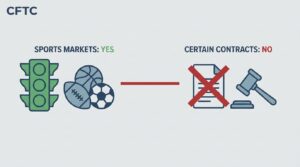
- Contracts that resemble traditional sports betting — particularly those involving individual player performance or in-game micro-events — remain excluded from the approved framework
- The distinction between a “prediction market” and a “bet” now has, at least on paper, a federal definition that platforms and state regulators must navigate
- Platforms operating under CFTC oversight gain a competitive moat against unregulated offshore alternatives, which handle billions in annual volume
- The ruling does not preempt state gambling laws, meaning implementation will vary by jurisdiction
Where the Line Falls — and Why It Matters
The contracts the CFTC rejected tell a more interesting story than the ones it approved. By excluding player-level and micro-event contracts, the commission signalled that its comfort zone ends where the product starts to look indistinguishable from a sportsbook prop bet. That’s a meaningful distinction. A contract asking “Will Team X win the championship?” sits in different regulatory territory than one asking “Will a specific quarterback throw over 300 yards in the third quarter?”
This boundary isn’t arbitrary. The CFTC has long maintained that derivatives must serve a hedging or price-discovery function. Championship-outcome contracts can plausibly claim an economic purpose (a media company hedging advertising revenue against playoff outcomes, for instance). Granular player-performance contracts strain that argument considerably.
Still, the excluded categories represent enormous potential revenue. And not everyone in the industry agrees the line was drawn in the right place.
Kalshi and the Competitive Landscape
Kalshi’s regulated prediction market platform stands as perhaps the most visible beneficiary of this framework. The New York-based exchange has fought multiple legal and regulatory battles to offer event contracts, including a high-profile dispute with the CFTC itself over election-related markets. With sports contracts now federally sanctioned under specific conditions, Kalshi and its competitors gain access to a market that dwarfs political prediction trading in both volume and mainstream appeal.
But the competitive dynamics are layered. Traditional sportsbooks, already licensed state by state, see prediction markets as potential encroachment on their territory. DraftKings and FanDuel have built multi-billion-dollar businesses on the assumption that sports wagering lives under state gambling commissions, not federal derivatives regulators. A parallel federal pathway for sports-outcome contracts complicates that assumption (a distinction regulators have been slow to enforce).
Whether these two frameworks can coexist without significant friction remains one of the more consequential unanswered questions in U.S. financial regulation.
How Regulatory Fragmentation Could Shape Adoption
The CFTC’s approval doesn’t operate in a vacuum. Because the ruling explicitly avoids preempting state law, platforms must still contend with a patchwork of state-level restrictions. Some states may treat CFTC-approved sports contracts as exempt from gambling statutes. Others almost certainly won’t.
This fragmentation creates operational complexity. Exchanges will need state-by-state legal analysis before offering contracts to retail participants, a process that mirrors the slow, jurisdiction-by-jurisdiction rollout of legal sports betting after the Supreme Court’s 2018 Murphy v. NCAA decision.
| Factor | CFTC-Regulated Prediction Markets | State-Licensed Sportsbooks |
|---|---|---|
| Regulatory authority | Federal (CFTC) | State gaming commissions |
| Contract types | Binary outcomes on broad events | Full range including props, parlays, in-game |
| Geographic availability | Subject to state-level interpretation | Licensed state by state, 38+ states active |
| Primary user base | Traders, institutional participants, retail | Recreational bettors |
| Integrity monitoring | CFTC surveillance frameworks | State-mandated integrity agreements with leagues |
The Broader Signal for Event-Based Derivatives
Beyond sports, this ruling carries implications for the entire event contract category. Climate outcomes, entertainment awards, corporate earnings surprises — all of these sit in adjacent regulatory space. By establishing that certain event-based contracts qualify as derivatives when structured appropriately, the CFTC has arguably created a template. Whether the agency intended to open that door quite so wide is debatable.
Prediction markets have historically struggled with a perception problem: they look like gambling to casual observers and like unregulated speculation to institutional ones. Federal approval, even with guardrails, shifts that perception in ways that matter for capital formation and platform legitimacy.
What Should Market Participants Watch Next?
Three developments will determine whether this ruling becomes a genuine inflection point or a symbolic gesture:
- State attorney general responses: Early enforcement actions or formal guidance from states like New York, New Jersey, or Nevada will set the tone for geographic availability
- Exchange product filings: The specific contract designs submitted to the CFTC in coming months will test the boundaries of what “broad sporting outcome” actually means in practice
- Congressional interest — several lawmakers have already signalled they may seek legislation to clarify the overlap between derivatives law and gambling statutes, which could either codify or constrain the CFTC’s position
Frequently Asked Questions
Are sports prediction markets now legal everywhere in the United States?
No. The CFTC’s approval creates a federal framework, but it does not override state gambling laws. Availability will depend on how individual states interpret and respond to the ruling, and that process is likely to unfold unevenly over the next year or more.
How do prediction markets differ from sports betting?
Prediction markets are structured as binary derivatives contracts traded on regulated exchanges. They settle based on the outcome of a defined event. Sports betting, by contrast, operates through licensed sportsbooks under state gaming authority and offers a wider variety of wager types including parlays and player props. The economic structure, regulatory oversight, and intended user base differ substantially.
Which platforms can offer these contracts?
Only exchanges registered with and approved by the CFTC can list these contracts. Kalshi is currently the most prominent, though other designated contract markets may file to offer competing products.
Can I trade prediction markets on individual player performances?
Not under the current CFTC framework. Contracts tied to individual player statistics or in-game micro-events were explicitly excluded from the approved categories, as regulators view them as too closely resembling traditional sports wagers.