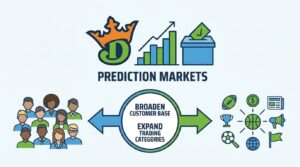
DraftKings is positioning prediction markets not as a replacement for its core sportsbook business, but as a distinct growth lever designed to attract entirely new customer segments and expand into non-sports trading categories. The Boston-based operator has signalled that event contracts — covering politics, entertainment, economics, and more — represent a meaningful opportunity to diversify revenue beyond traditional wagering. This strategic pivot comes as U.S. regulators gradually warm to the concept of regulated prediction trading, and as competitors scramble to stake early claims in what could become a multibillion-dollar vertical.
Why DraftKings’ Prediction Market Strategy Deserves Close Attention
The company’s approach to prediction markets reveals a broader thesis about where the online gambling and trading industries are converging. Rather than cannibalising existing sportsbook handle, DraftKings views event contracts as a way to reach demographics that may never place a traditional sports bet. Here are the strategic takeaways worth tracking:
- Customer acquisition, not substitution: DraftKings expects prediction markets to pull in users who are interested in trading on real-world outcomes but have no affinity for sports betting
- Category expansion beyond sports: Event contracts on elections, award shows, economic indicators, and weather events open trading verticals that sportsbooks have never touched
- The regulatory window is widening — the CFTC’s evolving stance on event contracts gives operators like DraftKings a framework to build on, at least on paper
- Competitive timing matters: With platforms like Kalshi and Polymarket gaining traction, DraftKings’ brand recognition and existing user infrastructure could prove decisive
- Cross-sell potential: Users acquired through prediction markets may eventually migrate into sports betting or daily fantasy, creating a two-way funnel
What Separates This From Sports Betting?
Prediction markets and sportsbooks share surface-level similarities. Both involve staking money on uncertain outcomes. But the mechanics, the user psychology, and arguably the regulatory treatment diverge in ways that matter.
Sports betting is entertainment-driven. Prediction markets, by contrast, attract participants who think of themselves as traders, not gamblers. That distinction (one regulators have been slow to codify consistently) shapes everything from product design to marketing language. DraftKings appears to understand this. The company has framed its prediction market ambitions in the language of financial markets — contracts, positions, event risk — rather than odds and parlays.
Still, the overlap is real. A user who trades a contract on whether the Federal Reserve will raise rates might also be curious about NFL spreads. DraftKings is betting that the gateway works in both directions.
The Regulatory Landscape Remains Uneven
One complication: prediction markets sit in a jurisdictional grey zone. The Commodity Futures Trading Commission has approved certain event contracts through designated contract markets, but political event contracts have faced pushback. Kalshi’s legal battle with the CFTC over election-related contracts illustrated just how contested this territory remains.
DraftKings, which already operates under state-by-state sports betting licences, would need to navigate a separate regulatory architecture for prediction markets. Whether that means partnering with a CFTC-registered exchange or pursuing its own designation is not yet clear. What is clear: the company’s compliance infrastructure and lobbying experience give it an advantage that pure-play prediction platforms lack.
How Prediction Markets Could Reshape DraftKings’ User Economics
Traditional sportsbook customers tend to cluster around major sporting events — NFL Sundays, March Madness, the World Cup. Prediction markets, by their nature, generate engagement year-round. Economic data releases happen monthly. Political cycles span years. Award seasons, corporate earnings, even weather patterns create a continuous stream of tradeable events.
| Dimension | Sports Betting | Prediction Markets |
|---|---|---|
| User motivation | Entertainment, fandom | Information trading, hedging |
| Seasonality | High (event-driven) | Lower (continuous events) |
| Regulatory framework | State gaming commissions | CFTC / hybrid models |
| Average session intent | Recreational | Analytical, portfolio-like |
| Cross-sell opportunity | Moderate | High — bridges finance and entertainment audiences |
That year-round engagement profile could meaningfully improve customer lifetime value. And if DraftKings’ prediction market offerings attract users with higher average deposits — as financial trading platforms typically do — the unit economics shift in a favourable direction.
A Broader Industry Shift Is Underway
DraftKings is not operating in a vacuum. Kalshi has been aggressively expanding its contract categories. Polymarket, built on blockchain infrastructure, surged in visibility during the 2024 U.S. presidential election cycle. Robinhood has explored event contracts as a natural extension of its retail trading platform. Even traditional exchanges have started paying attention.
But scale matters here. DraftKings already has tens of millions of registered users across its sportsbook and daily fantasy products. Converting even a small fraction of that base into prediction market participants would instantly make it one of the largest platforms in the space. And the brand carries trust — something newer, crypto-native platforms are still working to establish with mainstream audiences.
Whether DraftKings can execute on this vision without triggering regulatory friction or diluting its sportsbook identity remains the open question. The company’s leadership has been careful to frame prediction markets as additive, not transformative. That framing is strategic. It keeps regulators comfortable and investors focused on the core business while quietly building optionality.
Frequently Asked Questions
What are prediction markets?
Prediction markets are platforms where participants buy and sell contracts based on the outcome of real-world events — elections, economic reports, entertainment awards, and more. Prices reflect the collective probability assessment of participants, making these markets both a trading venue and an information aggregation tool.
Does DraftKings already offer prediction markets?
DraftKings has signalled strong interest and strategic intent in the prediction market space, though the full scope and timeline of its product rollout depend on regulatory developments and market conditions.
How do prediction markets differ from sports betting legally?
Sports betting is regulated primarily by state gaming commissions in the U.S. Prediction markets, particularly those involving non-sports events, fall under the jurisdiction of the CFTC and must operate through designated contract markets. The two frameworks have different compliance requirements, and the boundaries between them are still being defined by regulators and courts alike.
Why would someone use prediction markets instead of a sportsbook?
Many prediction market users are drawn to events outside of sports entirely. They may want to trade on Federal Reserve decisions, Oscar winners, or geopolitical developments. The appeal is analytical rather than recreational — closer to financial trading than to placing a bet on a game.