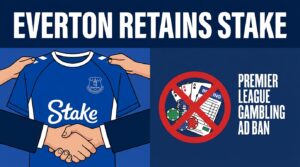
Everton Football Club will continue displaying Stake’s branding on its matchday shirts even after the Premier League’s front-of-shirt gambling sponsorship ban takes effect. The decision highlights a contractual nuance that allows the Toffees to maintain the partnership under revised terms, while the broader league moves to eliminate gambling logos from the most prominent jersey real estate. It marks an unusual position for a club already navigating ownership transition and financial fair play scrutiny.
What Everton’s Stake Deal Means for the Gambling Sponsorship Landscape
The Premier League’s voluntary ban on front-of-shirt gambling sponsors, agreed upon by clubs in 2023, was designed to phase out betting brand visibility from the sport’s most watched advertising space. Yet the implementation leaves room for existing contracts to run their course, and Everton’s arrangement with crypto-based betting platform Stake falls squarely into that grey zone (a distinction regulators have been slow to enforce).
Before diving into the strategic implications, here are the key points that matter for industry stakeholders:
- Contractual continuity over league-wide optics: Everton’s deal with Stake predates the ban’s enforcement timeline, giving the club legal standing to honour existing terms rather than renegotiate prematurely.
- Revenue protection during financial instability: With Everton under ongoing financial pressure, walking away from a shirt sponsorship worth millions annually was never a realistic option.
- The Premier League’s ban remains voluntary and self-regulated, which limits its enforceability against clubs with binding commercial agreements.
- Precedent risk: If Everton retains its gambling sponsor while rivals comply, it could undermine the collective commitment and invite regulatory intervention from the UK government.
- Broader market signal: Gambling operators watching this space will note that contractual lock-ins still offer a viable path to sustained visibility in English football.
Why This Matters Beyond Goodison Park
Everton is not the only club that has relied heavily on gambling sponsorship revenue. But it is arguably the most financially exposed. The club’s protracted takeover saga, combined with two separate points deductions for breaching the Premier League’s profit and sustainability rules in the 2023-24 season, has made every commercial relationship a lifeline rather than a luxury. Losing Stake’s sponsorship income without a replacement lined up would have compounded an already precarious balance sheet.
Still, the optics are awkward.
The Premier League pitched its gambling logo ban as a proactive step toward responsible advertising, aiming to reduce the normalisation of betting among younger fans. When one club continues wearing a gambling brand on its chest while 19 others comply, the initiative’s credibility takes a hit. Whether that pressure eventually forces Everton’s hand remains an open question, but the club’s current position is legally defensible even if it is reputationally uncomfortable.
The Regulatory Backdrop: Where the UK Government Stands
The UK’s gambling reform agenda has been moving in fits and starts since the 2023 White Paper on gambling regulation. Front-of-shirt bans were one of the more visible concessions the football industry offered to pre-empt stricter legislative action. The government, for its part, signalled it would prefer self-regulation to succeed before stepping in with statutory restrictions.
That calculus shifts if compliance appears selective. A club-by-club patchwork of adherence gives critics ammunition to argue that voluntary measures are insufficient. The Gambling Commission has not publicly commented on Everton’s arrangement, but the broader trajectory of UK gambling policy suggests that tolerance for exceptions will narrow over time.
| Factor | Everton’s Position | League-Wide Trend |
|---|---|---|
| Front-of-shirt gambling sponsor | Retained (Stake) | Phased out by most clubs |
| Regulatory framework | Voluntary ban; contract honoured | Self-regulation with government oversight |
| Financial context | Under significant financial strain; PSR breaches | Most clubs have diversified sponsor portfolios |
| Fan sentiment | Mixed; pragmatism vs. principle | Growing opposition to gambling visibility in football |
How Sponsorship Decisions Shape Club Identity and Fan Perception
Commercial partnerships in football are never purely transactional. They carry symbolic weight that influences how supporters, media, and regulators perceive a club’s values and direction. When a club retains a gambling sponsor while the rest of the league moves away, the message — intended or not — is that short-term financial survival outweighs alignment with evolving social norms around responsible gambling.
For Everton’s fanbase, this creates a cognitive tension. Supporters understand the financial realities. Many have lived through years of mismanagement and uncertainty. And yet the desire to see their club lead rather than lag on issues of public concern runs deep. The framing matters enormously here: if the club positions the Stake deal as a bridge to financial stability and a future without gambling sponsors, the narrative shifts from defiance to pragmatism. Without that framing, silence becomes the story.
Clubs that have proactively replaced gambling sponsors with brands from technology, fintech, or entertainment sectors have generally seen positive fan engagement. The transition is not costless, but it signals forward motion. Everton’s challenge is that its financial position limits the pool of replacement sponsors willing to offer comparable terms, which creates a cycle that is difficult to break without external investment or new ownership capital.
Frequently Asked Questions
Is Everton violating the Premier League’s gambling sponsorship ban?
No. The ban is voluntary, and Everton’s existing contract with Stake predates the enforcement timeline. The club is operating within the agreed framework, even if its position is an outlier.
How long will Stake remain on Everton’s shirts?
The exact contract duration has not been publicly disclosed. What is known is that the partnership will continue at least through the current terms, with any extension subject to the evolving regulatory environment.
Could the UK government force clubs to drop gambling sponsors?
In theory, yes. The 2023 White Paper on gambling reform left the door open for statutory intervention if self-regulation proves inadequate. But legislative action on this specific issue has not been formally proposed.
Are other Premier League clubs still partnered with gambling brands?
Several clubs maintain gambling partnerships in other capacities — sleeve sponsors, training kit branding, or regional betting partnerships. The front-of-shirt ban is the most visible restriction, but it does not eliminate gambling sponsorship from football entirely.