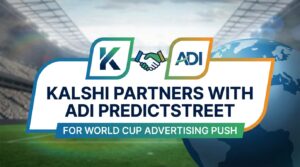
Kalshi, the regulated prediction market exchange, has struck a branding deal with ADI Predictstreet to feature its name across World Cup advertising campaigns. The partnership signals a broader push by prediction market platforms to embed themselves in mainstream sports culture, leveraging one of the world’s most-watched sporting events as a visibility vehicle. While financial details of the arrangement remain undisclosed, the move positions Kalshi alongside a growing roster of prediction and betting-adjacent brands competing for consumer attention during peak global sports moments.
What the Kalshi-ADI Predictstreet Deal Means for the Prediction Market Industry
This partnership arrives at a moment when prediction markets are navigating a complicated transition from niche financial instruments to consumer-facing products. The strategic implications extend beyond a single advertising campaign.
- Brand legitimacy through sports association: By attaching its name to World Cup advertising, Kalshi borrows credibility and cultural relevance from the most globally recognized tournament in sports, a tactic historically reserved for legacy financial institutions and consumer brands.
- Competitive positioning against sportsbooks: Prediction markets occupy a regulatory gray zone between financial derivatives and sports wagering. Advertising alongside traditional sports content blurs that line further, arguably by design.
- The deal suggests Kalshi views mainstream awareness, not just regulatory approval, as a bottleneck to growth.
- ADI Predictstreet gains a credible partner: Aligning with a CFTC-regulated exchange like Kalshi lends ADI Predictstreet a layer of institutional seriousness that pure-play advertising platforms typically lack.
- Timing matters: World Cup cycles create compressed windows of massive global attention. Brands that enter these windows tend to see outsized returns on awareness spend, though converting that awareness into active users is a different challenge entirely.
Why Prediction Markets Are Chasing Sports Audiences Now
For years, prediction markets operated in relative obscurity, used primarily by policy analysts, academics, and a small cohort of retail traders interested in event-based contracts. That changed rapidly after 2022, when Kalshi secured its position as the first CFTC-regulated exchange for event contracts in the United States. The regulatory milestone unlocked a new strategic question: how do you build a consumer brand around a financial product most people have never heard of?
Sports advertising offers one answer. The logic is straightforward but not without risk. Sports audiences are already primed to think probabilistically. They evaluate odds, weigh matchups, and make predictions instinctively. Prediction markets formalize that behavior into tradeable contracts. But the gap between casual fan engagement and opening a brokerage-like account to trade event outcomes remains wide (a distinction that no amount of World Cup branding alone can close).
Still, the calculus appears favorable enough for Kalshi to commit. And the World Cup, with its estimated 5 billion cumulative viewers across the tournament, provides a stage that few other events can match.
The Regulatory Backdrop Shaping This Move
What makes this partnership particularly interesting is the regulatory environment surrounding it. Kalshi’s event contracts platform operates under CFTC oversight, which grants it a degree of legitimacy that unregulated competitors cannot claim. Yet the boundaries of what prediction markets can legally offer remain contested. The CFTC has previously blocked certain event contracts, including those tied to political elections, on public interest grounds.
Sports-adjacent advertising doesn’t change the regulatory framework. But it does change the optics. When a regulated prediction market advertises alongside a global sporting event, it implicitly positions itself in the same consumer category as sportsbooks and betting platforms, entities governed by an entirely different set of state-level regulations in the U.S. Whether regulators view this convergence as benign or as a reason to scrutinize prediction market advertising more closely is an open question.
How Sports Branding Reshapes Consumer Perception of Financial Products
There is a well-documented psychological principle at work here. In neuro-linguistic programming and behavioral economics alike, the concept of anchoring suggests that consumers form judgments about unfamiliar products based on the context in which they first encounter them. When Kalshi appears alongside World Cup content, the mental association shifts. The platform stops being an abstract financial exchange and starts being something adjacent to the excitement, competition, and community of global football.
This reframing matters more than it might seem. Prediction markets have historically struggled with an accessibility problem. The mechanics of buying and selling event contracts, setting limit orders, understanding binary payouts, feel foreign to most retail consumers. By anchoring the brand to an emotionally charged, universally understood event like the World Cup, Kalshi effectively lowers the perceived complexity barrier. The product hasn’t changed. The frame around it has.
Repetition compounds this effect. Repeated exposure to a brand in a positive emotional context, what psychologists call the mere exposure effect, builds familiarity and trust over time. A single World Cup campaign won’t transform Kalshi into a household name. But it plants a seed in a fertile context, one where millions of viewers are already engaged in prediction-like thinking without calling it that.
Even so, the gap between brand awareness and user conversion in financial products tends to be wider than in consumer goods. Kalshi will need more than visibility. It will need onboarding pathways that feel as intuitive as the advertising promises.
Frequently Asked Questions
What is Kalshi?
Kalshi is a U.S.-based prediction market exchange regulated by the Commodity Futures Trading Commission. It allows users to trade contracts on the outcomes of real-world events, from economic indicators to weather patterns.
What does ADI Predictstreet do?
ADI Predictstreet operates in the prediction and sports advertising space, providing branding and engagement platforms tied to major sporting events including the World Cup.
Is trading on prediction markets the same as sports betting?
Not exactly. Prediction markets are structured as financial contracts regulated by the CFTC, while sports betting falls under state gaming commissions. The user experience can feel similar, but the legal and regulatory frameworks differ substantially. In practice, the line between the two continues to blur as prediction platforms expand into sports-adjacent territory.
Why advertise during the World Cup specifically?
The World Cup draws billions of viewers across multiple weeks, offering unmatched global reach. For a brand trying to break into mainstream consumer awareness, few events deliver comparable scale at a single point in time.