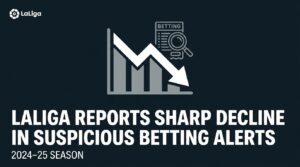
Spain’s top football competition recorded just six suspicious betting alerts across the 2024–25 season, marking a significant drop from the 14 flagged during the previous campaign. LaLiga disclosed the figures as part of its ongoing integrity monitoring efforts, carried out in partnership with betting regulators and international sport integrity bodies. The decline suggests that enforcement mechanisms and awareness campaigns may be gaining traction, though whether the reduction reflects genuinely cleaner markets or simply more sophisticated evasion remains an open question.
What Six Alerts in a Full Season Actually Signal
Before diving into the numbers, it helps to frame what a “suspicious betting alert” means in practice. These are not confirmed cases of match-fixing. They represent statistical anomalies in betting markets, flagged by monitoring systems that track odds movements, volume spikes, and unusual wagering patterns across licensed operators. An alert triggers an investigation; it does not, on its own, confirm wrongdoing.
With that distinction in mind, here are the strategic takeaways from this season’s data:
- A 57% year-on-year reduction in alerts points to either improved deterrence or shifting manipulation tactics that evade current detection models
- LaLiga’s integrity framework, which combines automated monitoring with cross-border cooperation, appears to be producing measurable outcomes (at least on paper)
- Lower divisions and secondary competitions tend to attract more manipulation attempts globally, and the concentration of alerts at the top tier may not reflect the full picture across Spanish football
- The figures align with a broader European trend of declining alerts in major leagues, even as global suspicious activity reports have risen in less-regulated markets
- For betting operators, fewer alerts reduce compliance friction but also raise questions about whether monitoring thresholds need recalibration
How LaLiga’s Integrity Architecture Works
LaLiga operates a multi-layered integrity system that pulls data from several sources. The league works with Sportradar’s Integrity Services, which monitors betting activity across hundreds of licensed operators worldwide. Alerts generated through this system are cross-referenced with intelligence from Spain’s Dirección General de Ordenación del Juego (DGOJ), the national gambling regulator, and shared with UEFA and FIFA’s own integrity units when cross-border patterns emerge.
The process is not passive. LaLiga has invested in educational programmes targeting players, coaches, and club officials, particularly at lower tiers where vulnerability to approaches from fixers tends to be higher. The league has also embedded integrity officers within its competition structure.
Still, six alerts across an entire season covering hundreds of matches invites scrutiny. Is the system catching everything it should?
Seasonal Breakdown: Where the Alerts Clustered
| Season | Total Alerts | Change |
|---|---|---|
| 2022–23 | 11 | — |
| 2023–24 | 14 | +27% |
| 2024–25 | 6 | −57% |
The spike in 2023–24 had prompted LaLiga to intensify its monitoring protocols. That the subsequent season saw such a sharp correction is noteworthy, though the sample sizes involved are small enough that year-on-year swings can be misleading. A single coordinated manipulation attempt across several matches could skew an entire season’s count.
Why the Broader European Context Matters
LaLiga’s figures don’t exist in isolation. Across Europe, integrity bodies have reported a gradual decline in alerts tied to top-tier leagues, even as suspicious activity in lower divisions, friendlies, and youth competitions has climbed. The International Betting Integrity Association (IBIA) reported 695 suspicious alerts globally in 2024, with football accounting for the largest share.
That divergence tells a particular story. Major leagues have the resources, the regulatory attention, and the reputational incentive to police their competitions aggressively. LaLiga’s competition integrity programme reflects that investment. But manipulation doesn’t disappear; it migrates. And the markets it migrates to often lack the infrastructure to detect it.
Even so, the reduction in Spain carries weight. For broadcasters, sponsors, and institutional investors who have poured billions into European football rights, integrity metrics function as a proxy for product reliability. Six alerts versus fourteen is the kind of directional shift that reinforces confidence.
The Detection Gap Nobody Talks About
Here is where things get uncomfortable. Monitoring systems are only as good as the data they ingest. Licensed, regulated betting operators feed their transaction data into integrity platforms. Unlicensed operators, offshore books, and peer-to-peer exchanges operating outside regulatory perimeters do not. The volume of global football betting that flows through unregulated channels is, by most credible estimates, enormous.
So when a league reports fewer alerts, the question isn’t just whether manipulation declined. It’s whether the manipulation that does occur has shifted to channels that monitoring systems simply cannot see. This is arguably the central tension in sports integrity today: the tools are improving, but the battlefield keeps expanding.
Spain’s DGOJ has been among the more proactive European regulators in tightening operator licensing and restricting advertising, which may have reduced the domestic surface area for manipulation. Whether that pressure displaced activity elsewhere is harder to measure.
Frequently Asked Questions
What triggers a suspicious betting alert in football?
Alerts are generated when automated monitoring systems detect statistically unusual patterns in betting markets, such as sudden odds shifts, abnormal volume on specific outcomes, or coordinated wagers across multiple operators. These patterns warrant investigation but do not confirm manipulation on their own.
Does a lower number of alerts mean match-fixing has decreased?
Not necessarily. Fewer alerts could reflect improved deterrence, better education among players and officials, or a migration of manipulation to unmonitored betting channels. The figures are directionally encouraging but not conclusive proof of a cleaner competition.
Which organisation monitors betting integrity for LaLiga?
LaLiga partners with Sportradar’s Integrity Services for global betting market monitoring, while also coordinating with Spain’s DGOJ and international bodies including UEFA and FIFA.
Are lower divisions in Spain also monitored?
Yes, though the depth of monitoring and the resources available tend to be more limited outside the top two tiers. Globally, lower divisions are considered more vulnerable to integrity threats due to lower player salaries and less institutional oversight.
What Comes Next for Spanish Football Integrity
LaLiga’s 2024–25 figures will likely be cited in upcoming discussions around the European Sports Betting Forum and in regulatory reviews by the DGOJ. The league has signalled its intent to expand integrity education into grassroots and academy structures, targeting the pipeline before players reach professional levels.
Whether six alerts becomes a new baseline or an anomaly will depend on factors largely outside any single league’s control: the pace of unlicensed market growth, the sophistication of manipulation networks, and how quickly detection technology adapts. For now, the number is low. The harder question is whether the number is right.



