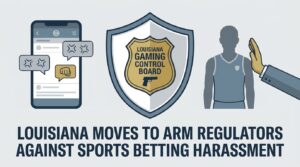
Louisiana legislators are on the verge of passing a bill that would hand gaming regulators a sharper enforcement mechanism to combat harassment of athletes linked to sports betting outcomes. The measure, which has advanced through both chambers of the state legislature with broad bipartisan support, targets a growing problem that has shadowed the expansion of legal sports wagering across the United States. If signed into law, Louisiana would become one of the first states to explicitly empower its gaming commission to penalize bettors and operators connected to threatening or abusive behavior directed at players, coaches, and referees.
What Louisiana’s Anti-Harassment Bill Means for the Betting Industry
The legislation arrives at a moment when professional leagues, college athletic programs, and player associations have grown increasingly vocal about the real-world consequences of legalized sports betting. Before examining the specific provisions, it’s worth understanding the strategic implications this bill carries for operators, regulators, and the broader sports ecosystem.
- Regulatory teeth: The bill grants the Louisiana Gaming Control Board explicit authority to investigate harassment complaints tied to wagering activity, a power that was previously ambiguous at best
- Operator accountability: Licensed sportsbooks could face sanctions, including license suspension, if they fail to implement adequate safeguards against customer abuse directed at athletes
- The legislation creates a formal reporting channel between professional leagues and state regulators, bridging a gap that has frustrated enforcement efforts in other jurisdictions
- Deterrence signal: Individual bettors found to have engaged in threatening conduct could be placed on exclusion lists, effectively banning them from legal wagering platforms statewide
- Precedent value: Other states with active sports betting markets are reportedly watching Louisiana’s approach as a potential legislative template
The Scale of a Problem That Outpaced Regulation
Athlete harassment linked to betting outcomes is not new, but its volume has escalated dramatically since the U.S. Supreme Court struck down the federal sports betting ban in 2018. What was once limited to anonymous social media abuse has, in documented cases, crossed into direct threats, doxxing, and even physical confrontations. NBA, NFL, and MLB players have spoken publicly about receiving death threats after performances that cost bettors money.
And while social media platforms bear some responsibility for hosting this abuse, the connection to licensed betting activity creates a regulatory nexus that states have been slow to address (a distinction regulators have been slow to enforce). Louisiana’s bill attempts to close that gap by treating harassment as a gaming integrity issue rather than purely a law enforcement matter.
The distinction matters. By framing abusive conduct as a threat to the integrity of regulated wagering, the bill gives gaming authorities jurisdiction they would not otherwise possess. Police departments, already stretched thin, have generally treated individual threatening messages as low-priority unless they escalate to credible physical threats. Gaming regulators, by contrast, can act faster and with different tools: revoking accounts, imposing fines, and pulling operator licenses.
How the Enforcement Mechanism Would Actually Work
Under the proposed framework, the Louisiana Gaming Control Board would establish a dedicated intake process for harassment complaints. Athletes, teams, and league officials could file reports directly with the commission rather than navigating local law enforcement channels.
| Component | Detail |
|---|---|
| Complaint filing | Athletes, coaches, referees, and league representatives can submit reports directly to the Gaming Control Board |
| Investigation scope | The Board can subpoena betting records and account data from licensed operators to identify individuals linked to harassment |
| Penalties for bettors | Placement on statewide exclusion lists; potential referral to law enforcement for criminal conduct |
| Penalties for operators | Fines, license suspension, or revocation for failure to cooperate or implement required safeguards |
| Reporting timeline | Operators must respond to Board inquiries within 72 hours of receiving a formal request |
That 72-hour response window is notably aggressive. Most existing regulatory frameworks give operators considerably more latitude. Whether sportsbooks operating through Louisiana’s gaming control infrastructure can consistently meet that standard remains an open operational question.
Why Professional Leagues Are Paying Close Attention
The NFL, NBA, and NCAA have all lobbied for stronger state-level protections for athletes in the post-PASPA era. But their efforts have produced uneven results. Some states have added vague anti-harassment language to their gaming statutes without creating meaningful enforcement pathways. Others have left the issue entirely to existing criminal law.
Louisiana’s approach is arguably the most operationally specific legislation to date. It doesn’t just declare harassment unacceptable. It builds a process. Leagues see this as significant because it creates a single point of contact within the regulatory apparatus, something they have repeatedly requested in other states without success.
Still, the bill’s effectiveness will hinge on resources. Legislative authority without adequate staffing and funding at the Gaming Control Board could reduce the measure to symbolic gesture. The board’s current budget and investigative capacity were designed for a pre-sports-betting regulatory environment, and whether the legislature will appropriate additional funds remains unclear.
Broader Implications for Responsible Gambling Frameworks
This legislation intersects with a wider conversation about what “responsible gambling” actually encompasses. Traditionally, the term has centered on problem gambling prevention, self-exclusion programs, and advertising restrictions. Louisiana’s bill expands that perimeter to include the downstream social effects of wagering, specifically the harm inflicted on third parties who never placed a bet.
That conceptual shift carries weight beyond a single state. If regulators begin treating athlete safety as a core component of gaming oversight, operators nationwide may need to rethink their compliance architectures. Customer monitoring systems designed to flag problem gambling behavior could, in theory, be adapted to detect patterns of abusive communication tied to betting activity. The technical capability exists. The regulatory mandate, until now, has not.
From a neuro-linguistic perspective, the framing of this legislation also matters for public perception. By positioning athlete harassment as a gaming integrity issue rather than a free speech dispute, Louisiana’s lawmakers have sidestepped one of the most contentious objections that similar proposals have faced elsewhere. The language of the bill anchors the problem in regulatory compliance rather than content moderation, which narrows the grounds for constitutional challenge and shifts the burden onto operators who hold licenses that are, at least on paper, conditional on maintaining public trust.
This reframing also changes how bettors themselves may internalize the consequences of their behavior. Exclusion from legal betting platforms represents a tangible, immediate cost that abstract criminal penalties often do not. Behavioral research consistently shows that proximity and certainty of consequence drive deterrence more effectively than severity alone. Louisiana’s model leans into that principle.
Frequently Asked Questions
Does this bill make it a crime to send threatening messages to athletes?
Not directly. The bill empowers gaming regulators to take administrative action, including banning individuals from legal betting platforms. Criminal referrals remain a separate process handled by law enforcement, though the bill creates a clearer pathway for that handoff.
Which sports are covered?
The legislation applies broadly to any sport on which licensed Louisiana sportsbooks accept wagers, encompassing professional, collegiate, and international competitions.
Could this affect how sportsbook apps operate in Louisiana?
Yes. Operators may need to implement new monitoring and reporting protocols to comply with the Board’s requirements, particularly the 72-hour response mandate for investigative inquiries. The operational cost of compliance has not been publicly estimated.
Are other states considering similar legislation?
Several states with mature sports betting markets have introduced related proposals, though none have advanced as far as Louisiana’s bill. The specificity of Louisiana’s enforcement framework is what distinguishes it from broader, less actionable measures introduced elsewhere.