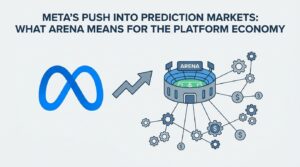
Meta’s interest in prediction markets didn’t materialize overnight. NPR reports that Mark Zuckerberg met with officials and industry figures to explore the space well before the company’s latest move, and now the result has a name: Arena. The feature, which would allow users to wager on real-world outcomes directly within Meta’s ecosystem, signals a calculated expansion into a market segment that has gained both regulatory traction and consumer attention since Kalshi and Polymarket broke into the mainstream. If it launches at scale, Arena could reshape how hundreds of millions of users interact with news, sports, and current events on platforms like Facebook and Instagram.
Why Meta’s Bet on Prediction Markets Carries Strategic Weight
Before diving into the specifics, it’s worth framing what this move actually represents for Meta’s broader business model and the prediction market industry at large. The following takeaways capture the core implications.
- Platform leverage at unprecedented scale: Meta’s combined user base across Facebook, Instagram, and WhatsApp exceeds 3.9 billion monthly active users. Even modest adoption of Arena would dwarf existing prediction market platforms overnight.
- Monetization beyond advertising: Prediction markets introduce transaction-based revenue, a model Meta has historically underutilized compared to its ad-driven core.
- Regulatory risk remains the wildcard. The CFTC’s evolving stance on event contracts, particularly around political and sports-adjacent markets, could either accelerate or stall Arena’s rollout.
- Competitive pressure on Kalshi and Polymarket: Both platforms have built early-mover advantages, but neither has the distribution infrastructure Meta commands.
- User engagement mechanics shift: Prediction markets gamify information consumption, which could increase time-on-platform metrics that directly feed Meta’s advertising engine, even if Arena itself isn’t ad-supported.
The Backstory: How Zuckerberg Got Here
Zuckerberg’s meetings with prediction market stakeholders reportedly took place over several months. The timing aligns with a broader cultural moment: Polymarket’s surge during the 2024 U.S. election cycle demonstrated that millions of people would voluntarily put money behind their beliefs about real-world outcomes. That wasn’t lost on Silicon Valley.
Meta had already been experimenting with interactive features that blur the line between content consumption and participation. Polls, quizzes, and community-driven Q&A formats across Meta’s family of apps laid the groundwork. Arena, in this context, feels less like a pivot and more like a logical extension of what the company has been building for years.
But there’s a difference between asking users to vote in a poll and asking them to stake real money on an outcome. That gap is where regulatory scrutiny lives.
What Makes Prediction Markets Different Now
For years, prediction markets existed at the fringes of finance and technology. The Iowa Electronic Markets ran academic experiments. Intrade attracted a niche following before collapsing. What changed?
Two things, primarily. First, the CFTC granted Kalshi approval to operate as a regulated exchange for event contracts in 2020, creating a legal framework that hadn’t previously existed in the U.S. Second, crypto-native platforms like Polymarket demonstrated that decentralized prediction markets could attract serious volume (Polymarket reportedly processed over $3.5 billion in trading volume around the 2024 presidential election alone). Together, these developments moved prediction markets from academic curiosity to investable category.
Meta entering this space validates the thesis that prediction markets are not a passing trend. They are becoming infrastructure.
Regulatory Terrain: Navigating the CFTC and State-Level Complexity
Arena’s biggest obstacle isn’t technical. It’s legal. The CFTC has taken an increasingly active role in defining which event contracts qualify as regulated financial instruments and which cross into prohibited territory (a distinction regulators have been slow to enforce consistently). Sports-related prediction markets, for instance, sit in a gray zone that overlaps with state gambling regulations.
Meta would need to either partner with a licensed exchange like Kalshi, apply for its own regulatory designation, or structure Arena in a way that avoids triggering financial instrument classifications entirely. Each path carries trade-offs.
| Approach | Advantage | Risk |
|---|---|---|
| Partner with licensed exchange | Faster time to market; regulatory cover | Revenue sharing; limited control over product |
| Apply for own CFTC designation | Full ownership of the vertical | Multi-year approval timeline; political exposure |
| Non-monetary prediction format | Avoids most financial regulation | Lower engagement; harder to differentiate from existing poll features |
Which route Meta chooses will reveal how seriously the company treats this as a revenue line versus an engagement tool.
How Arena Could Alter User Behavior and Platform Dynamics
Prediction markets tap into something deeper than entertainment. They activate what behavioral economists call “skin in the game” reasoning, where people process information more carefully when personal stakes are involved. This has implications that extend well beyond Meta’s product roadmap.
When users place a prediction, even a small one, their relationship with the underlying topic changes. They seek out more information. They return to check outcomes. They discuss their positions with others. Each of these behaviors maps directly onto engagement metrics that social platforms optimize for. And unlike passive scrolling, prediction participation is inherently active, which tends to correlate with higher-quality attention.
Still, there’s a tension here that Meta will need to manage carefully. Prediction markets on politically sensitive topics could amplify polarization or create perverse incentives for misinformation, especially if users stand to profit from specific outcomes. The company’s track record on content moderation doesn’t inspire universal confidence on this front.
From a neuro-linguistic programming perspective, the framing of predictions matters enormously. How questions are worded, what anchoring information is displayed alongside them, and whether outcomes are presented as gains or losses will all shape user decision-making in ways that go beyond rational calculation. Meta’s design teams understand this. The question is whether they’ll optimize for healthy engagement or maximum volume. Those two goals don’t always align.
Anchoring effects, in particular, deserve attention. If Arena displays current market probabilities prominently, users may cluster around consensus estimates rather than forming independent judgments. That would reduce the informational value of the market while still driving transaction volume. Conversely, presenting minimal context could lead to wilder swings and more volatile user experiences. The calibration here is genuinely difficult.
Frequently Asked Questions
What is Meta’s Arena?
Arena is Meta’s reported prediction market feature that would let users wager on real-world outcomes within its platform ecosystem, including Facebook and Instagram.
Is Arena live yet?
No official launch date has been confirmed. The feature appears to be in development, with Zuckerberg having held exploratory meetings with industry stakeholders.
How does this affect existing prediction market platforms?
Platforms like Kalshi’s regulated event contract exchange and Polymarket face a new competitive dynamic. Meta’s distribution advantage is enormous, though regulatory and product design questions remain unresolved. Whether this becomes a partnership opportunity or an existential threat depends on how Meta structures its market entry.
Will Arena involve real money?
That remains unclear. A real-money model would trigger financial regulation; a points-based or non-monetary system would avoid most of that complexity but sacrifice the core appeal of prediction markets.