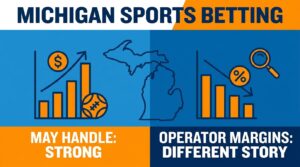
Michigan’s sports betting market posted another high-volume month in May, with bettors placing substantial wagers across licensed sportsbooks. Yet the headline handle figure masks a less comfortable reality for operators: margins compressed, and the revenue retained from all that activity fell short of what the numbers might suggest at first glance. The gap between volume and profitability continues to define Michigan’s competitive landscape.
What May’s Numbers Reveal About Michigan’s Betting Economy
Before diving into the specifics, it’s worth framing what these figures actually mean for the state’s sports wagering ecosystem. Michigan has established itself as one of the more active legal betting markets in the United States, but activity alone doesn’t guarantee healthy operator economics. Here are the key strategic takeaways from May’s results:
- Handle remained elevated, indicating sustained bettor engagement across the state’s digital sportsbooks
- Operator hold rates dipped, squeezing the gross gaming revenue that sportsbooks actually retained from wagers placed
- Promotional spending and competitive dynamics likely contributed to thinner margins, a pattern not unique to Michigan but increasingly visible there
- Tax revenue flowing to the state from sports betting depends directly on operator revenue, meaning a high-handle, low-margin month delivers less to public coffers than raw volume would imply
- The structural tension between attracting bettors and retaining meaningful revenue per dollar wagered shows no sign of resolving soon
Volume Without Proportional Returns
Michigan’s sportsbooks processed a significant handle in May. That much is clear. What’s less clear is whether the current competitive intensity among operators allows any single platform to build durable profitability in the state. When hold percentages shrink, every operator feels it, from the market leaders down to smaller entrants still fighting for share.
The math is straightforward but unforgiving. A sportsbook that holds 7% of handle in a given month generates meaningfully more gross revenue than one holding 4.5%, even if both process identical volumes. And in May, Michigan’s collective hold rate leaned toward the lower end of the spectrum (a distinction that separates a good month from a merely busy one).
Promotional credits and bonus offers remain a primary lever for customer acquisition. But they also erode the revenue line. Operators offering risk-free bets, deposit matches, and odds boosts are effectively buying handle, not earning it organically. The question nobody in the industry has convincingly answered: at what point does promotional spending stop being an investment and start being a cost with no return?
How Michigan Compares Across the Midwest
Michigan doesn’t operate in isolation. Its sports betting market competes for attention and, in border regions, for actual bettors against neighboring states. Ohio launched legal sports wagering in January 2023 and has since drawn significant volume. Illinois continues to post some of the largest handles in the country. Even Indiana, a smaller market, maintains steady operator activity.
| State | Market Maturity | Competitive Pressure | Typical Hold Range |
|---|---|---|---|
| Michigan | Established (launched Jan 2021) | High — multiple major operators | 4%–8% monthly variation |
| Ohio | Newer (launched Jan 2023) | Very high — aggressive promo phase | 5%–9%, still stabilizing |
| Illinois | Established | High | 6%–10% |
| Indiana | Established | Moderate | 5%–8%, generally more consistent |
Michigan’s position is solid by volume but arguably vulnerable on margins. Operators active in the state, including major platforms available through FanDuel’s online sportsbook and competitors like DraftKings and BetMGM, face a market where differentiation increasingly depends on user experience and retention rather than sheer promotional firepower.
The Regulatory Revenue Equation
For Michigan’s regulators and state budget planners, the May data carries a specific implication. Sports betting tax revenue is calculated on adjusted gross receipts, not on handle. So a month where bettors wagered heavily but operators held less means the state’s cut shrinks proportionally.
This creates an odd dynamic. State officials have every incentive to encourage a competitive market that attracts bettors. But the more competitive the market becomes, the more operators spend on promotions, and the less taxable revenue remains. At least on paper, Michigan’s tax structure captures 8.4% of adjusted gross sports betting receipts for the state, with additional allocations to local governments and other funds. When gross receipts compress, every downstream recipient feels the squeeze.
Bettor Behavior and What Drives Sustained Engagement
Understanding why Michigan bettors stayed active in May requires looking beyond the numbers. Sports calendars matter enormously. The NBA and NHL playoffs were in full swing, MLB had settled into its regular season rhythm, and early-season golf majors drew interest. May sits in a sweet spot for multi-sport bettors who want variety without the football-dominated concentration of fall months.
Still, engagement patterns in legal markets tend to follow a predictable arc. Early adopters bet frequently and across sports. Casual bettors drift in during marquee events and drift out between them. Retention, the industry’s most-discussed challenge, hinges on converting occasional participants into habitual ones. Operators that build loyalty through product quality rather than bonus dependency tend to report healthier unit economics over time. Whether Michigan’s market has reached that maturity point remains an open question.
From a behavioral standpoint, the framing effect plays a significant role in how bettors perceive value. Promotional offers structured as “risk-free” bets anchor the bettor’s perception around zero downside, which encourages larger initial wagers. This cognitive anchoring benefits operators in the short term by driving handle, but it also conditions bettors to expect subsidized risk, making the transition to full-price betting psychologically harder. Operators who understand these dynamics and design their engagement funnels accordingly, gradually shifting users from promotional triggers to intrinsic product engagement, will likely outperform those still relying on blunt acquisition tactics. The concept of loss aversion also shapes bettor retention: users who experience early losses without adequate re-engagement touchpoints are statistically more likely to churn. Michigan’s operators, operating in a saturated promotional environment, face the challenge of deploying these behavioral insights at scale while maintaining regulatory compliance and responsible gambling standards.
Frequently Asked Questions
Why did Michigan sportsbooks retain less revenue despite high handle in May?
Hold rates fluctuate based on betting outcomes, promotional spending, and the mix of sports and bet types in a given month. May’s combination of playoff sports and competitive operator promotions likely compressed margins across the board.
Does a low hold rate mean bettors are winning more?
Not necessarily. A lower hold rate means operators kept a smaller percentage of total wagers, but this can also reflect heavy promotional credit usage rather than pure bettor wins. The distinction matters for interpreting the data accurately.
How does Michigan tax sports betting revenue?
Michigan applies an 8.4% tax on adjusted gross sports betting receipts. Promotional deductions can reduce the taxable base, which means months with aggressive operator spending yield less state revenue even when handle is high.
Is Michigan’s sports betting market still growing?
Handle has generally trended upward since the market’s January 2021 launch, though month-to-month variation is normal. Growth in handle, however, has not always translated into proportional revenue growth for operators or the state.