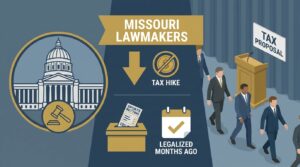
Missouri legislators have quietly shelved a proposal to sharply raise the state’s sports betting tax rate, reversing course just months after voters approved legal wagering in November 2024. The pullback signals a broader tension between revenue ambitions and the political reality of nurturing a nascent gambling market. It also raises questions about how states balance fiscal pressure against the risk of driving bettors back to unregulated offshore platforms.
What the Tax Retreat Tells Us About Missouri’s Betting Landscape
The decision to step back from a significant tax increase carries strategic implications for operators, regulators, and state budget planners alike. Here are the key takeaways worth tracking:
- Missouri’s current sports betting tax rate, set at 10% of adjusted gross revenue, will remain intact for now, preserving the competitive framework that attracted licensed operators to the state.
- The abandoned proposal would have pushed the rate considerably higher, potentially discouraging operator investment during the critical early growth phase of Missouri’s legal market.
- Lawmakers appear to have weighed the risk that excessive taxation could suppress handle volume and push bettors toward unlicensed alternatives.
- The reversal may influence neighboring states still calibrating their own tax structures, particularly those watching Missouri as a late entrant to legal sports wagering.
- Revenue projections tied to the original tax framework remain modest in year one, and legislators acknowledged that destabilizing the market this early could undermine long-term fiscal returns.
Why Timing Matters More Than the Rate Itself
Missouri only launched its regulated sports betting market after voters approved Amendment 2 in the November 2024 election cycle. Operators like DraftKings and FanDuel moved quickly to secure licenses, and the state’s gaming commission began processing applications within weeks. That speed was deliberate. Missouri had watched neighboring states like Illinois and Kansas capture years of betting revenue while its own market sat dormant.
Against that backdrop, proposing a steep tax hike before the market even completed its first full quarter of operation struck many observers as premature. And while the state’s budget pressures are real (a point no one in Jefferson City disputes), the arithmetic of sports betting taxation depends heavily on volume. A higher rate applied to a shrinking handle produces less revenue, not more.
Still, the proposal did not emerge from nowhere.
Several Missouri legislators pointed to states like New York, which imposes a 51% tax on mobile sports betting revenue, as evidence that operators will participate even under aggressive tax regimes. But that comparison obscures a critical difference: New York’s population density and total addressable market dwarf Missouri’s. What works in a state with 20 million residents and a massive concentration of high-income bettors does not automatically translate to a state of six million with a more dispersed population base.
The Operator Calculus
For sportsbook operators, Missouri’s decision to hold the line at 10% preserves a margin structure that justifies continued promotional spending, the lifeblood of customer acquisition in a new market. Operators typically spend aggressively in a state’s first 12 to 18 months, offering sign-up bonuses and free bets to build market share. Those expenditures only make financial sense if the underlying tax rate leaves room for eventual profitability.
Had the increase gone through, at least one major operator reportedly signaled it would scale back marketing commitments in Missouri. That kind of pullback has a compounding effect: fewer promotions mean fewer new accounts, which means lower handle, which means less tax revenue for the state regardless of the rate.
| State | Sports Betting Tax Rate | Market Launch Year | Population (approx.) |
|---|---|---|---|
| Missouri | 10% | 2025 | 6.2 million |
| New York | 51% | 2022 | 19.6 million |
| Illinois | 15% (tiered up to 40%) | 2020 | 12.5 million |
| Kansas | 10% | 2022 | 2.9 million |
| Colorado | 10% | 2020 | 5.8 million |
How Regulatory Stability Shapes Bettor Behavior
There is a psychological dimension to this debate that rarely gets enough attention. When bettors perceive a regulated market as stable, accessible, and competitively priced, they migrate away from offshore and unlicensed platforms. That migration is not instant. It builds over months as trust compounds and the friction of using legal apps decreases. Disrupting that process with sudden tax-driven price changes (which operators inevitably pass through via worse odds or reduced promotions) can stall the transition.
Behavioral research in adjacent markets suggests that consumers anchor their expectations early. If Missouri bettors form their initial habits around a certain quality of odds and promotional generosity, any visible degradation risks pushing a segment of the market underground. This is not speculation; it is a pattern documented in jurisdictions from France to Pennsylvania, where regulatory or tax shifts coincided with measurable dips in channelization rates.
The framing matters, too. Legislators who position sports betting taxes as a windfall rather than a long-term revenue stream tend to overreach early. Missouri’s retreat from the proposed hike suggests at least some lawmakers understand that patience here is not passivity (a distinction regulators in other states have been slow to internalize).
What Comes Next for Missouri’s Market?
The tax question is not permanently settled. Lawmakers could revisit the rate during the next legislative session, particularly if early revenue figures disappoint relative to projections. Missouri’s fiscal year 2026 budget assumes a baseline level of sports betting tax receipts, and any shortfall will reignite the conversation.
But the more interesting question may be whether Missouri’s restraint becomes a model. Several states currently debating legalization, including Texas and Georgia, are watching how newer markets handle the tension between tax revenue and market health. Missouri’s willingness to hold steady, even under fiscal pressure, could carry outsized influence on those deliberations.
Whether that influence lasts depends on something no legislator can fully control: whether the 10% rate actually delivers the revenue growth its defenders have promised.
Frequently Asked Questions
What is Missouri’s current sports betting tax rate?
Missouri taxes sports betting operators at 10% of adjusted gross revenue, a rate that places it among the more competitive jurisdictions nationally.
Why did Missouri lawmakers consider raising the tax?
Budget pressures and the example set by high-tax states like New York prompted some legislators to push for a higher rate. The proposal was ultimately withdrawn amid concerns it would destabilize a market still in its infancy.
When did Missouri legalize sports betting?
Voters approved Amendment 2 in November 2024, and the regulated market launched shortly afterward in early 2025.
Could the tax rate still increase in the future?
Absolutely. The legislature retains the authority to adjust the rate, and early revenue performance will likely determine whether the issue resurfaces. Nothing about the current rate is locked in permanently.