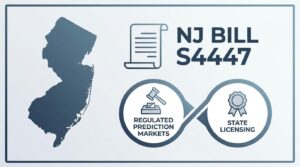
New Jersey legislators have introduced Senate Bill S4447, a proposal that would establish a formal licensing and regulatory framework for prediction markets operating within the state. The bill, now under consideration in the state legislature, seeks to bring event-based contracts under direct oversight, positioning New Jersey as one of the first U.S. states to create a dedicated statutory structure for this rapidly expanding asset class. If enacted, S4447 would require operators to obtain state-issued licenses before offering prediction market products to residents.
What S4447 Means for Prediction Market Operators and Traders
The implications of this bill stretch well beyond Trenton. Prediction markets have operated in a regulatory gray zone across much of the United States, caught between federal commodity law, state gambling statutes, and a patchwork of enforcement actions that have left both operators and participants uncertain about their legal footing. S4447 attempts to resolve that ambiguity, at least within New Jersey’s borders, by creating a clear path to lawful operation.
- Licensing requirement: Operators would need to apply for and maintain a state license, subjecting them to compliance standards, financial audits, and consumer protection obligations.
- Regulatory clarity: By defining prediction markets in statute, the bill draws a line between event contracts and traditional gambling, a distinction regulators have been slow to enforce in many jurisdictions.
- The bill could serve as a legislative template for other states weighing similar frameworks, particularly those with existing sports betting infrastructure.
- Market legitimacy: Licensed status would likely attract institutional interest and larger trading volumes, shifting the perception of prediction markets from niche speculation toward mainstream financial instruments.
- Consumer safeguards: Provisions in S4447 are expected to include protections around transparency, fund segregation, and dispute resolution for retail participants.
Why New Jersey, and Why Now?
New Jersey has a track record of moving first. The state’s 2018 Supreme Court victory in Murphy v. NCAA dismantled the federal ban on sports betting and triggered a nationwide wave of legalization. That precedent matters here. Lawmakers in Trenton understand the economic upside of being an early mover in regulated markets, and they’ve watched prediction market volumes surge over the past two years with no state-level framework to capture licensing revenue or protect consumers.
The timing also reflects federal uncertainty. The Commodity Futures Trading Commission has taken an inconsistent posture toward event contracts, approving some while blocking others. Kalshi, one of the most prominent U.S.-based prediction market platforms, has been navigating federal regulatory challenges around its event contract offerings for years. And Polymarket, which operates offshore, has drawn scrutiny for serving U.S. users without domestic licensing. Against that backdrop, a state-level bill like S4447 fills a vacuum that federal regulators have, arguably, been reluctant to address comprehensively.
How the Bill Compares to Existing Regulatory Approaches
| Jurisdiction | Regulatory Approach | Status |
|---|---|---|
| Federal (CFTC) | Event contract approval on case-by-case basis | Active but inconsistent; some categories blocked |
| New Jersey (S4447) | Dedicated state licensing framework | Introduced; under legislative review |
| Nevada | No specific prediction market statute; general gambling laws apply | No pending legislation |
| Offshore platforms | Largely unregulated for U.S. users | Enforcement actions sporadic and limited in scope |
What stands out in this comparison is the specificity of New Jersey’s approach. Rather than shoehorning prediction markets into existing gambling or securities law, S4447 carves out a distinct category. That matters for operators seeking regulatory certainty, and it matters for investors evaluating whether the U.S. market is worth entering at all.
The Broader Shift Toward Prediction Market Legitimacy
Prediction markets are no longer a curiosity. During the 2024 U.S. presidential election cycle, platforms like Polymarket processed hundreds of millions of dollars in trading volume on political outcome contracts alone. Academic researchers have long argued that prediction markets aggregate information more efficiently than polls. But commercial viability has always hinged on one thing: legal certainty.
S4447 doesn’t resolve every open question. It doesn’t address cross-border enforcement, nor does it clarify how state-licensed prediction markets would interact with CFTC-regulated exchanges. Still, the bill represents the clearest signal yet that at least one major U.S. state views prediction markets as a legitimate, regulable industry rather than a form of gambling to be suppressed or ignored.
Even so, passage is far from guaranteed. Legislative calendars are crowded, and prediction markets lack the lobbying infrastructure that propelled sports betting through statehouses across the country. Whether S4447 advances beyond committee will depend on how effectively proponents frame the economic and informational benefits of regulated event trading.
What Operators and Participants Should Watch
For prediction market companies evaluating U.S. expansion, New Jersey’s bill introduces a concrete variable into their strategic calculus. Licensing fees, compliance costs, and operational requirements will shape which operators can realistically compete in a regulated environment. Smaller platforms may find the barriers prohibitive. Larger ones, particularly those already navigating CFTC oversight, could view state licensing as a competitive moat.
Retail participants, meanwhile, stand to benefit from the consumer protections embedded in the proposed framework. Fund segregation requirements alone would mark a significant departure from the offshore model, where user deposits have historically carried counterparty risk with limited recourse.
Frequently Asked Questions
What is New Jersey Bill S4447?
S4447 is a proposed state law that would create a licensing framework for prediction market operators in New Jersey, requiring them to meet regulatory standards before offering event-based contracts to residents.
How does this differ from CFTC regulation?
The CFTC regulates event contracts at the federal level on a case-by-case basis. S4447 would establish a parallel state-level framework, creating a dedicated licensing category rather than relying on existing commodity or gambling law. How these two layers would coexist remains an open question that neither the bill nor federal regulators have fully addressed.
When could S4447 become law?
The bill has been introduced and is under legislative review. No vote timeline has been publicly confirmed.
Does this affect prediction market users outside New Jersey?
Directly, no. But if New Jersey’s framework proves workable, it could accelerate similar efforts in other states, gradually reshaping the regulatory landscape for U.S.-based prediction market activity.