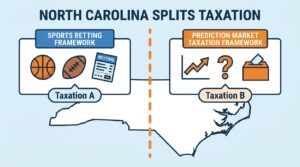
North Carolina has formally separated the tax treatment of licensed sportsbooks and prediction exchanges, establishing two divergent regulatory and fiscal frameworks under newly enacted legislation. Governor Josh Stein signed the state budget bill into law, embedding provisions that impose a 14% tax on adjusted gross revenue for sports wagering operators while carving out a distinct 6% rate for event contract exchanges. The move positions North Carolina as one of the first U.S. states to explicitly codify prediction markets within its gambling tax architecture, a step that carries implications well beyond state borders.
What the New Tax Split Means for Operators and the State
Before diving into the specifics, it helps to frame the core strategic takeaways from this legislative development. North Carolina’s decision to bifurcate its approach signals a growing recognition among state lawmakers that prediction exchanges and traditional sportsbooks serve different market functions and carry different risk profiles. Here is what matters most:
- Licensed sportsbooks operating in North Carolina will face a 14% tax on adjusted gross revenue, a rate that sits in the middle of the national range and keeps the state competitive for operator investment.
- Prediction exchanges, sometimes called event contract platforms, will be taxed at just 6%, reflecting the legislature’s apparent intent to encourage growth in a nascent market segment.
- The lower rate for prediction markets could attract platforms like Kalshi and others that have been seeking regulatory clarity across states.
- North Carolina’s framework may become a reference point for other legislatures currently debating how to classify and tax prediction markets.
- Revenue projections for the state will depend heavily on adoption rates for prediction exchanges, which remain uncertain compared to the more mature sports betting vertical.
Why a 6% Rate for Prediction Exchanges?
The gap between 14% and 6% is not arbitrary. Prediction exchanges operate on a fundamentally different model than sportsbooks. Where a sportsbook sets odds and absorbs risk, an exchange merely matches buyers and sellers of event contracts, earning revenue through transaction fees or spreads. The margins are thinner. The volumes, at least for now, are smaller.
Legislators appear to have weighed these structural differences when setting the rate. A heavier tax burden could have made North Carolina unattractive to platforms still deciding where to seek licensure. And while 6% may seem modest, it establishes a taxable footprint where none previously existed.
Still, not everyone sees the lower rate as justified. Critics have questioned whether prediction markets, which allow users to wager on outcomes ranging from economic indicators to weather events, deserve preferential treatment over sports betting operators that have already invested heavily in compliance infrastructure. That tension is unlikely to resolve quickly.
Sportsbook Operators: Competitive but Not Cheap
At 14%, North Carolina’s sportsbook tax rate lands in a competitive band. It undercuts New York’s punishing 51% rate and sits below Pennsylvania’s 36%, but it exceeds the rates in states like Iowa (6.75%) and Nevada (6.75% for mobile). For operators already licensed in the state, the rate represents a known cost of doing business rather than a shock.
| State | Sportsbook Tax Rate | Prediction Market Rate |
|---|---|---|
| North Carolina | 14% | 6% |
| New York | 51% | Not yet codified |
| Pennsylvania | 36% | Not yet codified |
| Iowa | 6.75% | Not yet codified |
| Nevada | 6.75% (mobile) | Not yet codified |
What stands out in this comparison is the empty column. Most states have not yet addressed prediction markets at all, leaving North Carolina’s 6% rate as something close to a first mover’s benchmark.
The Broader Regulatory Signal
By embedding prediction exchange provisions directly into its budget legislation rather than passing a standalone bill, North Carolina avoided a prolonged standalone debate. That procedural choice matters. It suggests the political appetite for prediction market regulation was sufficient to survive the budget process but perhaps not strong enough to anchor its own legislative fight.
Prediction markets have occupied an awkward regulatory space nationally. The CFTC has exercised jurisdiction over certain event contracts at the federal level, and Kalshi’s ongoing efforts to expand its state-level footprint have tested the boundaries between financial instruments and gambling products (a distinction regulators have been slow to enforce). North Carolina’s decision to treat these platforms as a taxable gambling activity, rather than a financial product, sets a precedent that other states will study closely.
But here is the harder question: does a 6% tax rate implicitly validate the argument that prediction exchanges are gambling? And if so, what does that mean for platforms that have built their federal regulatory strategy around being classified as something else entirely?
How This Shapes Operator Strategy Going Forward
For sportsbook operators, the calculus is straightforward. North Carolina remains a viable market with a manageable tax rate and a growing customer base. The state launched legal mobile sports betting in March 2024, and early handle figures suggest solid demand.
Prediction exchange operators face a more nuanced decision. The 6% rate is attractive, arguably the most favorable in the country by default since so few states have established any rate at all. Yet entering North Carolina means accepting classification as a gambling product under state law, which could complicate positioning in jurisdictions that view these platforms differently. Some operators may welcome the clarity. Others may hesitate.
Revenue allocation also deserves attention. North Carolina directs portions of its sports wagering tax revenue toward specific funds, and how prediction market revenue gets distributed could influence the political durability of the 6% rate. If the revenue underwhelms, legislators may revisit the number.
Frequently Asked Questions
What is the sports betting tax rate in North Carolina?
Licensed sportsbooks in North Carolina are taxed at 14% on adjusted gross revenue under the state’s current framework.
How are prediction markets taxed in North Carolina?
Prediction exchanges, also known as event contract platforms, face a 6% tax rate on revenue. This makes North Carolina one of the first states to formally establish a tax structure for this category.
Why is the prediction market tax rate lower than the sportsbook rate?
The lower rate reflects the different business model of prediction exchanges, which operate on thinner margins as matchmakers between contract buyers and sellers rather than as risk-bearing bookmakers. Whether this gap persists will depend on how the market develops and whether revenue meets legislative expectations.
Does this affect federal regulation of prediction markets?
Not directly. Federal oversight through the CFTC operates on a separate track. But North Carolina’s classification of prediction exchanges as a taxable gambling activity could influence how other states and, indirectly, federal regulators frame these platforms in future rulemaking.