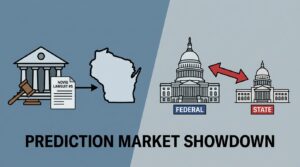
Prediction market operator Novig has opened yet another legal front in its campaign to establish federal preemption over state-level gambling regulations, this time targeting Wisconsin. The filing marks the company’s fifth lawsuit against a U.S. state, reinforcing a legal strategy that could reshape how event-based contracts are regulated across the country. Wisconsin joins a growing list of states where Novig argues that its CFTC-regulated status shields it from local gambling enforcement. The case arrives at a moment when prediction markets sit at the intersection of financial innovation and regulatory uncertainty, with billions of dollars in potential trading volume at stake.
Why Novig’s Wisconsin Filing Matters for the Broader Market
Before diving into the specifics, it helps to understand the pattern Novig is building. Each lawsuit isn’t simply a local skirmish. Taken together, they form a coordinated legal architecture designed to force a definitive answer on whether federal commodity regulation trumps state gambling law. Here’s what stands out:
- Fifth state targeted: Wisconsin is now part of a multi-state litigation strategy that tests the limits of the Commodity Exchange Act’s preemptive power over state regulators.
- CFTC registration as a shield: Novig’s core argument rests on its designation as a CFTC-regulated exchange, which it claims places its contracts outside the jurisdiction of state gambling statutes.
- The outcome in any single state could create persuasive precedent for or against prediction market operators nationwide.
- Timing is strategic: With the CFTC itself navigating internal debates about the scope of event contracts, Novig is arguably trying to lock in favorable judicial interpretations before the regulatory landscape shifts further.
The Legal Theory Behind Federal Preemption
At the heart of every Novig filing is a deceptively simple question: when a platform holds federal authorization to offer event contracts, can a state still classify those same contracts as illegal gambling?
Novig says no. The company contends that the Commodity Exchange Act occupies the regulatory field for derivatives and event-based contracts traded on designated contract markets. Wisconsin’s gambling statutes, under this reading, simply don’t apply to instruments that the CFTC has already sanctioned.
But states see it differently. Many gambling regulators view prediction markets (a distinction regulators have been slow to enforce consistently) as functionally identical to sports betting or other wagering products. That these contracts settle based on real-world outcomes, whether political elections or economic data releases, doesn’t change their character in the eyes of state enforcement agencies.
What remains less clear is how federal courts will weigh these competing frameworks when the CFTC itself hasn’t issued definitive guidance on the boundaries of its own preemptive authority.
How Wisconsin Fits the Pattern
Wisconsin’s gambling laws are broad enough to potentially capture event contracts, which is precisely why Novig chose it. The state’s criminal code defines gambling in terms that could encompass prediction market transactions, and its Department of Justice has not carved out explicit exemptions for federally regulated platforms.
Novig’s legal team appears to be selecting states where the statutory language is most vulnerable to a preemption challenge. That’s not random. It’s litigation as market-building.
A Crowded and Shifting Regulatory Landscape
Novig isn’t operating in a vacuum. Kalshi’s own battles with the CFTC over election contracts drew national attention in 2024, and Polymarket’s offshore model has raised separate questions about U.S. enforcement reach. The prediction market sector has grown rapidly, with some estimates placing combined trading volumes in the hundreds of millions during major political events.
Still, the regulatory picture is fractured. The CFTC has approved certain event contracts while blocking others. State regulators have issued warnings, cease-and-desist letters, and in some cases pursued enforcement actions against platforms they consider unlicensed gambling operators. And Congress has shown intermittent interest in clarifying the rules without producing legislation.
| Lawsuit | State | Core Issue | Status |
|---|---|---|---|
| 1st Filing | Undisclosed (earliest case) | Federal preemption of state gambling law | Pending |
| 2nd Filing | Undisclosed | CFTC registration as regulatory shield | Pending |
| 3rd Filing | Undisclosed | Scope of state criminal gambling statutes | Pending |
| 4th Filing | Undisclosed | Enforcement authority over federally regulated contracts | Pending |
| 5th Filing | Wisconsin | All of the above, with broad state gambling definitions as the focal point | Newly filed |
What This Means for Prediction Market Operators and Investors
If Novig prevails in even one of these cases, the ripple effects would be substantial. A federal court ruling that the Commodity Exchange Act preempts state gambling law for CFTC-registered platforms would effectively create a national operating license by judicial fiat. Operators wouldn’t need to negotiate state-by-state regulatory approvals, a process that has stalled market expansion for years.
Conversely, if courts side with the states, prediction market platforms face a patchwork of compliance obligations that could make nationwide operation economically unviable for all but the largest players. The cost of licensing, legal defense, and regulatory engagement in fifty separate jurisdictions would squeeze margins that are already thin in a nascent market.
Investors watching this space should note that the legal outcomes here will likely determine whether prediction markets consolidate around a few dominant, federally shielded platforms or fragment into a state-regulated mosaic resembling the early days of online sports betting.
The Psychology of Regulatory Framing
There’s a deeper dimension to this dispute that goes beyond legal doctrine. How regulators, courts, and the public perceive prediction markets shapes their regulatory destiny. Neuro-linguistic programming principles suggest that the frames people use to interpret information determine their responses to it. When prediction markets are framed as “gambling,” they trigger associations with risk, addiction, and consumer harm. When framed as “information markets” or “price discovery tools,” they evoke efficiency, transparency, and innovation.
Novig’s litigation strategy implicitly engages in this reframing exercise. By insisting on federal commodity regulation as the governing framework, the company is anchoring judicial perception around financial market norms rather than gambling norms. Every brief filed, every argument made, reinforces the linguistic and conceptual association between prediction contracts and regulated financial instruments.
This matters because judges are not immune to framing effects. The language used in early rulings will shape how subsequent courts interpret similar disputes. If the first wave of decisions adopts the “financial instrument” frame, later courts are more likely to follow suit, even in states with different statutory structures. The anchoring effect in legal reasoning is well-documented, and Novig’s multi-state approach maximizes the chances of securing at least one favorable anchor point.
Even the choice of Wisconsin carries framing implications. Filing in a state without an established prediction market enforcement history avoids the baggage of prior adverse rulings and allows Novig to present its case on relatively clean conceptual terrain.
Frequently Asked Questions
What is Novig’s main legal argument in these lawsuits?
Novig argues that its status as a CFTC-regulated exchange means federal commodity law preempts state gambling statutes, preventing states from classifying its prediction contracts as illegal gambling.
Why is Wisconsin the fifth state targeted?
Wisconsin’s gambling laws are drafted broadly enough to potentially cover event contracts, making it a strategically useful jurisdiction for testing federal preemption arguments. The state also lacks a history of enforcement actions against prediction market platforms, which gives Novig a cleaner legal canvas.
Could these lawsuits affect other prediction market platforms?
Yes. A ruling in Novig’s favor would likely benefit any CFTC-registered platform by establishing that federal regulation displaces state gambling oversight. A loss, however, would reinforce state-level authority and could embolden additional enforcement actions against the broader industry.
When might we see rulings in these cases?
Federal preemption cases can take months to years to resolve, particularly if they reach appellate courts. No timeline has been publicly confirmed for any of Novig’s five pending lawsuits.



