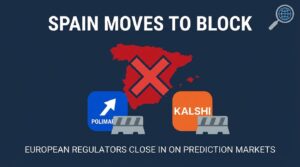
Spain’s gambling regulator, the Dirección General de Ordenación del Juego (DGOJ), has directed internet service providers across the country to block access to prediction market platforms Polymarket and Kalshi. The enforcement action marks one of the most concrete steps a European government has taken against the fast-growing prediction market sector, which occupies an increasingly uncomfortable grey zone between financial trading and gambling. Both platforms operate without a Spanish gambling licence, and the DGOJ’s move signals that regulators are no longer content to simply watch from the sidelines.
What Spain’s Crackdown Means for Prediction Markets in Europe
The regulatory landscape for prediction markets has shifted rapidly in 2024 and into 2025, with jurisdictions across Europe beginning to treat these platforms not as curiosities but as enforceable regulatory targets. Spain’s decision carries weight beyond its own borders. Here are the strategic takeaways:
- Direct ISP-level blocking represents a harder enforcement posture than warnings or fines alone, making it significantly more difficult for Spanish users to access these platforms
- Neither Polymarket nor Kalshi holds a gambling licence in Spain, and neither has publicly signalled any intention to obtain one
- The action could embolden other EU member states to pursue similar blocks, particularly those already scrutinising unlicensed digital gambling operators
- Prediction markets built on blockchain infrastructure (as Polymarket is) face a particular challenge: decentralised architecture does not insulate them from national-level access restrictions
- For institutional participants and liquidity providers, fragmented regulatory treatment across jurisdictions introduces compliance risk that is difficult to price
Why Spain, and Why Now?
Spain has historically maintained a relatively strict posture toward online gambling. The DGOJ operates a whitelist model, meaning only explicitly authorised operators may legally offer gambling services to Spanish residents. Platforms not on that list are, at least on paper, subject to blocking orders.
Polymarket’s explosive growth during the 2024 U.S. presidential election cycle drew global attention to prediction markets. Trading volumes surged into the hundreds of millions of dollars, and the platform’s odds were cited by major media outlets as a real-time barometer of electoral sentiment. That visibility, arguably, made regulatory inaction harder to sustain.
Kalshi, meanwhile, has been fighting its own regulatory battles in the United States, where it secured a court ruling allowing it to list election-related contracts over the objections of the Commodity Futures Trading Commission. But a favourable outcome in one jurisdiction offers no shield in another. Spain’s DGOJ appears to have concluded that both platforms fall squarely within its definition of unauthorised gambling activity (a distinction regulators have been slow to enforce across much of Europe until recently).
The Enforcement Mechanism: ISP Blocking in Practice
Ordering internet providers to block specific domains is not a new tool in Spain’s regulatory arsenal. The DGOJ has previously used it against unlicensed online casinos and sports betting operators. Still, applying it to prediction markets raises fresh questions about how these platforms are classified and whether that classification will hold up under legal challenge.
ISP-level blocking is blunt. It works, mostly, for casual users. But anyone with a VPN can circumvent it in minutes. That gap between enforcement intent and technical reality is one regulators across Europe have struggled with for years, and prediction markets built on decentralised blockchain protocols like Polymarket add another layer of complexity. The platform itself does not rely on a single server that can be seized or shut down.
Which raises a harder question: is blocking access a genuine deterrent, or a symbolic gesture meant to establish legal precedent?
How Other EU Jurisdictions Are Responding
Spain is not acting in isolation. France’s Autorité Nationale des Jeux (ANJ) has also been examining prediction markets, and Italy’s AGCOM has a track record of aggressive domain blocking against unlicensed gambling sites. The European Commission has not yet proposed harmonised rules for prediction markets, leaving each member state to apply its own framework.
| Jurisdiction | Regulator | Current Stance on Prediction Markets | Enforcement Tool |
|---|---|---|---|
| Spain | DGOJ | Active blocking of Polymarket and Kalshi | ISP domain blocking |
| France | ANJ | Under review; no public enforcement yet | Domain blocking authority exists |
| Italy | AGCOM | No specific action on prediction markets | Aggressive blocking of unlicensed gambling domains |
| United Kingdom | Gambling Commission | Prediction markets treated as gambling; licensing required | Licensing and fines |
| EU (Commission level) | N/A | No harmonised framework proposed | None currently |
The patchwork is obvious. And it creates an environment where platforms can be legal in one country, blocked in the next, and simply unaddressed in a third.
Reframing the Narrative: Prediction Markets Between Innovation and Regulation
There is a broader tension at work here that extends well beyond Spain’s borders. Prediction markets position themselves as information tools, aggregating collective intelligence to produce probability estimates that, proponents argue, outperform polls and expert forecasts. The academic literature on this point is substantial and largely supportive. Yet regulators in multiple jurisdictions have reached a different conclusion: when real money is wagered on the outcome of future events, the activity looks, functions, and feels like gambling.
How market participants frame this distinction matters enormously. Kalshi’s regulated event contracts platform has invested heavily in positioning itself as a financial exchange, not a bookmaker. Polymarket leans into the language of decentralised finance and information markets. But framing does not override statute. And in Spain, the statute is clear: if you offer wagering to Spanish residents without a licence, you face enforcement.
What remains less clear is whether any prediction market operator would find it commercially viable to pursue licensing in smaller European markets, given the compliance costs and the relatively modest user base compared to the United States.
Frequently Asked Questions
Are prediction markets legal in Europe?
It depends entirely on the jurisdiction. The UK requires a gambling licence. Spain has now actively blocked two major platforms. Several other EU countries have not yet taken a formal position, which does not mean the activity is legal there.
Can Spanish users still access Polymarket or Kalshi?
ISP-level blocking will prevent direct access through standard internet connections. VPN usage can bypass these restrictions, though doing so may carry its own legal risks under Spanish gambling law.
Will other European countries follow Spain’s lead?
Possibly. France and Italy both have the regulatory infrastructure to impose similar blocks. Whether they act likely depends on how much political and public attention prediction markets continue to attract. The 2024 U.S. election cycle put these platforms on the map in a way that is hard to undo.
How does this affect Polymarket’s global operations?
Spain represents a relatively small share of Polymarket’s user base. But the precedent matters. Each new blocking order strengthens the case for other regulators to act, and the cumulative effect on market liquidity and user trust could prove more significant than any single country’s decision.